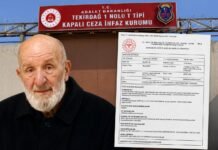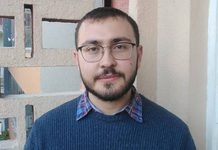
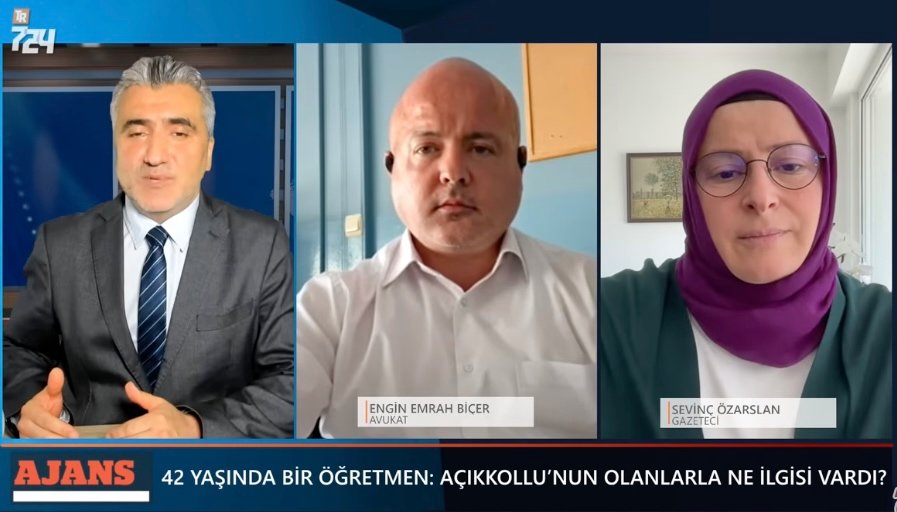
A Turkish lawyer who shared a police detention cell with teacher Gökhan Açıkkollu has said he witnessed signs of torture before Açıkkollu died in custody in 2016 following his detention over alleged links to the faith-based Gülen movement.
Attorney Engin Emrah Biçer said Açıkkollu was taken from the cell for hours-long informal interrogations and returned in worsening condition after alleged repeated beatings, in an account published by the TR724 news website, which also posted a video interview with him.
Biçer said Açıkkollu, who had diabetes and suffered from panic attacks, was held in a hot, poorly ventilated detention cell and returned from the interrogations appearing increasingly distressed and frequently crying, shouting and expressing fear.
He said he could identify two police officers involved in the abuse if he saw them again, adding that some 15 detainees in nearby cells may also have witnessed what happened.
Biçer also said Açıkkollu suffered rib fractures and severe breathing difficulties, adding that doctors who examined him in custody confirmed the fractures. He said Açıkkollu was taken for another interrogation on the night of his death and that surveillance footage from the detention facility should exist.
Açıkkollu died of a heart attack on August 5, 2016, after 13 days in police custody during a sweeping crackdown that followed a coup attempt in Turkey.
The İstanbul Chief Public Prosecutor’s Office initially issued a decision of non-prosecution on December 20, 2016, saying there was no evidence indicating that an external factor had caused his death.
An additional autopsy report prepared on January 18, 2017, by forensic expert Professor Şebnem Korur Fincancı, then chair of the Human Rights Foundation of Turkey (TİHV), concluded that Açıkkollu died of a heart attack as a result of torture in detention.
Based on that report, Açıkkollu’s wife, Tülay Açıkkollu, challenged the initial non-prosecution decision, which was overturned seven months later. The prosecutor’s office nevertheless issued a second decision of non-prosecution in May 2020, prompting her to apply to the Constitutional Court the following month.
The Constitutional Court recently ruled that Turkish authorities violated Açıkkollu’s right to life and the prohibition of torture and ill-treatment. The court also cited a petition Biçer filed with the İstanbul Chief Public Prosecutor’s Office on September 20, 2016, shortly after Açıkkollu’s death. Stating in his petition that the teacher had been beaten to death, Biçer requested information on whether an investigation had been opened and, if so, asked for the relevant case file number to be disclosed.
Biçer was detained on July 22, 2016, due to his legal work on cases linked to emergency decrees issued after the coup attempt and later spent 27 months in İstanbul’s Marmara Prison before being released in November 2018.
The United Nations Human Rights Committee had previously found in October 2022 that Turkey violated Açıkkollu’s rights under several articles of the International Covenant on Civil and Political Rights. The committee also assessed the suffering caused to his wife and children, ruling that the prohibition of torture and ill-treatment had been violated with respect to them as well.
Turkish President Recep Tayyip Erdoğan has targeted followers of the Gülen movement, inspired by the US-based cleric Fethullah Gülen, who died in 2024, since corruption investigations in December 2013 implicated him as well as some members of his family and inner circle. He dismissed the probes as a Gülenist conspiracy and later designated the movement as a terrorist organization in May 2016, intensifying a sweeping crackdown after the coup attempt in July of the same year that he accused Gülen of orchestrating. The movement denies involvement in the coup attempt or any terrorist activity.
According to the latest figures from the justice ministry, more than 126,000 people have been convicted of alleged links to the movement since 2016, with 11,085 still in prison. Legal proceedings are ongoing for over 24,000 individuals, while another 58,000 remain under active investigation nearly a decade later.
Torture and ill-treatment in police custody and prisons in Turkey have remained a persistent concern since the aftermath of the July 15, 2016, coup attempt. The widespread and systematic torture in Turkish detention centers was evidenced by the UN special rapporteur on torture and other cruel, inhuman, or degrading treatment or punishment in a report based on his mission to Turkey in November 2016. The Council of Europe’s Committee for the Prevention of Torture also reported that allegations of police ill-treatment remained at a worrying level following visits in 2017 and 2019, although Turkey has blocked publication of the committee’s report on its 2016 post-coup visit.