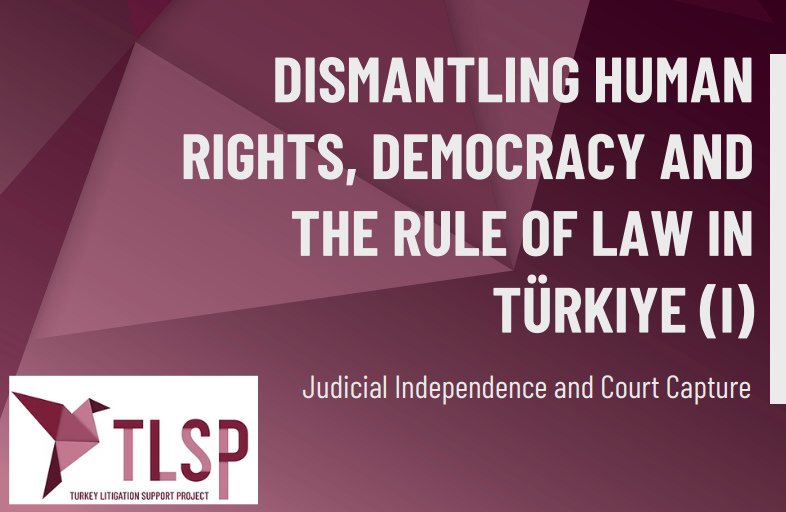
Turkey’s judiciary has been transformed into a tool of political control under President Recep Tayyip Erdoğan, weakening checks and balances and enabling the suppression of dissent, according to a new report by the Turkey Human Rights Litigation Support Project (TLSP).
The report identifies political interference in judicial governance, mass purges and politicized recruitment and the use of criminal law against perceived government critics as the main mechanisms behind what it describes as the collapse of judicial independence under President Erdoğan. It also cites the weakening of the Constitutional Court, the non-implementation of European Court of Human Rights judgments and the erosion of prosecutorial independence as key indicators of the broader deterioration of the rule of law in Turkey.
“Individuals tied to the ruling AKP [Justice and Development Party] and allied groups have been appointed to key positions within the judicial system and have fostered a climate of fear and submission throughout that system,” the report said, calling for comprehensive reform to reverse what it described as the judicial capture and bring Turkey into line with its international obligations.
According to the TLSP, the erosion of judicial independence has effectively eliminated the system of checks and balances in Turkey, created an atmosphere of fear within the legal profession, facilitated human rights violations and undermined public confidence in the courts.
The report found that constitutional amendments approved in 2017 played a central role in expanding Erdoğan’s influence over the Council of Judges and Prosecutors (HSK), the top judicial body responsible for appointments, promotions and disciplinary matters within the judiciary. It said the changes enabled the executive and parliament, dominated by Erdoğan’s ruling AKP and its allies, to exercise decisive control over the composition of the HSK, undermining the independence of judicial governance.
The report said a post-coup purge enabled the government to reshape the judiciary on a large scale. More than 4,000 judges and prosecutors were dismissed following a coup attempt in 2016, while close to 10,000 new judges and prosecutors were recruited through procedures the TLSP said lacked transparency and favored candidates associated with or supportive of the ruling coalition.
The TLSP said the judiciary has increasingly been used as a tool of repression against perceived government opponents through the criminalization of lawful conduct, particularly in Gülen movement-linked terrorism cases. It cited the use of the ByLock encrypted messaging app, having an account at the now-closed Bank Asya and participating in protests as evidence in terrorism-related prosecutions.
Turkish President Erdoğan has been targeting followers of the faith-based Gülen movement, inspired by US-based cleric Fethullah Gülen, who died in 2024, since corruption investigations in December 2013 implicated him as well as some members of his family and inner circle. He dismissed the probes as a Gülenist conspiracy and later designated the movement as a terrorist organization in May 2016, intensifying a sweeping crackdown after the coup attempt in July of the same year that he accused Gülen of orchestrating. The movement denies involvement in the attempted coup or any terrorist activity.
According to the report, the effectiveness of the Constitutional Court has also been compromised by politicized appointments and what the TLSP described as a selective approach in politically sensitive cases, with the court often avoiding rulings against the government.
The report also cited Turkey’s repeated non-implementation of rulings from the European Court of Human Rights (ECtHR), particularly in high-profile cases such as those of Selahattin Demirtaş, the imprisoned former leader of the pro-Kurdish Peoples’ Democratic Party (HDP), and Osman Kavala, a prominent philanthropist and rights advocate.
The TLSP said prosecutors have become “functionally autonomous” only in service of government objectives, adding that career advancement increasingly favors prosecutors who lead investigations targeting the opposition, citing the appointment of former prosecutor Akın Gürlek as justice minister.
Founded in 2018 and hosted by the School of Law of Middlesex University, the TLSP monitors systemic human rights violations in Turkey to support efforts aimed at strengthening democratic resilience, upholding the rule of law and protecting fundamental rights.