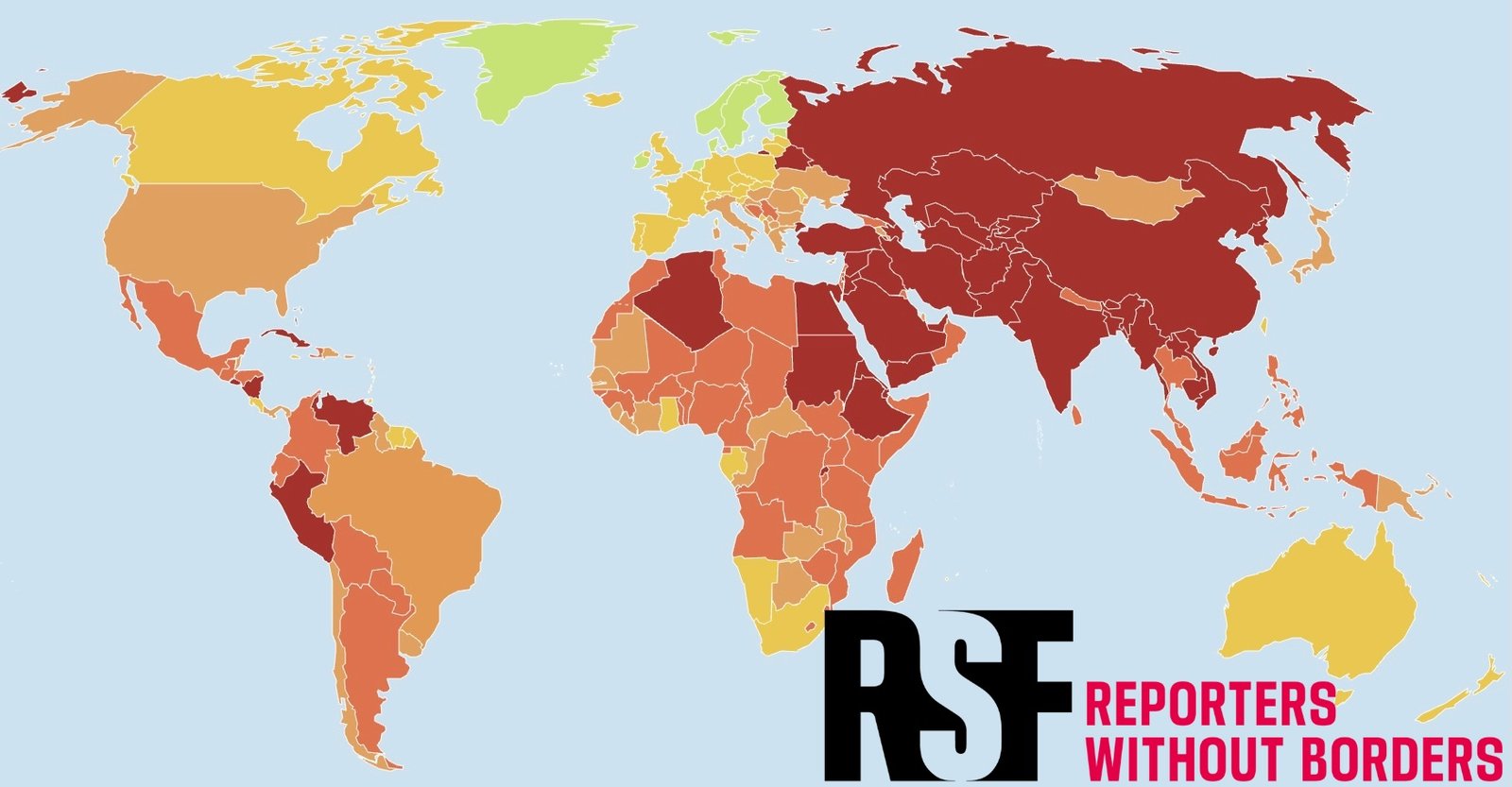
Turkey fell to 163rd out of 180 countries in the 2026 World Press Freedom Index published by Reporters Without Borders (RSF) on Thursday, down from 159th in 2025, as the group warned that authoritarianism is deepening and media pluralism is increasingly under threat in the country.
According to Turkish Minute, Turkey’s ranking puts it among countries with some of the most restrictive media environments, below Venezuela (159th), Cuba (160th), Sudan (161st) and Iraq (162nd), and just ahead of Yemen (164th), Belarus (165th) and Myanmar (166th), according to the index.
Turkey’s overall score declined to 27.94 from 29.40 a year earlier, reflecting a worsening environment across multiple indicators, including political pressure, economic constraints and journalist safety.
RSF said “all possible means are used to undermine critics” in Turkey, pointing to a media landscape in which about 90 percent of national outlets are under direct or indirect government control.
The report noted that audiences have increasingly turned to a limited number of independent and critical outlets, including Now TV, Halk TV, Tele1 and Sözcü, as well as international platforms such as BBC Turkish, Deutsche Welle Turkish and Voice of America Turkish, which was shut down in May 2025 following US funding cuts.
The political indicator remained among the weakest areas, ranking 163rd, as RSF said violence and mass arrests have become common tactics against journalists covering protests since the 2023 elections when President Recep Tayyip Erdoğan was elected for yet another term.
Following the arrest of Istanbul Mayor Ekrem İmamoğlu in March 2025, widely seen as President Erdoğan’s strongest political rival, mass protests broke out across the country.
İmamoğlu was arrested on corruption charges that critics say are politically motivated and aimed at sidelining him ahead of the 2028 general election.
Journalists covering the demonstrations faced significant pressure, with at least 11 detained in early-morning raids and at least 12 assaulted by police on March 23, 2025, the day İmamoğlu was put in pretrial detention.
The protests were also met with widespread restrictions on media coverage.
RSF also cited widespread internet censorship, prosecutions targeting critical media and what it described as manipulation of the judiciary.
In the legal sphere, which measures laws and judicial practices affecting journalists, Turkey ranked 159th, with RSF highlighting the frequent use of charges such as “disinformation,” “insulting the president” and “denigrating state institutions” to prosecute journalists or open investigations into them.
Recent cases show the trend. Journalist Furkan Karabay was held in pretrial detention for more than 100 days last year over social media posts authorities said insulted public officials and the president, while prominent journalist Fatih Altaylı was jailed after prosecutors alleged that remarks he made about historical events threatened the president.
Foreign journalists have also been affected. Swedish journalist Joakim Medin was arrested in İstanbul while traveling to cover the İmamoğlu protests and charged with “membership in a terrorist organization” and “insulting the president.” He was held for more than a month before being released.
BBC correspondent Mark Lowen was detained for 17 hours and later deported after authorities said he “posed a threat to public order.”
The controversial Article 217/A of the Turkish Penal Code, known as the disinformation law, which entered into force in October 2022, has been widely used in such cases. At least 83 journalists have faced charges under the law in 114 separate cases on allegations of spreading disinformation.
This week, 25 international and local press freedom organizations condemned Turkey’s intensified use of the law to prosecute journalists, calling for its repeal and the immediate release of those detained under it.
The organizations cited several recent cases, including the February arrest of journalist Alican Uludağ on charges of spreading disinformation and insulting the president and the March arrests of journalist Bilal Özcan over his reporting on an influencer’s death and journalist İsmail Arı over his reporting on alleged financial mismanagement of public foundations.
Economic pressures on independent media have also intensified, RSF said, citing the use of state advertising and subsidies to reward pro-government outlets while penalizing critical ones.
Regulatory bodies such as the Press Advertising Agency (BİK), which oversees the distribution of public advertising, and the Radio and Television Supreme Council (RTÜK) were described as key mechanisms used to exert financial pressure through advertising cuts and fines.
Many newspapers in Turkey rely heavily on advertising revenue allocated by BİK, particularly those outside major media conglomerates.
Pro-opposition broadcasters frequently face sanctions from RTÜK, which can restrict their programming. The regulator’s board is appointed in proportion to parliamentary representation, giving the ruling Justice and Development Party (AKP) significant influence over its decisions.
Turkey’s social indicator fell to 162nd, reflecting growing polarization and pressure on journalists, according to RSF. This category measures how social attitudes and public discourse affect media freedom, including hostility toward reporters, lawsuits for “insult” and online harassment campaigns, particularly targeting women journalists.
The security indicator also worsened, dropping to 159th from 149th in 2025, with RSF reporting that journalists covering anti-government protests are frequently targeted by law enforcement and face threats from ultranationalist groups and political actors.
RSF said members and leaders of the far-right Nationalist Movement Party (MHP), an ally of President Erdoğan’s AKP, do not hesitate to threaten journalists “who dare to draw attention to embarrassing issues.”
Globally, RSF said press freedom has reached its lowest level in 25 years, with more than half of the world’s countries now classified as having a “difficult” or “very serious” situation.
Norway ranked first for the 10th consecutive year, followed by the Netherlands and Estonia, while China, North Korea and Eritrea ranked at the bottom of the index.
“How much longer will we tolerate the suffocation of journalism, the systematic obstruction of reporters and the continued erosion of press freedom?” RSF Editorial Director Anne Bocandé said, adding that authoritarian states, political actors and economic pressures are “directly and overwhelmingly responsible” for the trend.
She called for stronger protections for journalists and an end to the criminalization of journalism.
Turkey has consistently ranked among the lowest-performing countries in the index in recent years, revealing what rights groups describe as a sustained decline in press freedom marked by arrests, prosecutions and increasing pressure on independent journalism.
In RSF’s first press freedom index published in 2002, the year the AKP came to power, Turkey had a ranking of 100th among 139 countries, dropping to 151st in 2016, 155th in 2017, 157th in 2018 and 2019, 154th in 2020 and 153rd in 2021.
Its worst performance was in 2023, when it ranked 165th among 180 countries.
The World Press Freedom Index score is calculated on a scale from 0 to 100, with 100 representing the highest level of press freedom. RSF evaluates countries across five indicators — political context, legal framework, economic conditions, sociocultural pressures and journalist safety — each contributing equally to the final score. Turkey is classified in the “very serious” category, the lowest tier on the RSF scale.