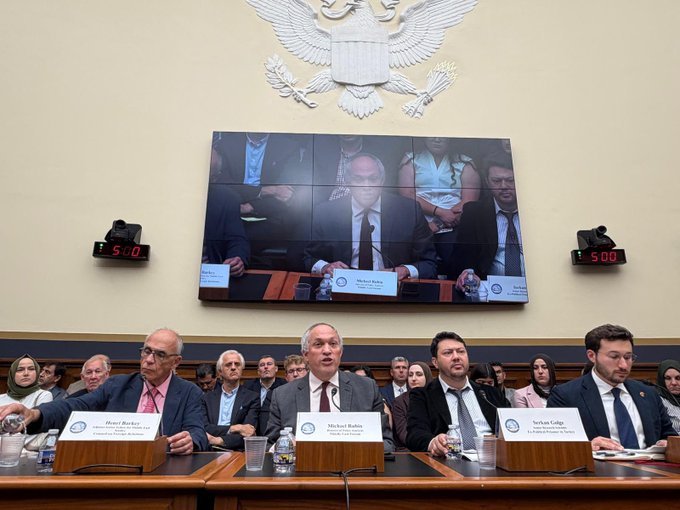
Turkey is moving toward full authoritarian rule as the government of President Recep Tayyip Erdoğan intensifies its crackdown on political opposition, independent media, civil society and perceived critics at home and abroad, US lawmakers and expert witnesses warned at a congressional hearing on Wednesday.
Speakers pointed to the March 2025 arrest of İstanbul Mayor Ekrem İmamoğlu, pressure on the main opposition Republican People’s Party (CHP), the misuse of terrorism charges against government critics, Turkey’s refusal to comply with European Court of Human Rights judgments and its targeting of dissidents overseas as signs of accelerating authoritarian consolidation.
The hearing was held by the Tom Lantos Human Rights Commission, a bipartisan body in the US House of Representatives, and hosted by Representatives Christopher Smith, a Republican representing New Jersey, and James McGovern, a Democrat from Massachusetts. Witnesses included Henri Barkey, an adjunct senior fellow at the Council on Foreign Relations; Michael Rubin, a senior fellow at the American Enterprise Institute; Serkan Gölge, a NASA scientist who was imprisoned in Turkey for nearly five years; and Andrew O’Donohue, a nonresident scholar at the Carnegie Endowment for International Peace.
Rep. Smith said thousands of people remain imprisoned in Turkey on terrorism-related charges based on activities that were lawful at the time, such as attending schools affiliated with the Gülen movement, having bank accounts at Bank Asya or maintaining ties to family members accused of links to the movement.
Smith also said Turkey targets critics abroad through surveillance, intelligence-gathering and intimidation campaigns, citing an incident in which Erdoğan’s security detail attacked protesters in Washington, D.C., during an official visit.
President Erdoğan has targeted followers of the Gülen movement, inspired by the late Muslim cleric Fethullah Gülen, since corruption investigations in December 2013 implicated him as well as some members of his family and inner circle. He dismissed the probes as a Gülenist conspiracy and later designated the movement as a terrorist organization in May 2016, intensifying a sweeping crackdown after a coup attempt in July of the same year that he accused Gülen of orchestrating. The movement denies involvement in the coup attempt or any terrorist activity.
Congressman McGovern said the human rights situation in Turkey has continued to deteriorate, pointing to pressure on the main opposition CHP, criminal investigations targeting journalists and activists and Ankara’s refusal to comply with binding judgments from the European Court of Human Rights.
Henri Barkey said Turkey’s state institutions have been reshaped to ensure Erdoğan’s political survival, with the judiciary increasingly used as a political tool against opponents. He described İstanbul Mayor İmamoğlu’s arrest as the most aggressive use of prosecutorial power against electoral competition in Turkey’s history.
İmamoğlu, widely seen as President Erdoğan’s strongest political rival, was arrested in March 2025 on corruption charges that critics say are politically motivated and intended to sideline him ahead of the 2028 general election.
Barkey warned that the appointment of trustees to opposition-run municipalities on terrorism-related grounds has enabled authorities to override democratic election results.
Barkey also said tens of thousands of people dismissed under emergency decrees following the coup attempt in 2016 continue to face what he called “civil death,” losing not only their jobs but also passports, professional licenses, pensions, social security and health insurance while being stigmatized as linked to terrorism without evidence or conviction.
Following the attempted coup, the Turkish government declared a state of emergency, known as OHAL, that remained in effect until July 19, 2018. During that period, the government purged state institutions through emergency decrees, dismissing more than 130,000 public servants, including 4,156 judges and prosecutors and more than 24,000 members of the armed forces, over alleged links to terrorist organizations.
Serkan Gölge, who was imprisoned in Turkey for nearly five years before returning to the US, said his case showed how individualized justice has been replaced by collective punishment. He said activities that were legal at the time, including opening a bank account and attending a legally operating school, were presented years later as evidence of terrorism.
Gölge said the punishment extended to his family, with his wife and children, all US citizens, prevented from leaving Turkey while he was imprisoned.
Describing his prosecution as an example of “hostage diplomacy,” Gölge said his US citizenship brought international attention to his case, while hundreds of thousands of less visible victims of the post-coup crackdown remained largely forgotten.
Gölge said the post-coup purge of the judiciary left defendants in politically sensitive cases with little hope of impartial review after Turkey’s judicial council suspended 2,745 judges and prosecutors the day after the coup attempt, with more than 4,000 ultimately removed. He said the message to those who remained was clear: Rule against the government, and “you may be next.”
Andrew O’Donohue warned that Turkey has reached a “dangerous inflection point,” saying the country is shifting from a system in which elections are unfair but still competitive to one in which opposition forces are prevented from gaining power.
He described İmamoğlu’s arrest as a decisive moment in that transition and warned that the muted international response risked enabling further democratic backsliding.
Michael Rubin described the current period as among the most repressive in modern Turkish history, saying Erdoğan used the 2016 abortive putsch as a “gift from God” to justify a pre-planned extensive crackdown against perceived opponents.
He characterized Erdoğan’s targeting of opposition figures such as former pro-Kurdish party leader Selahattin Demirtaş, İmamoğlu and CHP leader Özgür Özel as “political decapitation,” saying it was aimed at reshaping society along authoritarian lines while preserving the ruling establishment’s access to state resources.
The hearing also addressed religious freedom and the situation of Turkey’s Christian communities. While Barkey described the outlook as “a lost cause,” Rubin warned that silence would likely result in a further deterioration of religious freedoms.
Witnesses called on Washington to tie cooperation with Ankara more closely to respect for the rule of law, democratic norms and fundamental rights, including at the upcoming NATO summit in Ankara.
Rubin urged US officials to raise concerns about political prisoners and democratic backsliding more forcefully. “It would be great to have a prominent American say, ‘Mr. Erdoğan, tear down Silivri,” he said, referring to the high-security prison outside İstanbul that holds many of Turkey’s best-known political prisoners. He called on Washington to encourage European allies to do the same if necessary.