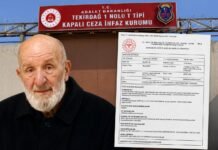

Former European Court of Human Rights (ECtHR) judge Rıza Türmen has warned that democracy in Turkey has been dismantled and replaced by an authoritarian order under the ruling Justice and Development Party (AKP), calling for a broad social movement to resist it.
In an interview with the Yeni Yaşam daily, Türmen said conventional political channels and parliamentary opposition alone would not be sufficient to reverse the current trajectory. He said democratic forces should come together in a grassroots social movement against a centralized political order where the rule of law, judicial independence and basic rights have been eroded.
Criticizing judicial interventions in opposition politics, Türmen pointed to a court ruling that annulled the 2023 congress of the main opposition Republican People’s Party (CHP), saying the decision reflected the erosion of multiparty democracy and a shift toward what he described as a bureaucratic, single-party state.
The ruling concerned the CHP’s 38th Ordinary Congress, where Özgür Özel defeated former chairman Kemal Kılıçdaroğlu and became party leader. The court found the congress legally invalid, temporarily removing Özel and the party’s current leadership from office and reinstating Kılıçdaroğlu and his team.
The decision came amid mounting judicial pressure on the CHP since its sweeping gains in the March 2024 local elections, with investigations targeting party-run municipalities and officials.
He also cited Turkey’s failure to implement ECtHR rulings, including those concerning businessman and philanthropist Osman Kavala and the jailed former leader of the pro-Kurdish Peoples’ Democratic Party (HDP), Selahattin Demirtaş, as evidence of disregard for international legal obligations and the rule of law. The court called for Kavala and Demirtaş to be released, finding in both cases that their detention had pursued political purposes.
Türmen said Turkey’s current crisis also presented an opportunity to learn from past mistakes and build a more inclusive and pluralistic republic based on equal citizenship and constitutional protections of different identities and beliefs.
Türmen referred to a forthcoming conference titled “Democratic Transformation of the Republic in its Second Century” scheduled for June 13, describing it as a call to action to address Turkey’s political crisis and lay the groundwork for a more democratic future.
He is among 29 organizers of the conference along with a group of academics, lawyers, journalists, rights advocates and former politicians who say Turkey needs a new democratic framework in the second century of the republic. Its title refers to the centenary of the Turkish Republic, founded in 1923, and ongoing debates over whether the country’s second century can be built on pluralism, equal citizenship and the rule of law.
Türmen also linked Turkey’s economic problems to its democratic backsliding, saying citizens needed to understand that economic hardship and the absence of democracy were interconnected.
He also criticized the Turkish government’s current peace efforts with the outlawed Kurdistan Workers’ Party (PKK), saying they focused narrowly on disbanding the group while failing to address the democratic grievances underlying the conflict.
The PKK, designated as a terrorist organization by Turkey and its Western allies, has waged an insurgency against the Turkish state since 1984 but announced in May 2025 it would disband and end its armed campaign.
Turkey’s democratic backsliding has drawn criticism from various international organizations, including the EU and the Council of Europe, with scrutiny intensifying following a judicial crackdown on the CHP that began in October 2024.
At least 20 mayors from the party, including İstanbul Mayor Ekrem İmamoğlu, have been jailed, while 25 others have been suspended and several municipalities put under trustee rule. İmamoğlu, a leading figure in Turkey’s main opposition and widely seen as President Recep Tayyip Erdoğan’s strongest political rival, was detained on March 19, 2025, and arrested days later on corruption charges. Critics and international observers say the case is politically motivated, aimed at sidelining a major challenger ahead of the 2028 general election.
At least 14 CHP-elected mayors have since joined the AKP.
In the latest global Rule of Law Index released in October 2025 by the World Justice Project, Turkey was ranked 118th out of 143 countries.