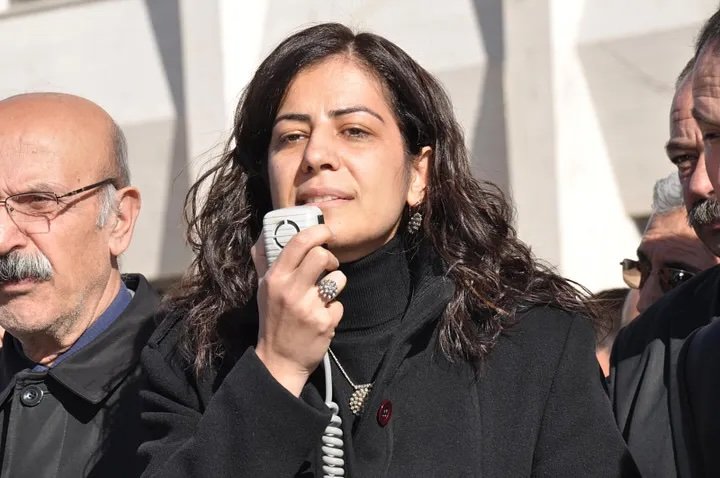
The European Court of Human Rights (ECtHR) has ruled that Turkey violated the rights of former Kurdish lawmaker Ayla Akat Ata by holding her in pretrial detention for six months in 2016 on terrorism-related charges without reasonable grounds for suspicion.
The Strasbourg-based court found violations of Article 5 and Article 10 of the European Convention on Human Rights, which protect the right to liberty and freedom of expression. The court said Turkish authorities failed to provide sufficient evidence or reasonable suspicion of criminal activity to justify Ata’s detention.
The case stems from the arrest of Ata, a former deputy of the pro-Kurdish Peoples’ Democratic Party (HDP) from southeastern Batman province on October 30, 2016. She was accused of establishing and leading an armed terrorist organization, disseminating terrorist propaganda and participating in unlawful meetings and demonstrations.
The accusations were based on her role in the establishment and activities of the Democratic Society Congress (DTK), her position as an executive of the Association of the Free Women’s Congress (KJA) and a director of its periodical as well as her participation in demonstrations. After six months in pretrial detention she was released on May 4, 2017, under judicial supervision.
The DTK, a Kurdish umbrella organization bringing together political parties, civil society groups and activists advocating Kurdish rights and regional self-governance in Turkey, was found to be affiliated with the outlawed Kurdistan Workers’ Party (PKK), which is designated as a terrorist organization by Turkey and its Western allies, in a 2020 ruling of Turkey’s Supreme Court of Appeals.
The ECtHR found that Ata’s pretrial detention was unlawful and violated her right to liberty and that domestic courts failed to provide relevant and sufficient reasons for justification. The court also said there was no concrete evidence that the DTK was an unlawful entity and that Ata’s involvement in the DTK consisted of political activities that did not amount to incitement to violence.
The court further ruled that Ata’s detention, based largely on her political speeches and social media posts, constituted an unjustified interference with her freedom of expression because it was not prescribed by law. The court said her statements and participation in meetings were political in nature and therefore protected under freedom of expression.
The court ordered Turkey to pay Ata €8,000 in non-pecuniary damages in addition to €1,000 for costs and expenses.
Ata was rearrested in February 2018 as part of a separate investigation and was later tried in the Kobani case, a mass prosecution of HDP politicians and members over deadly protests that erupted across Turkey in October 2014, following the Islamic State’s siege of the Syrian Kurdish town of Kobani. She remained in pretrial detention throughout the proceedings until May 2024, when she was sentenced to nine years in prison. However, she was released at the time of the verdict due to time already served while in detention.
The ECtHR’s ruling is the latest in a long line of its judgments against Turkey. Turkish authorities have for years pursued investigations and prosecutions against members of the Kurdish political movement on terrorism charges, citing alleged links with the PKK. Dozens of Kurdish politicians, including former lawmakers, party executives and mayors, have been detained or imprisoned as part of sweeping counterterrorism investigations.
Turkey has also removed numerous elected Kurdish mayors from office over alleged terrorism links and replaced them with government-appointed trustees, a practice widely criticized by rights groups and opposition parties as undermining democratic representation.