Former Constitutional Court president Haşim Kılıç and Hüseyin Çelik, a founding member of Turkey’s ruling Justice and Development Party (AKP) and a former education minister, have sharply criticized Turkey’s judiciary and executive presidency system, describing the current model as a “disaster” and warning of a deepening erosion of fundamental rights, Turkish Minute reported, citing the Anka news agency .
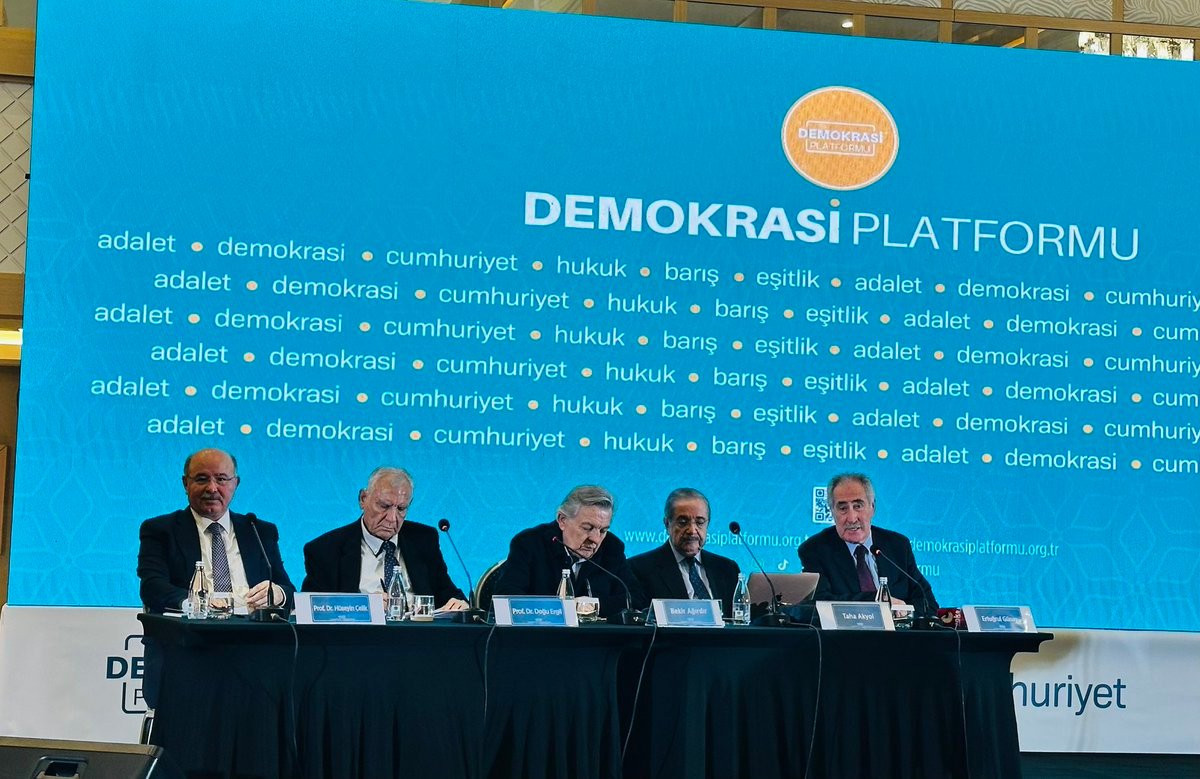
Speaking at a conference on Sunday in Ankara titled “Politics Must Change First,” organized by the Democracy Platform, the two men pointed to what they described as a growing judicial crisis and the weakening of democratic safeguards under the presidential system, adopted after a 2017 constitutional referendum.
Kılıç said freedom of expression in Turkey had significantly deteriorated, arguing that society has shifted from exercising the right to free speech to resorting to what he called the “right to remain silent.”
Kılıç said that before constitutional amendments passed in 2010, there was an understanding that confined faith to the private sphere, but afterward this moved toward urging people to keep their thoughts to themselves, gradually narrowing freedom of expression.
He also criticized the Constitutional Court for what he described as a “timid and anxious stance” in rights violations, warning that its failure to assert authority over lower courts was damaging its well-known libertarian approach and undermining public trust in the judiciary.
“Violations identified by the European Court of Human Rights [ECtHR] must be implemented with courage, and injustices must be remedied. Problems related to the judiciary are no longer matters that can be postponed,” he added.
The former top court president’s remarks come amid an ongoing controversy over Turkey’s failure to comply with rulings from the ECtHR, including high-profile cases such as that of businessman Osman Kavala, who remains imprisoned despite a 2019 ruling that his detention was arbitrary and politically motivated.
Kavala recently warned in remarks published by the T24 news website that arguments presented by Turkey at a hearing in Strasbourg reflected a “dangerous” understanding of justice that resembled a Stalin-era conspiracy doctrine and said continued disregard for human rights law was causing deeper damage to Turkey’s legal system.
Similar concerns have been raised in the case of jailed Kurdish politician Selahattin Demirtaş, whose release has repeatedly been denied despite multiple ECtHR rulings finding violations of his rights. Legal experts and bar associations have stressed that such judgments are binding under both international conventions and Turkey’s constitution.
Critics say the lack of compliance with top court rulings reflects a broader pattern of political influence over the judiciary, particularly in cases involving opposition figures. Turkish authorities deny such claims and insist that the judiciary operates independently.
Opposition politicians have faced a series of investigations, detentions and arrests in recent years, in what critics describe as an effort to stifle dissent and weaken electoral rivals.
At the same conference, Çelik directly targeted the presidential system, arguing that it had eroded institutional merit and accountability.
“When leaders consolidate power in their hands, the principles of merit and competence disappear,” he said. “In their place comes absolute loyalty and obedience. Criticizing the party leader is treated as betrayal.”
Çelik described the current system as incompatible with democratic governance.
“This so-called ‘Turkish-style’ presidential system have been a disaster for Turkey,” he said. “You are the president and you have a party. You say whatever you want about the opposition, but when they respond, it becomes an insult to the president.”
Turkey transitioned from a parliamentary system to an executive presidential system following a 2017 referendum, granting sweeping powers to President Recep Tayyip Erdoğan and eliminating many traditional checks and balances, according to critics.
Some analysts claim that the system has concentrated excessive authority in a single office, weakening institutional oversight and contributing to declining trust in political institutions.
Analysts also argue that Turkey’s 2018 shift to a presidential system may be a key factor behind the country’s economic difficulties.
The country has experienced persistent double-digit inflation since 2019. The annual rate, which peaked at 85.5 percent in October 2022, has declined over the years and currently stands at 30.87 percent, according to official data.
The Turkish lira has also lost more than 130 percent of its value against the dollar since mid-2022, with the exchange rate rising from approximately 17.5 to more than 44 lira to the dollar in nearly four years.
Public dissatisfaction with economic management has grown significantly. An 2025 survey by ASAL Research found that only 13.2 percent of respondents viewed the government’s economic performance positively, while 74.7 percent said it was unsuccessful, reflecting widespread concern over the rising cost of living.