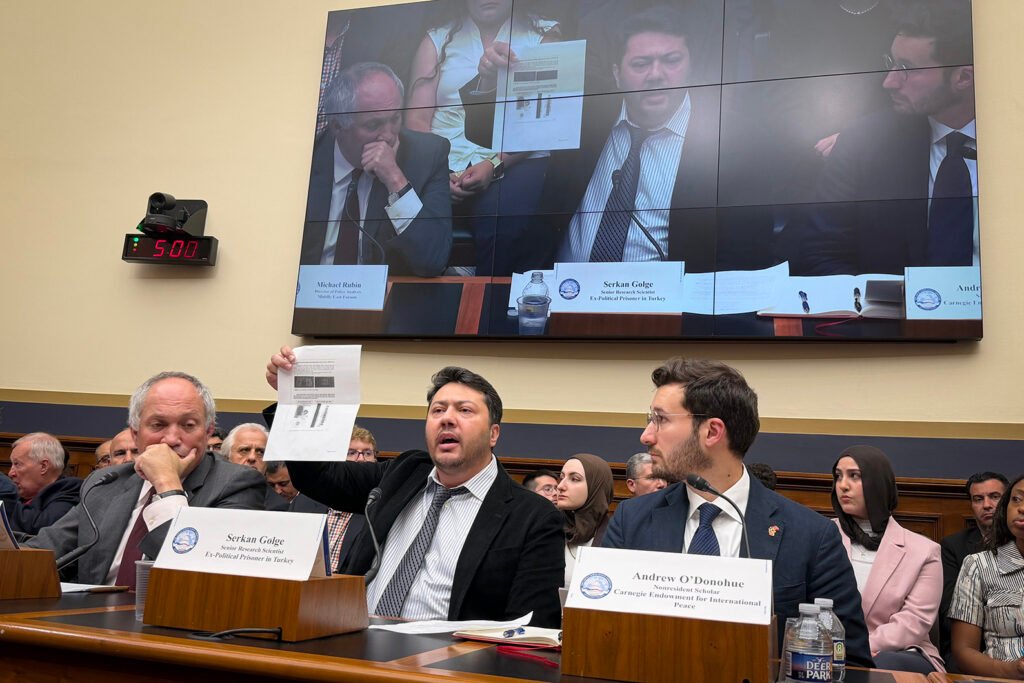
Turkish-American NASA scientist Serkan Gölge told a US congressional hearing on Wednesday that the Turkish government used ordinary, lawful activities, including having a one dollar bill, as evidence of terrorism in a case he said reflected the country’s broader system of collective punishment after a 2016 coup attempt.
Gölge said his conviction showed how Turkey’s post-coup prosecutions have shifted from individualized responsibility to collective and profile-based guilt, with courts treating a person’s education, banking history and family associations as markers of criminality .
Gölge, a physicist who had worked as a senior researcher at NASA on radiation studies related to future human space missions, was detained while on a family vacation in Turkey in July 2016, days after the coup attempt, and later sentenced to prison despite the absence of material evidence linking him to any criminal activity.
Prosecutors accused Gölge of links to the Gülen movement and of acting as a CIA operative, initially seeking aggravated life imprisonment on terrorism charges. They cited an anonymous informant’s statement, his account at Bank Asya, his education at Fatih University and a one-dollar bill found in his brother’s room as evidence of affiliation with the movement. Bank Asya and Fatih University were both legally operating at the time but were later shut down over alleged movement links.
The congressional hearing was held by the Tom Lantos Human Rights Commission, co-chaired by Representatives Christopher Smith and James McGovern.
“This was the reason I spent three years in prison and one year under house arrest,” Gölge said, holding up a page from his indictment showing copies of his NASA ID card and a one-dollar bill.
Turkish President Recep Tayyip Erdoğan has targeted followers of the Gülen movement, inspired by US-based cleric Fethullah Gülen, who died in 2024, since corruption investigations in December 2013 implicated him as well as some members of his family and inner circle. He dismissed the probes as a Gülenist conspiracy and later designated the movement as a terrorist organization in May 2016, intensifying a sweeping crackdown after a coup attempt in July of the same year that he accused Gülen of orchestrating. The movement denies involvement in the coup attempt or any terrorist activity.
Gölge said he was held in police custody for 13 days before his arrest, repeatedly questioned about his private life and pressured to provide names that would fit what he called a pre-written narrative.
“First the Turkish government puts a person in a category,” he said. “Then every detail of that person’s life is interpreted through that category.”
He said the burden was effectively shifted onto him to explain why ordinary facts from his life were not crimes.
Gölge also said the punishment extended to his family, with his wife and children, all US citizens, barred from leaving Turkey while he was imprisoned. He said his eventual release coincided with high-level diplomatic engagement between the US and Turkey.
Citing reports that linked his release to a meeting between then-US president Donald Trump and Turkish President Erdoğan, Gölge said the timing showed the political nature of his case. “If I was truly a terrorist threat, why did my restrictions rise and fall around presidential meetings?” he asked.
Gölge said the broader post-coup crackdown swept up judges, prosecutors, teachers, journalists and civil servants and others accused of ties to the movement, arguing that the scale of prosecutions showed a system based on collective rather than individual responsibility.
He cited the European Court of Human Rights’ ruling in Yalçınkaya v. Türkiye, which found that digital indicators such as mobile applications cannot automatically be treated as proof of terrorism and urged US officials to press Ankara to comply with ECtHR judgements.
Gölge also questioned the transparency of Turkey’s investigation into the coup attempt, saying key figures were not meaningfully examined and that the government used the abortive putsch as a pretext for mass punishment. He said the speed of arrests in the immediate aftermath, before the alleged coup plotters were identified, suggested that the lists had been prepared in advance.
According to the latest figures from Turkey’s justice ministry, more than 126,000 people have been convicted of alleged links to the movement since 2016, with 11,085 still in prison. Legal proceedings are ongoing for over 24,000 individuals, while another 58,000 remain under active investigation nearly a decade later.