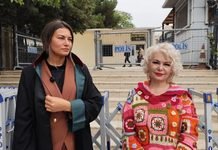

A Turkish court has handed down an 11-month suspended sentence to social media personality and singer Murat Övüç for insulting religious values in a video in which he wore a headscarf, Turkish Minute reported, citing the Bianet news website.
Övüç was arrested on December 20 on charges of inciting hatred and hostility and spent 102 days in pretrial detention before being released under judicial supervision, including a travel ban and a requirement to report to police weekly.
The Küçükçekmece 5th Criminal Court of First Instance in İstanbul ruled on Wednesday that his actions amounted to insulting religious values and handed down an 11-month suspended sentence.
In his defense Övüç said the video was intended as humor and to entertain his followers who wear headscarves, claiming that he had no malicious intent. He added that he had apologized for any misunderstanding.

The investigation was launched after a video circulated on social media showing Övüç wearing a headscarf while drawing attention to a ring on his finger, with a folk song playing in the background.
Prosecutors said the video mocked women who wear headscarves and risked provoking one segment of society against another, posing a threat to public order.
The indictment described Övüç as “a suspect who displays feminine behavior and identifies as gay,” noting that his large social media following allowed the video to reach a wide audience.
Övüç’s lawyer, Çağdaş Çelik, said the legal process was flawed and that the sentence was unlawful.
According to the lawyer, his client should not have been detained under the relevant provision of the Turkish Penal Code, which carries a maximum sentence of one year and generally does not allow pretrial detention.
Çelik said he expects the conviction to be overturned on appeal.
Övüç also said on social media after the hearing that his judicial supervision and travel ban had been lifted and that he had “regained my freedom,” adding that he expected the ruling to be overturned on appeal.
Prosecutors had earlier sought up to three years in prison under Article 216 of the Turkish Penal Code, which criminalizes inciting hatred and hostility among various segments of society.
The indictment, submitted weeks after his arrest, argued that the video posed a “clear and imminent danger” to public order, citing Övüç’s large online following.
He has 3.7 million followers on Instagram.
A higher court will review the ruling if it is appealed.
Legal experts and the defense say pretrial detention in such cases should be an exceptional measure under Turkish law, requiring evidence of risks such as flight or tampering with evidence.
They claim that in this case detention may not have been justified, noting that the main evidence was a publicly shared video and that no clear flight risk was identified in the indictment or publicly available information.
The case is not an isolated one. In a recent example stand-up comedian Tuba Ulu was detained after making a joke about Suleiman the Magnificent during a performance, prompting an investigation on charges of “insulting historical, national and moral values.”
The detention followed the circulation of a video from the performance on social media and sparked criticism from free speech advocates, who said comedians should not face legal action over their stage material.
International monitors rank Turkey poorly on freedom of expression and media freedom. Freedom House classifies the country as “Not Free,” while Reporters Without Borders ranked it 159th out of 180 countries in its 2025 World Press Freedom Index.