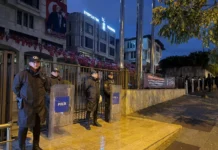
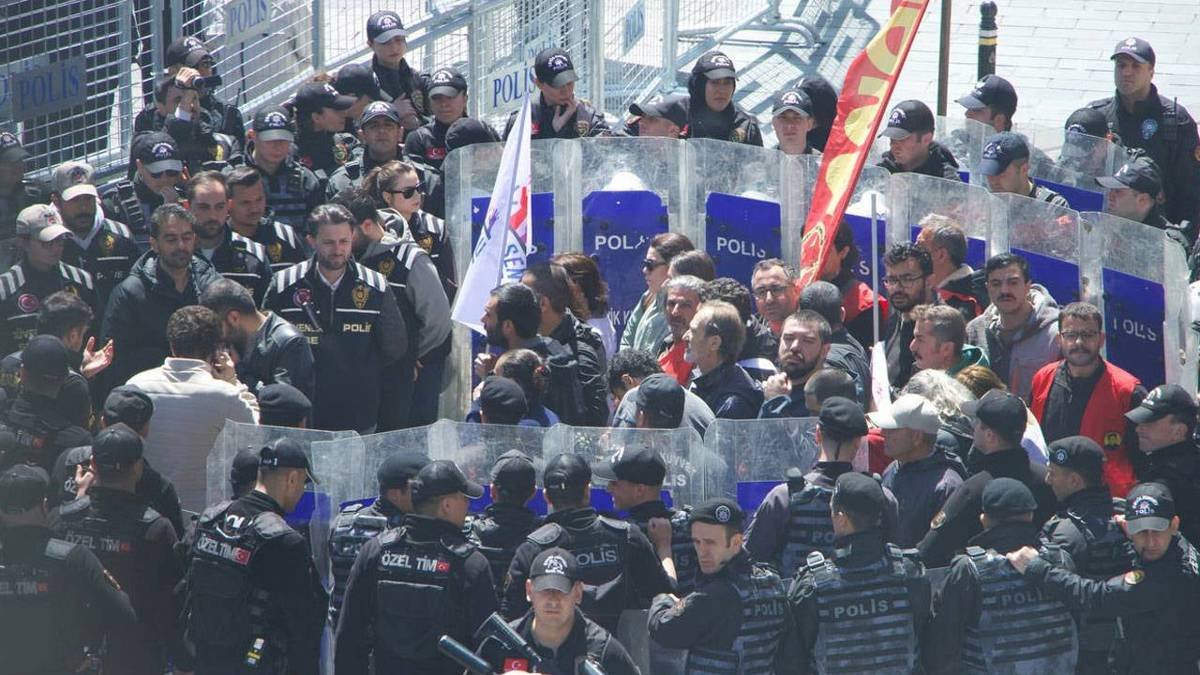
Turkish police detained more than 30 people in İstanbul on Monday after blocking a May Day commemoration near Taksim Square, including union leaders and representatives of political parties and civil society groups, Turkish Minute reported, citing the Anka news agency.
The police prevented members of the May 1 Taksim Initiative, a coalition of unions and civil society organizations, from gathering at Kazancı Yokuşu, a symbolic site linked to the 1977 May Day killings.
Police surrounded the group near Gezi Park and intervened as participants attempted to hold the event.
According to reports cited by sendika.org, more than 30 demonstrators were detained, with some subjected to physical force during the police operation.
Ahead of the gathering, police sealed off Taksim Square and surrounding areas with barriers, effectively restricting access to the site. İstanbul’s metro operator announced that the Taksim subway station and funicular line were closed in line with a decision by the İstanbul Governor’s Office.
Officials said the ban was based on a district-level decision following calls for an alternative May Day gathering in the area.
Despite the restrictions, demonstrators raised carnations and chanted slogans asserting that Taksim Square is the rightful site for May Day commemorations.
Süleyman Keskin, head of the Energy Workers’ Union (Enerji-Sen), affiliated with the Confederation of Progressive Trade Unions (DİSK), criticized the ban, saying that the government had repeatedly attempted to prevent workers from exercising their right to gather in Taksim despite previous court rulings in favor of demonstrators.
The ban on May Day gatherings in Taksim Square dates back to 2013, when police repeatedly used force to prevent trade unions and their supporters from assembling in the area.
In December 2023 Turkey’s Constitutional Court ruled that bans and police interventions during May Day celebrations in 2014 and 2015 had violated the right to peaceful assembly of DİSK members.
A 2013 ruling by the European Court of Human Rights had similarly found that Turkey violated the right to peaceful assembly by restricting a May Day rally in Taksim in 2008.
After Keskin’s remarks, the group staged a brief sit-in before police moved in and carried out detentions.
Kazancı Yokuşu has deep symbolic significance in Turkey’s labor movement. The 1977 events, known as “Bloody May Day,” remain one of the deadliest attacks on labor demonstrators in the country’s history.
During the May 1 gathering in Taksim Square, gunfire erupted from surrounding buildings, triggering panic and a deadly stampede. Between 31 and 36 people were killed and more than 100 injured.
In the aftermath, over 500 demonstrators were detained and 98 were indicted, but none of the perpetrators were ever identified. Suspicion at the time focused on clandestine state-linked networks and right-wing groups amid the widespread political violence of the late 1970s.
Labor unions and professional organizations, including DİSK, the Confederation of Public Employees’ Trade Unions (KESK), the Union of Chambers of Turkish Engineers and Architects (TMMOB) and the Turkish Medical Association (TTB), have continued efforts to commemorate the victims each year at Kazancı Yokuşu, often facing restrictions from authorities.