
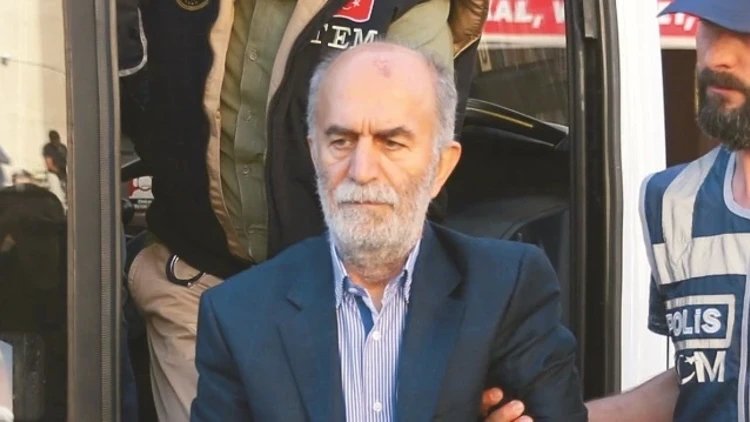
A 76-year-old former Turkish governor has been sent to prison after the Supreme Court of Appeals upheld his sentence in a retrial on terrorism charges over alleged links to the faith-based Gülen movement, the TR724 news website reported.
Şehabettin Harput, the former governor of both Bursa and Şanlıurfa, was retried after an earlier ruling was overturned on procedural grounds. The Bursa Regional Court of Justice in January 2023 again sentenced him to eight years, nine months in prison on charges of membership in an armed terrorist organization, the ruling recently upheld by the Supreme Court of Appeals.
In the initial trial the Bursa 8th High Criminal Court sentenced Harput to six years, three months in prison in December 2018. The Bursa Regional Court of Justice increased the sentence to eight years, nine months in October 2019.
The Supreme Court of Appeals later overturned the ruling on procedural grounds, saying the presiding judge had participated in the pretrial questioning of 60 defendants in the case. Under Turkish criminal procedure, a judge who takes part in any earlier stage of proceedings — including the pretrial investigation of the suspects — is barred from presiding over the trial.
His conviction was based on activities that Turkish courts have treated as evidence of Gülen movement affiliation, including his role on the board of trustees of a Gülen movement-affiliated university shut down by government decree after a 2016 coup attempt, deposits in the now-shuttered Bank Asya and participation in overseas trips organized by businessmen’s associations alleged to be linked to the movement.
The ruling came days after the Grand Chamber of the European Court of Human Rights found in Yasak v. Türkiye that Turkish courts had failed to show that the applicant’s earlier activities proved intent to commit a terrorist offense. The court criticized the use of activities that were lawful at the time — including employment in Gülen-affiliated institutions and transactions with the now-defunct Bank Asya — as evidence of terrorism-related offenses. The Grand Chamber had also previously ruled in its Yalçınkaya v. Türkiye decision that use of the ByLock messaging application or participation in peaceful activities alone could not justify terrorism convictions.
Harput was detained on July 28, 2016, in the aftermath of the coup attempt in Turkey and later arrested. During the proceedings Harput was released pending trial due to his advanced age and health problems, but was later put under house arrest following an objection by prosecutors.
The decision prompted criticism from rights advocates.
Journalist Ahmet Erkan said in a social media post that while many were expecting Turkey to comply with rulings from the European Court of Human Rights concerning post-coup prosecutions, Harput had instead been jailed for a second time.
Lawyer Hatice Yıldız pointed to the recent release on health grounds of a 76-year-old cancer patient convicted of killing two people in a street shooting, saying unequal application of the law against a particular segment of society amounted to “a crime against humanity.”
Turkish President Recep Tayyip Erdoğan has targeted followers of the Gülen movement, inspired by the US-based cleric Fethullah Gülen, who died in 2024, since corruption investigations in December 2013 implicated him as well as some members of his family and inner circle. He dismissed the probes as a Gülenist conspiracy and later designated the movement as a terrorist organization in May 2016, intensifying a sweeping crackdown after the coup attempt in July of the same year that he accused Gülen of orchestrating. The movement denies involvement in the coup attempt or any terrorist activity.
According to the latest figures from the justice ministry, more than 126,000 people have been convicted of alleged links to the movement since 2016, with 11,085 still in prison. Legal proceedings are ongoing for over 24,000 individuals, while another 58,000 remain under active investigation nearly a decade later.