
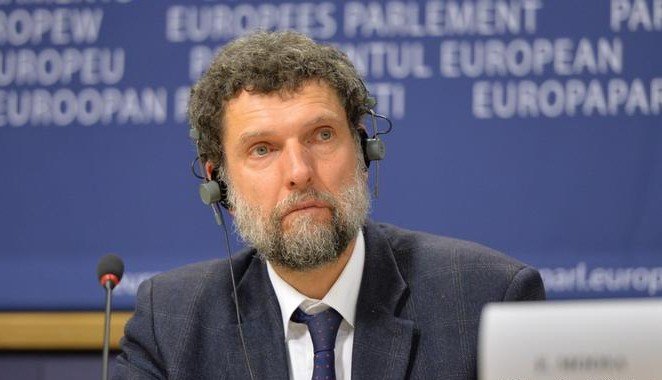
Imprisoned Turkish businessman and civil society figure Osman Kavala said a Turkish government lawyer’s arguments at a recent European Court of Human Rights (ECtHR) hearing reflected a “dangerous” theory of punishment that resembled a Stalin-era conspiracy doctrine, warning that continued disregard for human rights law was causing deeper damage to Turkey’s legal system, Turkish Minute reported.
In remarks published by the Turkish T24 news website on Saturday, Kavala criticized arguments presented on behalf of Turkey at the March 25 Grand Chamber hearing in Kavala v. Türkiye (No. 2) before the ECtHR in Strasbourg, France. The case concerns his continued imprisonment despite the court’s 2019 judgment and the criminal proceedings that later led to his aggravated life sentence.
Kavala has been in prison since 2017. He was convicted in 2022 over the 2013 Gezi Park protests, a wave of anti-government demonstrations that began over plans to redevelop a park in central İstanbul and spread across Turkey.
In 2019 the ECtHR found that his detention was arbitrary and pursued an ulterior political purpose, and in 2022 the court ruled that Turkey had failed to comply with that judgment. His aggravated life sentence was upheld in September 2023.
Government lawyer defends Gezi prosecution
At the March hearing, Ali Emrah Bozbayındır, dean of the law faculty at Boğaziçi University in Istanbul and part of Turkey’s legal team, argued that international courts should not delve into the details of domestic criminal proceedings and defended the Gezi prosecution by describing the protests as an “insurrectionary movement.” He also argued that success was not required for an attempt to overthrow the government, because if such an effort succeeded, “there would be no judge” left to try the offense.

Kavala rejected that argument in strong terms. According to T24, he said Bozbayındır was defending a view under which peaceful acts that contain no element of force or violence can still be treated as components of a collective crime aimed at overthrowing the government. Kavala said that approach erased the line between legal and illegal conduct and recalled the conspiracy theory associated with Soviet prosecutor Andrey Vyshinsky during the Stalin period, under which people could be treated as criminal partners based on an alleged unity of purpose even if they did not know one another.
He also criticized the logic used against him, saying it amounted to claiming that he had tried to overthrow the government by directing or inspiring people whose own actions had in fact been found not to amount to such a crime. T24 quoted him as saying the theory reminded him of a medieval belief that the devil entered innocent people and pushed them into wrongdoing.
Constitutional Court and ECtHR role
Kavala also defended the role of Turkey’s top court in reviewing evidence in rights cases. He said efforts to argue that neither Turkey’s Constitutional Court nor the ECtHR should examine whether evidence actually supports a criminal accusation would strip those courts of their function as safeguards against abuses, especially in politically sensitive trials. He said the more serious threat to the Constitutional Court’s standing was not his application to Strasbourg but the refusal of lower courts to implement Constitutional Court rulings in other prominent cases, including those involving jailed lawmaker Can Atalay and Gezi co-defendant Tayfun Kahraman.
On the broader state of the rule of law, Kavala said a recent Turkish parliamentary committee report stressing that ECtHR and Constitutional Court rulings must be followed was important because the Turkish Constitution requires compliance with both. But he warned that the deeper problem went beyond noncompliance with court judgments. T24 quoted him as saying that as long as politics, public administration and the judiciary continue to tolerate a failure to fully respect legal rules that protect human dignity and human rights, “the ship of law” carrying everyone in Turkey will keep taking on water.
Kavala also commented on the recent conviction of talent manager Ayşe Barım on a charge of attempting to overthrow the government in a separate Gezi-related case. He said the sentence showed that facts and findings were not being assessed through rational reasoning and accused prosecutors of presenting events that never happened as if they had occurred, which he called an abuse of authority.
The Grand Chamber did not issue a ruling after the March 25 hearing. The court said it would deliberate and announce its judgment at a later date.