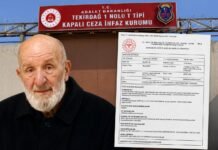

A leading Turkish rights organization has urged the government to revise Article 314 of the Turkish Penal Code (TCK), a widely used provision criminalizing membership in an armed terrorist organization, and to create effective retrial mechanisms for people convicted under it in cases that violate European Court of Human Rights (ECtHR) case law.
According to Turkish Minute, the Ankara-based Human Rights Association (İHD) made its statement on Thursday following a recent decision from the ECtHR Grand Chamber about Şaban Yasak, a 39-year-old Turkish man who was convicted of membership in a terrorist organization over alleged links to the faith-based Gülen movement and held for years in overcrowded prison conditions.
The Grand Chamber ruled on Tuesday that Turkey violated Article 7 of the European Convention on Human Rights, which prohibits punishment without law, and Article 3, which bans inhuman or degrading treatment, in the case of Yasak, who was convicted in 2018 under Article 314 over alleged links to the Gülen movement.
Turkish President Recep Tayyip Erdoğan has targeted followers of the Gülen movement, inspired by the US-based cleric Fethullah Gülen, who died in 2024, since corruption investigations in December 2013 implicated him as well as some members of his family and inner circle. He dismissed the probes as a Gülenist conspiracy and later designated the movement as a terrorist organization in May 2016, intensifying a sweeping crackdown after a coup attempt in July of the same year that he accused Gülen of orchestrating. The movement denies involvement in the coup attempt or any terrorist activity.
The İHD said Article 314 of the TCK, which criminalizes membership in an armed terrorist organization, should be revised in line with the principles of legality, clarity and foreseeability.
“The scope of the offense of ‘membership in an organization’ should be narrowly and clearly defined so as not to violate freedom of expression, freedom of association, the right to assembly and demonstration and the presumption of innocence,” the İHD said.
Like Yasak, tens of thousands of people were investigated and convicted in Turkey under Article 314 due to their real or perceived links to the Gülen movement as part of a massive cracdown launched by the Turkish government under the pretext of an anti-coup fight.
Yasak’s conviction was based on witness statements about his alleged role in the movement’s student network before 2014, his account at the now-closed, Gülen-linked Bank Asya, his employment at a private tutoring center considered affiliated with the movement, membership in two associations allegedly linked to the movement and mobile phone records allegedly showing contact with another suspect in a Gülen-linked investigation.
Tens of thousands of others in Turkey have similarly faced Gülen-related accusations over what were largely routine or lawful activities, such as having accounts at Bank Asya, working for or attending Gülen-linked schools, joining associations, using certain communication tools or having social contacts with people later investigated over alleged movement links.
For the İHD, the ECtHR ruling confirmed that courts cannot impose serious criminal liability merely on the basis of a person’s contacts, institutional links or participation in activities that were legal at the time.
The association said that criminal responsibility must be individualized and based on concrete, lawful and convincing evidence.
It also called for “effective, swift and accessible” retrial mechanisms for finalized convictions under Article 314 in cases that conflict with ECtHR jurisprudence, saying the consequences of such judgments should be remedied.
That reasoning has implications far beyond Gülen-linked trials. Article 314 has long been one of the most controversial provisions in Turkey’s criminal law, used not only in post-coup prosecutions but also in cases involving Kurdish politicians, journalists, lawyers, activists and civil society figures accused of links to outlawed groups, mainly the outlawed Kurdistan Workers’ Party (PKK), designated as a terrorist organization by Turkey and its Western allies.
Rights groups and legal experts have repeatedly warned that the provision is applied too broadly and unpredictably, with courts treating lawful activities, social ties, professional work, association or union membership, bank records, schooling or communication data as evidence of terrorist organization membership when viewed in a political context.
The İHD urged judicial authorities to apply the principles set out in both Yasak v. Türkiye and the ECtHR’s 2023 Grand Chamber judgment in Yalçınkaya v. Türkiye to similar cases.
In the Yalçınkaya case, the court found rights violations in the conviction of a teacher over alleged Gülen links, including the use of ByLock, an encrypted messaging application Turkish authorities claim was used by Gülen movement members, as evidence.
The call is particularly significant because the İHD has for years campaigned against the criminalization of Kurdish political activity and has frequently criticized Turkey’s use of terrorism laws against elected Kurdish politicians and activists.
In its statement the association also referred to Turkey’s failure to implement binding ECtHR judgments in the cases of jailed Kurdish politician Selahattin Demirtaş and jailed businessman Osman Kavala, along with the Yalçınkaya and Yasak rulings.
Demirtaş, a former co-chair of the pro-Kurdish Peoples’ Democratic Party (HDP), has been in prison since November 2016 despite ECtHR rulings calling for his release.
Kavala, a philanthropist and civil society figure, has remained behind bars since 2017 despite a binding Strasbourg judgment finding that his detention pursued an ulterior political purpose.
Turkey’s refusal to fully implement such rulings has deepened concerns over judicial independence and the rule of law.
Under Article 46 of the European Convention on Human Rights, member states are legally bound to comply with final ECtHR judgments. Article 90 of Turkey’s constitution also gives international human rights treaties priority over domestic law in cases of conflict.