
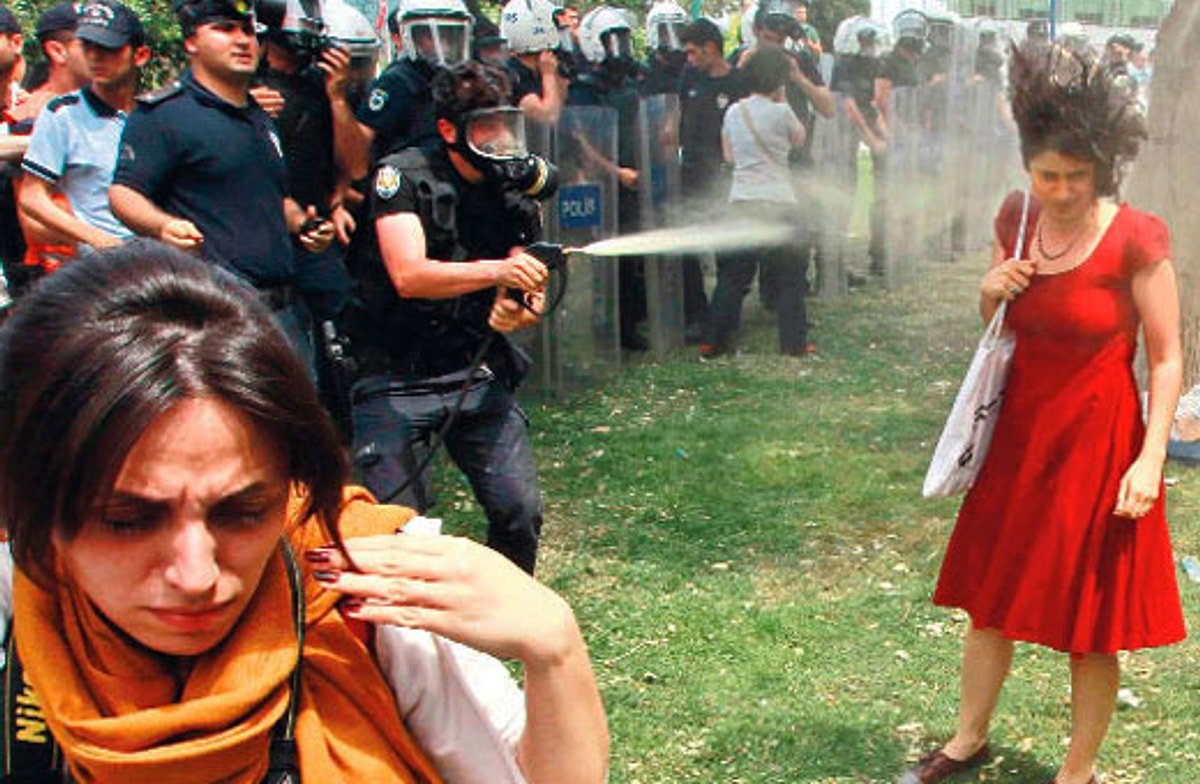
The European Court of Human Rights (ECtHR) has ruled that Turkey violated the rights of Ceyda Sungur, widely known as the “woman in red” during the 2013 Gezi Park protests, after a police officer sprayed her in the face with tear gas at close range, Turkish Minute reported.
In its judgment on Tuesday in Sungur v. Türkiye, the Strasbourg-based court found a violation of Article 3 of the European Convention on Human Rights, which prohibits torture and inhuman or degrading treatment.
The case stems from an incident on May 28, 2013, when a riot police officer sprayed tear gas directly into then-27-year-old Sungur’s face during a peaceful sit-in in Gezi Park in İstanbul’s central Taksim neighborhood, as security forces moved in to disperse demonstrators.
Sungur, then an academic at İstanbul Technical University, had joined the protest to oppose a controversial redevelopment project that threatened one of the city’s last green spaces.
The officer continued advancing and spraying gas even as she turned away. Images of the incident, captured by Reuters photographer Osman Orsal, quickly spread across social media and international media.
The treatment of a non-violent protester sparked widespread attention at the time and contributed to growing public scrutiny of police use of force during the demonstrations.
Sungur, wearing a red dress, became known as the “woman in red,” one of the most prominent symbols of the protests.
The ECtHR ruled that the use of force was disproportionate and that Turkish authorities failed to ensure accountability through an effective and deterrent response.
Following the incident the officer, identified only by the initials F.Z., initially received a disciplinary warning. In criminal proceedings a Turkish court later sentenced him to 10 months in prison for intentional injury, but the sentence was suspended and converted into alternative measures, including planting 300 trees.
The case was closed after the officer fulfilled those conditions.
Sungur challenged the outcome domestically, claiming that the punishment lacked deterrent effect. However, Turkey’s Constitutional Court ruled in 2019 that the sanction was sufficient and found no violation of her rights.
The ECtHR disagreed, concluding that the penalties imposed on the officer were inadequate to prevent similar abuses and failed to meet the state’s obligation to effectively investigate and punish ill-treatment by law enforcement.
The court ordered Turkey to pay Sungur €6,500 in non-pecuniary damages and €5,400 for legal costs and expenses.
In a later interview, Sungur said she was uncomfortable being portrayed as the “face” of the Gezi protests, noting that many demonstrators were subjected to tear gas and water cannons during the three-week unrest. Still, she acknowledged that her image had encouraged others to join the protests.
Sungur currently lives in Paris.
The ruling adds to a series of ECtHR judgments criticizing Turkey over police conduct during the Gezi Park protests and the lack of effective accountability mechanisms in cases involving excessive use of force.
The Gezi protests, which began as a small environmental sit-in against plans to redevelop the Gezi Park, grew into nationwide demonstrations challenging the government of then-prime minister and current president Recep Tayyip Erdoğan.
The government’s crackdown on protesters left 11 people dead and thousands injured.