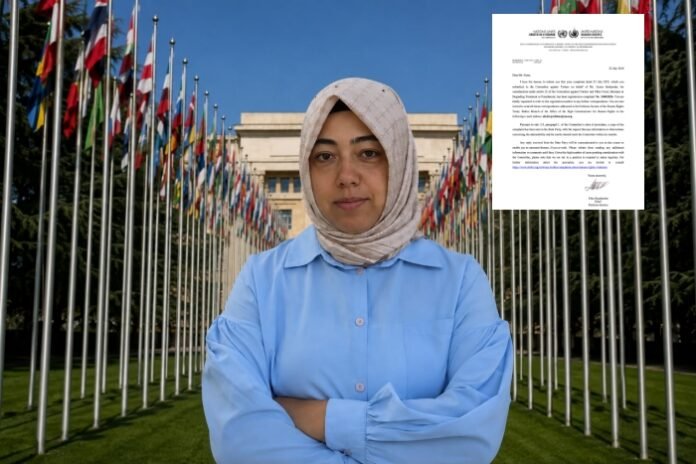
The UN Committee Against Torture has asked Turkey to respond within six months to a complaint by Aysun Işınkaralar, who says she was tortured in police custody after being detained over alleged links to the faith-based Gülen movement.
The TR724 news website reported that a complaint filed by Işınkaralar on July 23, 2023, was sent to the Turkish government, according to a July 22 letter from the UN human rights office.
The development comes after Turkish prosecutors dismissed Işınkaralar’s torture complaint in April 2024, despite a report by the Human Rights Foundation of Turkey (TİHV) supporting her allegations. An earlier complaint she filed shortly after her detention in 2018 had also resulted in a decision of non-prosecution.
Işınkaralar, the former director of a student dormitory allegedly affiliated with the Gülen movement, was detained in Afyonkarahisar in May 2018 and held in police custody for four days.
She was later sentenced to more than seven years in prison on terrorism-related charges stemming from her alleged links to the Gülen movement. She was released in December 2022 after spending 56 months in prison.
Turkish President Recep Tayyip Erdoğan has targeted the Gülen movement, a worldwide civic initiative inspired by the ideas of Muslim cleric Fethullah Gülen, who died in 2024, since corruption investigations in December 2013 implicated him as well as some members of his family and inner circle. He dismissed the probes as a Gülenist conspiracy and designated the movement as a terrorist organization in May 2016, intensifying a sweeping crackdown after a coup attempt in July of the same year that he accused Gülen of orchestrating. The movement denies involvement in the coup attempt or any terrorist activity.
Işınkaralar has said while she was in police custody, officers subjected her to electric shocks, strangulation, sexual harassment and a mock execution while interrogating her about other people allegedly linked to the movement. According to Işınkaralar, the abuse stopped after opposition lawmakers drew attention to allegations of torture in her case on social media.
Medical examinations conducted three days after her detention and later at Afyonkarahisar Prison documented injuries, including scars on both ankles. A subsequent report by the TİHV found Işınkaralar’s account credible and consistent with medical and psychological findings.
The Afyon Chief Public Prosecutor’s Office dismissed her complaint in April 2024, citing insufficient evidence and a report finding no signs of physical abuse by a doctor who Işınkaralar said had never examined her. She said the medical report documenting her injuries had not been included in the case file. Her application to the Constitutional Court was also unsuccessful.
According to figures announced by Justice Minister Akın Gürlek, authorities have initiated legal proceedings against 720,338 people over alleged Gülen links since 2016 and secured the conviction of 127,102. Investigations or trials involving another 83,404 people are ongoing, while 10,485 people accused or convicted of involvement in the coup attempt or membership in the movement are still in prison.
Torture and ill-treatment in police custody and prisons in Turkey have remained a persistent concern since the aftermath of the July 15, 2016, coup attempt. The widespread and systematic torture in Turkish detention centers was evidenced by the UN special rapporteur on torture and other cruel, inhuman, or degrading treatment or punishment in a report based on his mission to Turkey in November 2016. The Council of Europe’s Committee for the Prevention of Torture also reported that allegations of police ill-treatment remained at a worrying level following visits in 2017 and 2019, although Turkey has blocked publication of the committee’s report on its 2016 post-coup visit.