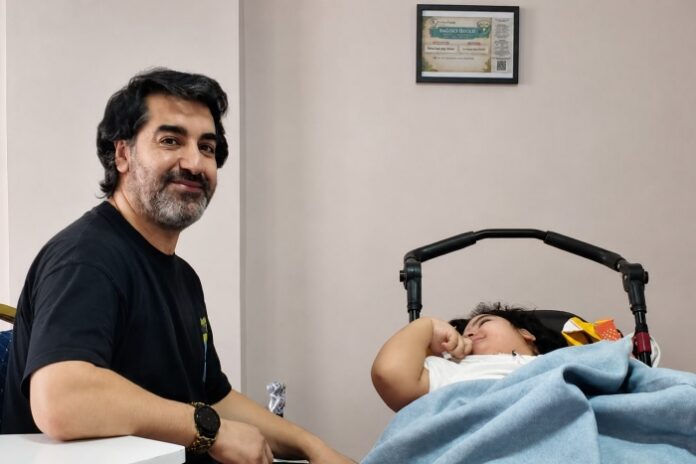
Former civil servants dismissed by emergency decrees following a 2016 coup attempt in Turkey have recounted how the government’s crackdown on the faith-based Gülen movement devastated their lives and those of their children, the TR724 news website reported.
Former police officer Mustafa Selçuk Gürbüz and former academic İbrahim Coşkun shared their experiences at a Father’s Day event, organized in Ankara by Vicdan Vakfı (Conscience Foundation), founded by Peoples’ Equality and Democracy Party (DEM Party) MP Ömer Faruk Gergerlioğlu.
Coşkun recounted the ordeal surrounding his daughter, Hümeyra Sinem, who was 4 when he was arrested in 2016 and later sentenced to more than eight years in prison. She was diagnosed with a neurological disease two years later.
He said his daughter gradually lost all bodily functions as her condition worsened but continued visiting him in prison, where authorities created difficulties for her during security searches.
Turkish President Recep Tayyip Erdoğan has targeted followers of the Gülen movement, inspired by the late Muslim cleric Fethullah Gülen, since corruption investigations in December 2013 implicated him as well as some members of his family and inner circle. He dismissed the probes as a Gülenist conspiracy and later designated the movement as a terrorist organization in May 2016, intensifying a sweeping crackdown after the coup attempt in July of the same year that he accused Gülen of orchestrating. The movement denies involvement in the coup attempt or any terrorist activity.
After becoming eligible for conditional release, Coşkun applied to be freed so he could care for his daughter. Despite what he described as good conduct in prison, the request was denied on the grounds that he was allegedly attempting to use her illness to secure release.
Under the Turkish Penal Code, inmates who have served three-fourths of their sentence are eligible for conditional release.
Coşkun served the entirety of his prison sentence. His daughter died in 2024, one year before his release.
He said he was taken to her funeral in handcuffs and later wrote in a petition to prosecutors and prison authorities, “Your hearts stopped before my daughter’s heart did.”
Coşkun said the petition led to disciplinary punishment and that he spent the final 14 months of his sentence in solitary confinement.
Gürbüz attended the event with his 16-year-old daughter, who is dependent on a ventilator and requires constant care. He said the family had previously employed a caregiver but the family took over her care after his dismissal.
To support his family following the dismissal, Gürbüz said he worked as a construction worker, cleaner, taxi driver and real estate broker.
Gürbüz said an investigation launched after his dismissal ended with decision of non-prosecution but that he was never reinstated. His appeals to the State of Emergency Procedures Investigation Commission (OHAL Commission), an appeals body set up to review measures taken under Turkey’s post-coup state of emergency, and the Council of State were rejected and his case has been pending before Turkey’s Constitutional Court for two years, he said.
His exemption from compulsory military service was revoked after his dismissal and he later received a call-up notice, a development he described as one of the most devastating consequences of his dismissal because of his daughter’s need for constant care.
Following the failed coup, the Turkish government declared a state of emergency (OHAL) that remained in effect until July 19, 2018. During this period, the government carried out a purge of state institutions under the pretext of an anti-coup fight by issuing a number of government decrees, known as KHKs. Over 130,000 public servants, including 4,156 judges and prosecutors, as well as more than 24,000 members of the armed forces were summarily removed from their jobs for alleged membership in or relationships with “terrorist organizations” by emergency decree-laws subject to neither judicial nor parliamentary scrutiny.
According to the latest figures from the justice ministry, more than 126,000 people have been convicted of alleged links to the movement since 2016, with 11,085 still in prison. Legal proceedings are ongoing for over 24,000 individuals, while another 58,000 remain under active investigation nearly a decade later.
In addition to the thousands who were jailed, scores of other Gülen movement followers had to flee Turkey to avoid the government crackdown.