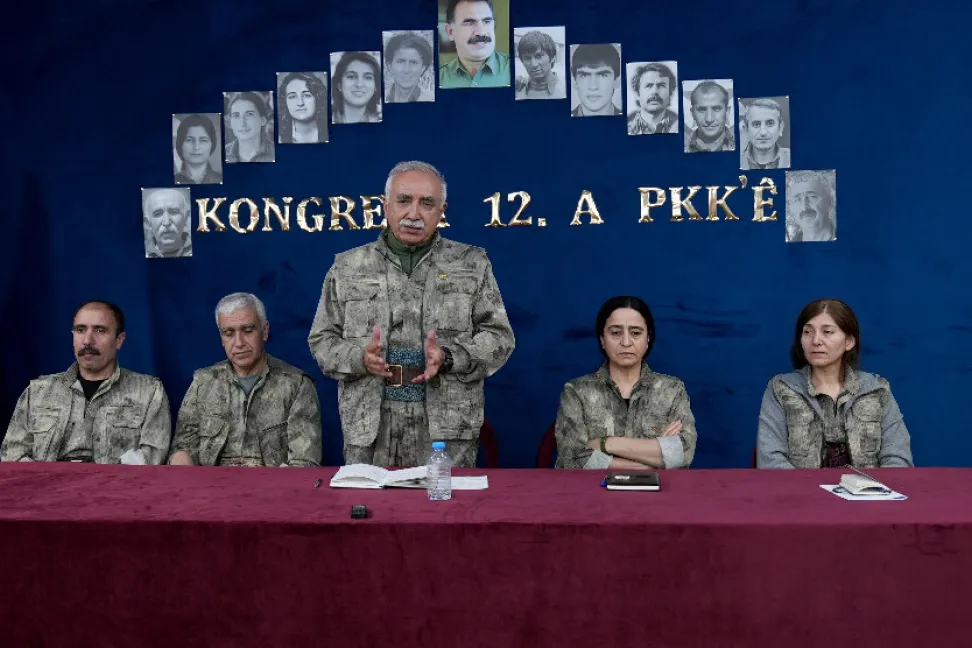
A senior figure in the outlawed Kurdistan Workers’ Party (PKK) has urged Ankara to adopt legal measures to protect Turkey’s new peace initiative, warning that a narrow law focused only on the group’s laying down of arms would deepen the deadlock rather than help resolve the Kurdish issue, Turkish Minute reported.
Murat Karayılan, one of the PKK’s leaders, told Kurdish television station Sterk TV that the Kurdish side had taken “radical decisions” in response to jailed PKK leader Abdullah Öcalan’s February 2025 call for the group to lay down arms and disband, but said the Turkish state had yet to respond with concrete legal guarantees.
The latest process gained momentum after Öcalan, who has been imprisoned on İmralı Island near İstanbul since 1999, called on the PKK in February 2025 to end its armed campaign.
The group announced in May 2025 that it had decided to dissolve itself and abandon armed conflict, a move that followed months of renewed contacts involving Öcalan, the pro-Kurdish Peoples’ Equality and Democracy Party (DEM Party) and Turkish officials.
Kurdish political actors have since pressed Ankara to pass laws that would protect militants who leave armed activity and provide guarantees for the political side of the process.
Their demands have included improved contact with Öcalan, legal protection for former militants, democratic reforms, constitutional recognition of Kurdish rights, education in Kurdish and changes to counterterrorism legislation, which they say has been used to prosecute Kurdish politicians, activists and elected officials.
Karayılan said the PKK had acted on Öcalan’s call by ending its armed conflict strategy and announcing its dissolution, while Ankara had failed to take the legal steps needed to build trust.
“We dissolved the PKK and stopped the armed conflict strategy. In other words, we ended the hostility,” Karayılan said. “We said, ‘We are opening a new page; we no longer want hostility but friendship.’”
His remarks come amid reports that a planned law linked to the process will focus mainly on verifying the PKK’s laying down of arms and managing the return of some members, while excluding any change in Öcalan’s prison conditions.
The reports have raised concern among Kurdish political actors that Ankara is preparing a limited technical arrangement rather than legal and political guarantees for the wider process.
Öcalan’s access to lawyers, family members and political delegations has long been a central demand for the Kurdish movement.
Kurdish actors argue that he must be able to communicate regularly with the PKK and political representatives if he is expected to oversee the implementation of his call to end the armed campaign.
Karayılan said no delegation other than state officials had seen Öcalan for 42 days and denied reports that he had approved the content of a planned framework law.
“If there had been an agreement, they would have opened the way, and the DEM Party delegation would have gone to İmralı the same day,” he said.
Karayılan said the proposed legislation would be a test of Ankara’s intentions.
“If the content of this framework law is not one-sided and is inclusive, this will be a historic opportunity for Turkey,” he said, adding that any law should treat the Kurdish issue as a century-old political and social problem and should include Kurds as equal and free citizens within a democratic republic.
The Kurdish issue refers to a long-running conflict over the political, cultural and language rights of Kurds in Turkey, as well as decades of armed conflict between the state and the PKK.
Kurds have sought recognition of their identity, greater local democracy, education and public services in Kurdish and an end to policies they describe as assimilationist or punitive.
Turkey has generally treated the issue mainly through a security lens, particularly because of the PKK’s armed campaign, which began in 1984.
A narrow arrangement that only classified PKK members according to their status while leaving Kurdish demands outside the process, Karayılan warned, would deepen the deadlock.
Karayılan also criticized the government’s description of the initiative as a “terrorism-free Turkey,” saying the Kurdish issue could not be reduced to terrorism.
He said the Turkish state also needed to change its approach if it expected the Kurdish movement to remain committed to dialogue and democratic politics.
Karayılan said the PKK remained committed to what he called a strategy of democratic politics but rejected claims from government circles that the group had entered the process because it had been militarily weakened.
The PKK, designated as a terrorist organization by Turkey and its Western allies, has waged an armed campaign against the Turkish state since 1984. The conflict has killed more than 40,000 people.
He said the group still had significant military capacity, including tunnel warfare experience, drones and fiber-optic FPV drones, as well as the ability to strike distant targets, including economic and oil infrastructure.
The decision not to use that capacity, he said, was a political choice made in line with Öcalan’s call, not a sign of weakness.
“If Öcalan had not made the call, we could have expanded the war further,” he said, adding that the group could respond more strongly than before if it faced attacks aimed at destroying it.
Karayılan stressed, however, that the decision to end the armed conflict strategy was final.
“Our strategy is democratic politics,” he said. “But if they come at us, we will defend ourselves.”
The process has been marked by disagreement over conditions for moving forward. Ankara says the PKK must take verifiable steps to end its armed activity before wider legal and political measures are taken.
Kurdish political actors say Öcalan’s call and the PKK’s decision to end its armed campaign should be followed by laws that would protect militants and allow members of the group to leave armed activity without fear of prosecution or attack.
In April Karayılan said the process had been “frozen,” citing the lack of contact with Öcalan and the absence of legal steps.
DEM Party officials have also accused the government of hesitating and delaying the process, while President Recep Tayyip Erdoğan has said it will continue and that Turkey has passed several critical thresholds.