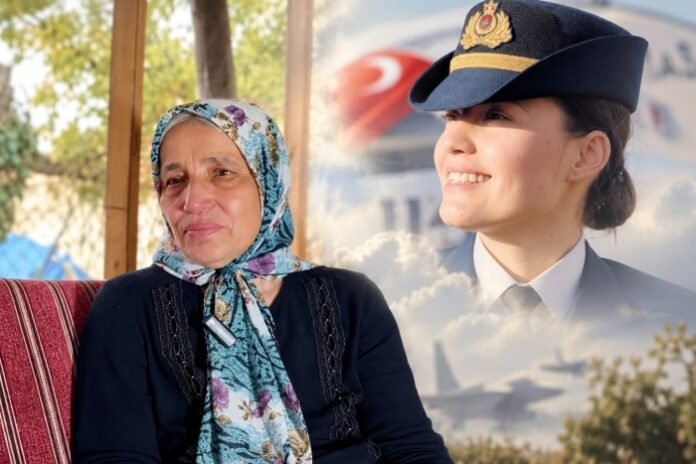
The mother of a former Turkish Air Force pilot serving an aggravated life sentence over the 2016 coup attempt has broken years of silence, saying her daughter was convicted for flights carried out under orders in an unarmed search-and-rescue helicopter during the attempted coup.
Atiye Yıldırım, the mother of former Turkish Air Force 1st Lt. Kerime Yıldırım, said in an interview on KHK TV, a YouTube channel that features the stories of people dismissed by emergency decrees, that her daughter had been unfairly portrayed as an F-16 pilot who bombed the Turkish parliament and has spent about five years in a single-person cell.
Yıldırım entered the Turkish Air Force Academy in 2004, graduated in 2008 and became the first woman in her class to qualify as a pilot. On July 15, 2016, she was serving as an instructor pilot overseeing cadets at a training camp in Yalova. She had returned home after the day’s activities when her superiors called her back to duty that evening, according to her mother.
According to her mother, Yıldırım made three flights that night. On her third flight, she was ordered to pick up four military pilots who she had been told were at risk of being attacked by a crowd in İstanbul’s Nakkaştepe neighborhood and take them to the Air Force Academy.
Her mother said Yıldırım was unaware a coup attempt was underway during the flights and learned about it the following morning. She then returned to her duty station and was instructed to report to her unit, where police later took her into custody.
The coup attempt killed 251 people and wounded more than 2,000. Many military personnel later testified that they had reported to their units after receiving warnings of a possible terrorist attack and were unaware they were being drawn into the coup attempt. President Recep Tayyip Erdoğan accused the faith-based Gülen movement of orchestrating the coup, an accusation the movement strongly denies. A decade later, key aspects of the coup, including its operational planning and chain of command, remain unresolved.
Her mother said she was unable to see Yıldırım for more than 10 days after she was taken into custody. When they finally met, she recalled her daughter saying, “I successfully carried out my duty. I have no regrets. I did not commit any crime.”
Yıldırım was subsequently jailed pending trial. In August 2018, the İstanbul 26th High Criminal Court convicted her of attempting to overthrow the constitutional order and sentenced her to aggravated life imprisonment. The Supreme Court of Appeals later upheld the conviction.
Prosecutors accused Yıldırım of transporting military personnel to several locations in İstanbul during the coup attempt. She acknowledged making the flights but maintained at trial that she had acted on orders and did not learn that a coup was underway until the following morning.
Her mother criticized the conduct of the trial, saying prosecutors cited phone calls allegedly made to her daughter from payphones as evidence against her. She said the family requested the underlying phone records but was not given access to them and that the records were not presented in court. She also said defense lawyers were repeatedly interrupted and prevented from fully presenting their arguments.
Prosecutors in post-coup investigations have alleged that members of the Gülen movement used payphones to contact their associates consecutively and have treated numbers called immediately before or after an alleged movement member as evidence of Gülen links. Thousands of people, particularly current and former military personnel, have been detained in such investigations based solely on payphone call records, without the actual content of the calls.
Her mother also disputed the way Yıldırım’s actions were portrayed by the Turkish media, saying she had been falsely described in news reports as an F-16 pilot who bombed the Turkish parliament and as having rescued people portrayed as coup participants. She said her daughter had never flown an F-16 and that the helicopter she flew that night was an unarmed search-and-rescue aircraft.
Yıldırım said the family had declined previous interview requests because they no longer trusted the media and had instead waited for the Supreme Court of Appeals and then the Constitutional Court to review her daughter’s conviction. After both avenues failed, she said, they decided there was no longer any reason to remain silent. The case is now pending before the European Court of Human Rights, according to her mother.
Kerime Yıldırım has spent about five years in a single-person cell and faces restrictions on phone calls, visits and access to prison activities, her mother said. The distance to the prison and the financial cost of travel mean the family generally sees her once a month during open visitation. Her retired father returned to work to help meet the financial burden, she said.
The repercussions also extended beyond prison. Yıldırım said she deliberately distanced herself from friends and acquaintances after the coup attempt because she feared they could face problems at work simply for remaining in contact with the family.
“I told them, ‘You can delete my number. You don’t have to call me.’” she said. “But I stood by my daughter then, and I will stand by her for as long as I live.”
Yıldırım called on authorities to distinguish between those who committed crimes during the coup attempt and military personnel she said were simply following orders.
“Soldiers operate under a chain of command. [During drills,] They cannot even drink water without orders,” she said. “There may have been people who committed crimes but separate the guilty from the innocent. Those who are guilty should serve their sentences. Let the innocent go.”
A total of 289 coup-related trials have been concluded, with 4,891 people convictions, according to Justice Ministry figures. Of those convicted, 1,634 received aggravated life sentences, 1,366 were sentenced to life in prison and 1,891 received sentences of varying lengths. The Supreme Court of Appeals upheld 236 of the 271 case files sent to it.