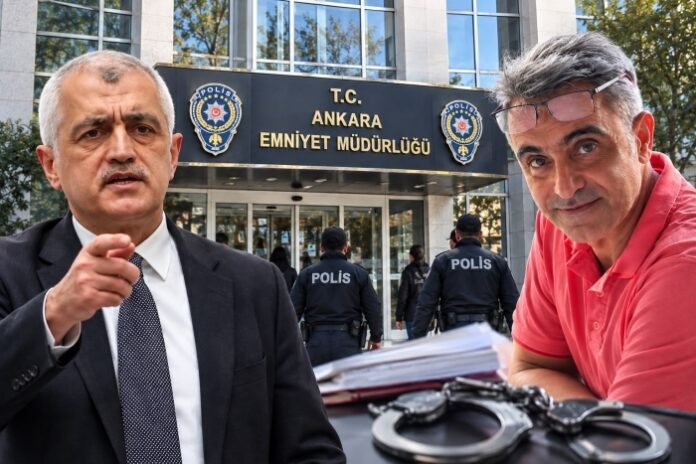
A former Turkish soldier who was missing for eight days resurfaced in police custody in Ankara, after his wife was jailed during his absence, prompting calls for an investigation into possible enforced disappearance or unlawful detention.
Bora Arslanoğlu, who had not been heard from since leaving his home on September 15, was located at the Ankara Police Department on Monday, according to Ömer Faruk Gergerlioğlu, a lawmaker from the Peoples’ Equality and Democracy Party (DEM Party) and a human rights defender.
In an X post on Tuesday, Gergerlioğlu said Arslanoğlu disappeared after telling his friends he would arrive at work in 15 minutes. His phone was switched off shortly afterward, and his family was unable to reach him.
Gergerlioğlu had said on Saturday that the Ankara Police Department confirmed Arslanoğlu was not in custody.
According to Gergerlioğlu, a lawyer retained by Arslanoğlu’s family visited him after he was found in custody. Arslanoğlu gave only brief answers, saying he did not want the lawyer hired by his family and that he had spent the previous eight days wandering in parks.
Arslanoğlu did not ask about his family during the meeting, Gergerlioğlu said, although his wife had been jailed after his disappearance and sent to Sincan Women’s Prison.
Gergerlioğlu questioned where Arslanoğlu had been during those eight days, whether police knew of his whereabouts and when, where and on what grounds he was taken into custody. He also asked why his family had not been informed and whether there was any connection between his disappearance and his wife’s imprisonment.
Gergerlioğlu called on the Ankara Police Department and Ankara Governor’s Office to provide “clear and satisfactory answers” and urged Interior Minister Mustafa Çiftçi to make a public statement. He said the circumstances should be investigated to determine whether Arslanoğlu had been subjected to enforced disappearance, unlawful detention or another rights violation.
Arslanoğlu was dismissed from the Turkish Armed Forces by an emergency decree and later prosecuted as part of Turkey’s post-coup crackdown but was ultimately acquitted.
Last month Gergerlioğlu documented 73 alleged abductions and disappearances in Turkey since 2015, many involving people dismissed by emergency decrees or accused of links to the Gülen movement. Some remain missing, while others later resurfaced in police custody and said they had been held at secret locations and tortured.
Turkish President Recep Tayyip Erdoğan has targeted the faith-based Gülen movement, inspired by Muslim cleric Fethullah Gülen, who died in 2024, since corruption investigations in December 2013 implicated Erdoğan as well as some members of his family and inner circle. He dismissed the probes as a Gülenist conspiracy and designated the movement as a terrorist organization in May 2016, intensifying a sweeping crackdown after the coup attempt in July of the same year that he accused Gülen of orchestrating. The movement denies involvement in the coup attempt or any terrorist activity.
Turkey’s National Intelligence Organization (MİT) has reportedly abducted more than 30 people since 2016, most of them accused of links to the Gülen movement. Many resurfaced in police custody after being missing for months.
The UN Human Rights Committee has also raised concerns about allegations of enforced disappearances involving people accused of links to the Gülen movement, while Human Rights Watch has repeatedly called on Turkish authorities to effectively investigate allegations of enforced disappearances and torture.