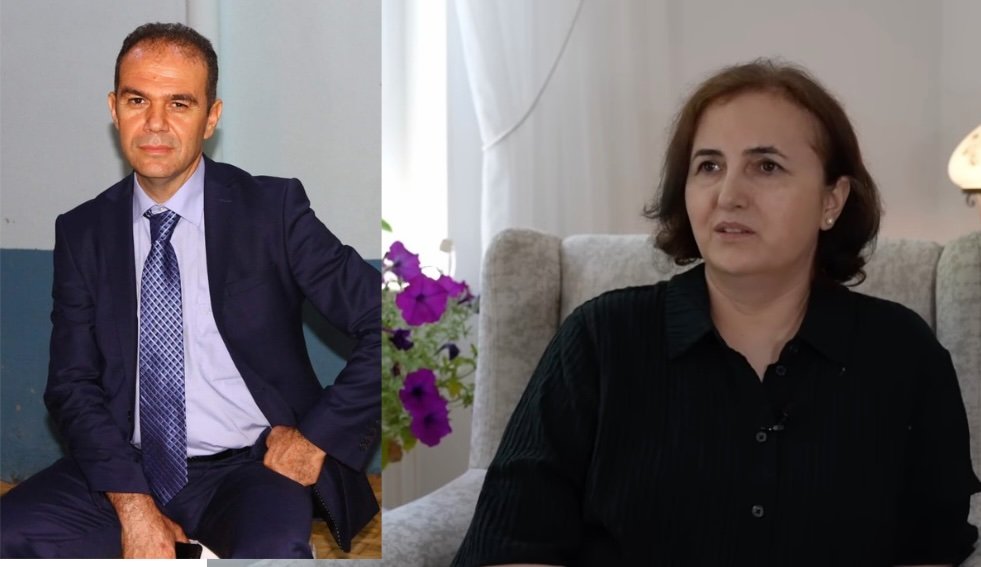
The wife of former police intelligence chief Zeki Güven, who died under suspicious circumstances in pretrial detention in 2018, said her husband was murdered in prison and that she was threatened for questioning his death.
Sevda Güven recounted the couple’s detention, what she described as politically motivated prosecutions and public defamation and the yearslong legal battle she fought after her husband’s death before eventually leaving Turkey with her children, in an interview with the TR724 news website.
Zeki Güven graduated at the top of his class from the Police Academy in 1992 and served in counterterrorism units before being assigned to Şırnak in 2012. Sevda Güven, whom he had met while she was studying at law school, later became a judge and moved there with him.
Following corruption investigations in 2013, Zeki Güven was suspended from duty in March 2014 and later dismissed from the police force despite obtaining a court order staying his suspension.
The December 17 and 25, 2013, corruption investigations implicated the sons of three cabinet ministers, then-prime minister and current president Recep Tayyip Erdoğan’s son Bilal and other members of his family and inner circle, prompting four ministers to resign. Erdoğan denounced the probes as an attempted coup against his government and accused the faith-based Gülen movement, inspired by the late Turkish cleric Fethullah Gülen, of orchestrating them, an allegation the movement denied. Prosecutors and judges were removed from the cases, more than 700 police chiefs and dozens of prosecutors were dismissed or reassigned and the investigations were closed.
In February 2015 Zeki Güven appeared before an Ankara court, which allowed him to stand trial without being held in detention. Prosecutors challenged the ruling, and an arrest warrant was issued after Erdoğan publicly criticized the decision, prompting Güven to go into hiding.
While her husband was attempting to evade apprehension, Sevda Güven was reassigned to the northern province of Ordu, and the couple continued to meet in secret. She was dismissed from her judicial post in August 2016 as part of purges that followed a coup attempt on July 15, 2016, with a warrant issued for her detention.
Erdoğan also accused the Gülen movement of orchestrating the coup attempt, a charge it denies. The Turkish government, which had designated the movement as a terrorist organization in May 2016, intensified a sweeping crackdown after the attempted coup. More than 130,000 public servants, including 4,156 judges and prosecutors, as well as over 24,000 members of the armed forces were summarily dismissed by emergency decree-laws subject to neither judicial nor parliamentary scrutiny, while hundreds of thousands of people were investigated or prosecuted over alleged links to the movement.
The couple remained in hiding until they were detained in Eskişehir on May 22, 2018. After a week in custody, Zeki Güven was arrested and sent to Sincan Prison in Ankara, while Sevda Güven was arrested and sent to Samsun Prison.
She said prison authorities made her detention more difficult because of her husband, obstructing her access to basic necessities from the prison canteen and medication, restricting her phone calls and refusing to process her petitions.
Sevda Güven said she last saw her husband at the police station shortly after their detention, when she passed a restroom and saw him performing wudu, the ritual washing Muslims perform before prayer. When she asked whether he was well, he smiled and replied, “I’m fine,” the last words they exchanged.
Zeki Güven died on July 1, 2018, 40 days after his detention. Authorities attributed his death to a heart attack, but his wife disputed that account and pursued legal action over the circumstances.
Prosecutors closed the case with a decision of non-prosecution, and Turkey’s Constitutional Court ruled in 2021 that authorities had not violated his rights. Sevda Güven subsequently took the case to the European Court of Human Rights, where it is pending.
Güven said the circumstances surrounding her husband’s death and the subsequent investigation were marked by irregularities. She cited witness statements saying two police officers removed him from his cell two days before he died, but investigators did not examine surveillance footage to determine where he was taken or when he was returned. She also said a letter from his brother was sent back on June 30 on the grounds that he was not at the prison, one day before his death.
Güven said she believed her husband had been targeted because of his role in exposing an unlawful surveillance network in the Ankara police intelligence branch in 1997 and 1998. She said the operation had earned him enemies within the branch and that an inspector prosecuted in that case later led the administrative investigation into him.
She said authorities later merged several surveillance-related investigations into a single case file, which linked her husband to the illegal wiretapping of Deniz Baykal in 2010, then-leader of the main opposition Republican People’s Party (CHP), even though he was not accused of carrying out that operation.
Güven said reporting by journalist Alican Uludağ that associated her husband with the Baykal wiretapping case, along with remarks by former police chief Hanefi Avcı describing Zeki Güven as “a key figure” who should be “thoroughly interrogated,” contributed to portraying him as someone who should be questioned in a way that would make him talk.
She said her husband was denied an adequate defense, put in solitary confinement and subjected to restrictions on his communication with the outside world, including being prevented from receiving letters.
Güven said the Ankara branch of the Council of Forensic Medicine was unable to determine the cause of her husband’s death and referred the case to the İstanbul branch. The prosecutor nevertheless closed the investigation with a decision of non-prosecution.
She was taken to her husband’s funeral in handcuffs after midnight, briefly held at a police station and later brought to the cemetery under gendarmerie escort and wasn’t allowed to leave the vehicle. Her son was left to handle the funeral arrangements, while her daughter was deeply distressed after seeing her father’s body.
Güven wrote to her lawyer after her husband’s death, explaining who she believed might have killed him and why. A few days later, she and her cellmates found a bullet in the middle of the prison yard, which she interpreted as an attempt to intimidate and silence her. Prison officials said it was a spent bullet that had fallen into the yard after being fired elsewhere, but no investigation was opened, she said.
Güven was released pending trial in October 2018 after six months in detention. She was later sentenced to more than six years in prison for membership in a terrorist organization over alleged links to the Gülen movement but remained free pending appeal. During that period, her father was detained and her brother was sentenced to prison. She said she eventually left Turkey because she feared being imprisoned if the Supreme Court of Appeals upheld her sentence and wanted to protect her children’s future.