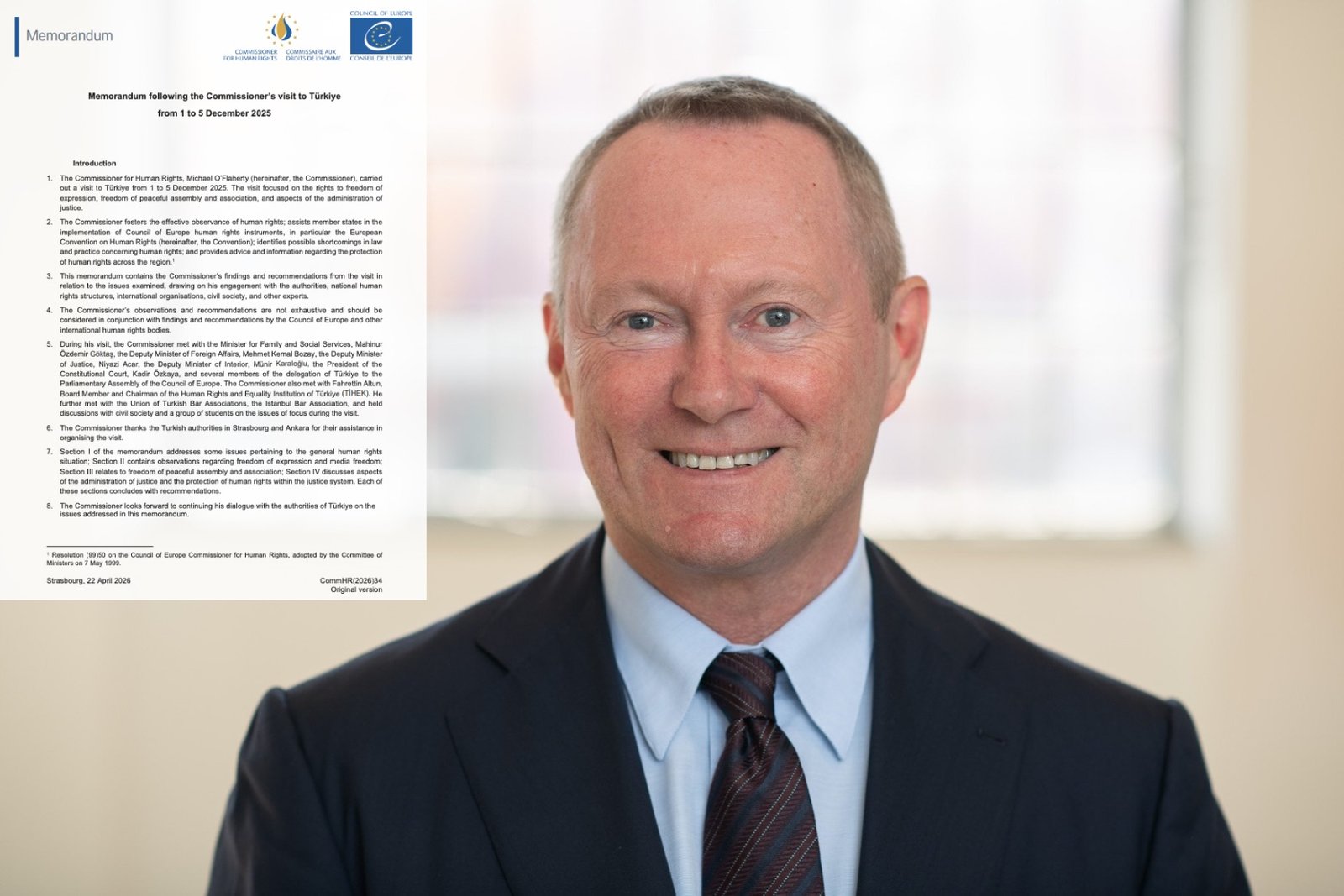
The Council of Europe’s Commissioner for Human Rights, Michael O’Flaherty, called on Turkey to safeguard freedom of expression and freedom of the press, restore judicial independence and repeal laws used to prosecute journalists and silence dissent, in a memorandum documenting restrictions he said were incompatible with democratic standards.
O’Flaherty said Turkish authorities misuse criminal and counterterrorism legislation to suppress free expression, pressure journalists and target civil society organizations, while also restricting peaceful demonstrations through excessive use of police force and broad protest bans. He also raised concerns about the judiciary’s lack of independence from the executive branch.
The memorandum, dated April 22 and made public on Tuesday, followed his visit to Turkey December 1-5, 2025.
The commissioner said a range of provisions in the Turkish Penal Code (TCK) and the Counterterrorism Law have been used by domestic courts to unduly restrict freedom of expression through accusations including insulting the president and spreading terrorist propaganda.
O’Flaherty said 29 journalists were in pretrial detention at the time the memorandum was prepared and said journalists in Turkey continue to face detention and prolonged pretrial imprisonment. He criticized what he described as arbitrary pressure by the Radio and Television Supreme Council (RTÜK), Turkey’s broadcasting and streaming regulating authority, on independent media outlets as well as blanket bans targeting websites and social media platforms.
The memorandum also recalled restrictions on freedom of assembly and association, pointing to the excessive use of police force during protests that erupted after the detention of İstanbul Mayor Ekrem İmamoğlu in March 2025 and repeated bans on demonstrations on broad grounds such as “public order” and “morality.”
İmamoğlu, a leading figure in Turkey’s main opposition and widely seen as President Recep Tayyip Erdoğan’s strongest political rival, was detained on March 19 and arrested days later on corruption charges. Critics and international observers say the case is politically motivated, aimed at sidelining a major challenger ahead of the 2028 general election.
According to the commissioner, such restrictions disproportionately affect LGBTI+ groups, women’s rights advocates and environmental activists. He added that civil society organizations are increasingly subjected to judicial harassment, including closure cases and disproportionate administrative audits.
O’Flaherty expressed serious concern over the state of Turkey’s judiciary, particularly the lack of independence of the Council of Judges and Prosecutors (HSK), which he said remains under significant executive influence. He said indictments are frequently of poor quality, often lacking sound legal analysis and treating lawful activities as evidence of criminal intent. He also voiced concern that lower courts refuse to implement legally binding judgments of Turkey’s Constitutional Court.
According to the commissioner, Turkey’s 2021 withdrawal from the Council of Europe Convention on Preventing and Combating Violence against Women and domestic Violence, widely known as the Istanbul Convention, had created a “gap in protection” for women facing violence.
Turkey was the first country to ratify the convention but withdrew by presidential decree on March 21, 2021, a move that sparked criticism from rights organizations, which warned that it weakened protections and accountability mechanisms for victims of domestic violence.
The commissioner also pointed out that the Human Rights and Equality Institution of Turkey (TİHEK) is only partially compliant with the UN Paris Principles, citing its lack of independence from the executive and failure to engage constructively with civil society.
Among his recommendations, O’Flaherty called on Turkey to rejoin the Istanbul Convention, reform TİHEK to ensure full independence, repeal Article 299 of the TCK criminalizing insults to the president and amend counterterrorism legislation in line with European standards.
He also urged authorities to revise internet and broadcasting laws and establish judicial oversight, protect journalists and human rights defenders from reprisal and ensure that pretrial detention is used only as a last resort.
The commissioner further recommended reforms to ensure that the HSK operates independently from political influence, improve the quality of judicial decisions and fully implement judgments of both Turkey’s Constitutional Court and the European Court of Human Rights without delay.