
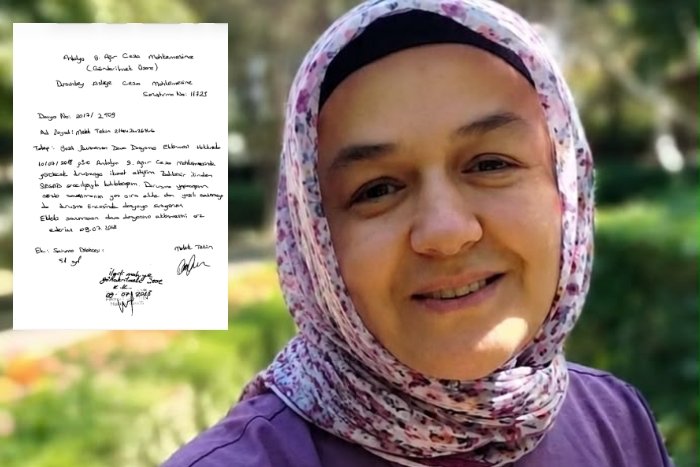
A 51-page court statement submitted by a Turkish woman imprisoned on a conviction of alleged links to the faith-based Gülen movement came to light Thursday, detailing allegations that police threatened her with a gun, struck her, removed her headscarf and subjected her to prolonged physical and psychological abuse in custody, the TR724 news website reported.
Melek Tekin submitted the statement to the Antalya 9th High Criminal Court on July 9, 2018, but its full contents were published only now, more than seven years later and nearly six months after Turkey’s top appeals court upheld her six-year, three-month prison sentence. A November 2025 report had briefly disclosed some of her claims, but the newly published document provides a substantially fuller account of her five days in police custody.
Tekin, a mother of two, said she was detained on December 10, 2016, in Dursunbey, a district in the western Turkish province of Balikesir, and taken to the southern district of Finike. She alleged that a female police officer punched her in the chest in front of her relatives as she was put in a taxi for the journey.
At the Finike police station, Tekin said she was handcuffed to a chair for nearly 24 hours. She alleged that the district police chief showed her a gun and told her that if she wanted to walk out of the building, she would have to accept what officers said and disclose what she knew.
Tekin said officers removed her headscarf, forced her to stand on one leg and repeatedly threatened her. She also alleged that police prevented her from seeing her 3-and-a-half-year-old son, who had allergic asthma, and threatened to place him in state care because her husband was imprisoned and relatives might be unable to look after him.
She said officers questioned her about teaching the Quran, denied her access to her lawyer and pressured her to accept statements made by other suspects. The treatment caused lasting psychological harm, she said.
Tekin said the pressure left her so psychologically vulnerable that she would have obeyed if officers had ordered her to jump from the building. She said the threats involving her son caused her the greatest distress.
Turkish President Recep Tayyip Erdoğan has targeted followers of the Gülen movement, inspired by the late Muslim cleric Fethullah Gülen, since corruption investigations in December 2013 implicated him as well as some members of his family and inner circle. He dismissed the probes as a Gülenist conspiracy and designated the movement as a terrorist organization in May 2016, intensifying a sweeping crackdown after a coup attempt in July of the same year that he accused Gülen of orchestrating. The movement denies involvement in the coup attempt or any terrorist activity.
Tekin was prosecuted over allegations that included using ByLock, an encrypted messaging application Turkish authorities associated with the Gülen movement; activity in an account at Bank Asya, a lender authorities considered part of the movement’s financial network; and participation in religious discussions, charity bazaars and other events. Her membership in an association later closed by emergency decree and employment at institutions linked by authorities to the movement were also cited.
Turkish authorities have considered ByLock to be a secret tool of communication among supporters of the Gülen movement since a coup attempt on July 15, 2016, despite a lack of evidence that ByLock messages were related to the abortive putsch.
Although the European Court of Human Rights (ECtHR) has in many cases made clear that use of the ByLock messaging app does not constitute a criminal offense, detentions and arrests of individuals continue in Turkey for their alleged use of the ByLock application.
Tekin denied using ByLock or belonging to a terrorist organization. She said her Bank Asya account had been opened to receive her salary and that the charitable association she joined operated legally, including holding events with permission from local authorities.
She also alleged that police copied names, meeting locations and other details from another suspect’s statement and forced her to accept them as her own account.
The Antalya court initially sentenced Tekin to eight years, nine months in prison. The Supreme Court of Appeals overturned that judgment on March 19, 2024, citing restrictions on her right to present a defense, the failure to hear witnesses directly in court and the severity of the sentence.
Tekin received a sentence of six years, three months at her retrial and was remanded in custody on September 12, 2025, while the case was still under appeal. She was transferred to Ödemiş Prison in the western province of İzmir in February 2026, and the Supreme Court of Appeals upheld her conviction on February 2.