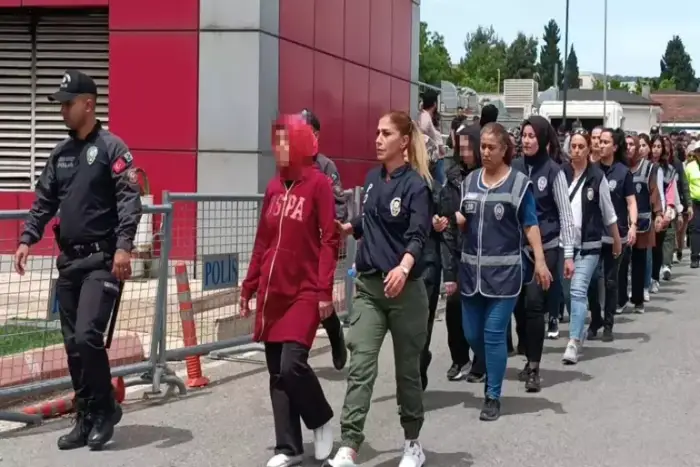
A secret witness in an investigation targeting alleged members of the faith-based Gülen movement told Turkish prosecutors that he planted a listening device in a student apartment without court authorization, according to the TR724 news website, raising questions about the evidence used in a nationwide crackdown that led to the detention of 208 people, most of them university students.
The investigation, launched on accusations of membership in a terrorist organization under Article 314 of the Turkish Penal Code, led to coordinated raids across 47 provinces on May 6, 2025. Seventy-seven of the detainees were later jailed pending trial, while others were released under judicial supervision.
According to a witness statement included in the investigation file and cited by Bold Medya, the secret witness said he placed the device inside the apartment in mid-2024 and kept it there for months, first beneath a carpet and later near a shoe cabinet and exercise equipment. The recordings were later transferred to a flash drive and handed to authorities.
The witness statement indicated that some of the recorded conversations involved plans to send students abroad to countries including Bosnia, Albania and Georgia. Prosecutors cited those discussions as evidence of what they described as an effort to rebuild the Gülen movement.
Turkish President Recep Tayyip Erdoğan has targeted followers of the Gülen movement, inspired by the late Muslim cleric Fethullah Gülen, since corruption investigations in December 2013 implicated him as well as some members of his family and inner circle. He dismissed the probes as a Gülenist conspiracy and later designated the movement a terrorist organization in May 2016, intensifying a sweeping crackdown after a coup attempt in July of the same year that he accused Gülen of orchestrating. The movement denies involvement in the coup attempt or any terrorist activity.
Most detainees faced accusations under Article 314 of the Turkish Penal Code, which punishes membership in an armed terrorist organization.
The detainees were questioned over travel for tourism or study, including Erasmus student exchanges, over shared rental payments among roommates, over the use of secure messaging apps such as Signal and over family ties to people who had been fired or convicted after 2016 coup attempt.
Turkey experienced a controversial military coup attempt on the night of July 15, 2016 which, according to many, was a false flag operation aimed at entrenching the authoritarian rule of President Recep Tayyip Erdoğan by rooting out dissidents and eliminating powerful actors such as the military in his desire for absolute power.
During the first phase of detention, many suspects were denied access to lawyers for 24 hours. Families did not know where their relatives were held or received misleading information. Lawyers were pushed out of police stations or prevented from seeing clients. Some defense lawyers were pressured to sign pre-written notes, while detainees were asked to sign statements without legal representation.
Several students alleged that officers used coercive questioning tactics during custody, repeatedly asking about foreign travel, encrypted messaging applications and possible links to Gülen-affiliated networks.
One female detainee said officers attempted to pressure students into making incriminating statements during informal interrogations conducted before formal questioning began.
“You are a terrorist,” a student recalled an officer telling her. “That’s how the state sees you.”
Another student said men identifying themselves as intelligence officers questioned a female detainee in a small room and claimed authorities possessed photographs showing she had received money from unknown sources abroad.
The student said the detainee later returned to her holding cell visibly shaken.
Former detainees also described repeated questioning outside formal interrogation settings, including during fingerprinting and medical procedures shortly before court hearings.
After several days in custody, some detainees were released under judicial supervision, while 77 were jailed pending trial.
After leaving custody, several female students gathered inside a prayer room at a shopping mall while trying to contact relatives and arrange transportation back to their cities.
“We hugged each other and cried,” one former detainee said.