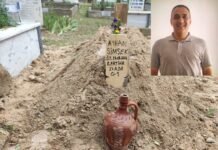

Süleyman Yıldırım, a 59-year-old lawyer who lost his leg after what his relatives described as months of delayed medical care in prison and was later diagnosed with stage 3 lung cancer, died Monday morning at İzmir City Hospital, Turkish Minute reported, citing the TR724 news website.
Yıldırım was taken into custody on July 27 to serve a six-year, three-month sentence on terrorism-related charges due to his links to the faith-based Gülen movement.
President Recep Tayyip Erdoğan has been targeting followers of the Gülen movement, inspired by the late Muslim cleric Fethullah Gülen, since corruption investigations in December 2013 implicated him as well as some members of his family and inner circle.
Dismissing the investigations as a Gülenist coup and a conspiracy against his government, Erdoğan began to target the movement’s members. He designated the movement as a terrorist organization in May 2016 and intensified the crackdown on it following an abortive putsch in July of the same year that he accused Gülen of masterminding. The movement strongly denies involvement in the coup attempt or any terrorist activity.
Yıldırım had previously spent 10 months in pretrial detention following the launch of the post-coup crackdown in 2016. Relatives and lawyers said his health deteriorated rapidly in Denizli T-type Prison in western Turkey, where they allege he went nearly two months without proper medical treatment.
He was admitted to intensive care on September 6 after suffering cardiac complications and later underwent heart surgery.
Doctors amputated his left leg below the knee in October due to circulation problems. Despite medical reports stating he was unable to remain in prison or travel for checkups, authorities initially denied requests to suspend his sentence.
The Council of Forensic Medicine in İstanbul also summoned him in person for evaluation, a decision his lawyers said put him at further risk. Despite being in intensive care and unable to travel to İstanbul due to his life-threatening condition, Yıldırım was not granted a suspension of his sentence at the time.
Following his release from prison in late October only after his condition became life-threatening, Yıldırım was intubated on December 1. His weight had dropped to around 40 kilograms, and his family said he received inadequate care both in prison and after his release.
“His right to life and to medical treatment were violated,” a relative told TR724, describing him as a respected lawyer who “paid with his life for the lack of proper care.”
International bar associations and human rights groups, including the German Bar Association, had previously raised concerns about his treatment and urged Ankara to free him on humanitarian grounds.
A graduate of Dokuz Eylül University’s law faculty in the western province of İzmir, Yıldırım practiced law in Denizli for nearly three decades. He was convicted on accusations that included using the ByLock messaging app, depositing money in Bank Asya and sending his children to schools later closed by emergency decree, activities Turkey has treated as evidence of affiliation with the Gülen movement since the coup attempt.
He is survived by his wife and five children. Yıldırım will be buried in Denizli.
Yıldırım’s health crisis came as rights groups highlight the death of other ailing prisoners with alleged Gülen ties, according to the Stockholm Center for Freedom. In August and September, at least three men — Hüseyin Parlak, 70, who died of a brain hemorrhage during a heatwave; İbrahim Güngör, 72, an Alzheimer’s patient who succumbed to pneumonia; and Asaleddin Çelik, 52, who died of lung cancer shortly after a delayed release — all passed away in custody or shortly afterward.
According to Law No. 5275, the sentence of a prisoner who, due to a serious illness or disability, is unable to manage life on their own under prison conditions and who is not considered a serious or concrete danger to society, may be suspended until they recover. However, the stipulated suspension of the sentence is often not implemented.
The Human Rights Association (İHD) says more than 1,400 sick prisoners are currently held in Turkey, including hundreds in critical condition. Complaints include delays in transferring inmates to hospitals, inadequate treatment in prison infirmaries and forensic reports that allow seriously ill detainees to remain incarcerated.
Turkey recorded 709 deaths in prison in the first 11 months of 2024, according to data from the Ministry of Justice shared in response to a parliamentary inquiry.