Turkey’s Constitutional Court has ruled that two ministries, the Ministry of Labor and Social Security, the Ministry of Industry and Trade, as well as local authorities in Ankara failed in their duty to protect workers’ lives in connection with industrial explosions that killed 20 people in 2011.
According to the T24 news website, the court found that the state had violated its obligation to protect life in an individual application filed by Nihat Günerkaya, a family member of one of the victims. It ordered the Ankara 7th Administrative Court to re-examine the case in light of that finding and awarded 30,000 Turkish lira (about $630) in non-pecuniary damages.
The ruling, published in the Official Gazette, comes 15 years after the disaster and highlights the state’s responsibility to enforce workplace safety regulations, following a long legal process in which victims’ families challenged earlier proceedings.
The court did not say public institutions directly caused the explosions but found that authorities failed to meet their obligation to safeguard life through effective inspection and oversight.
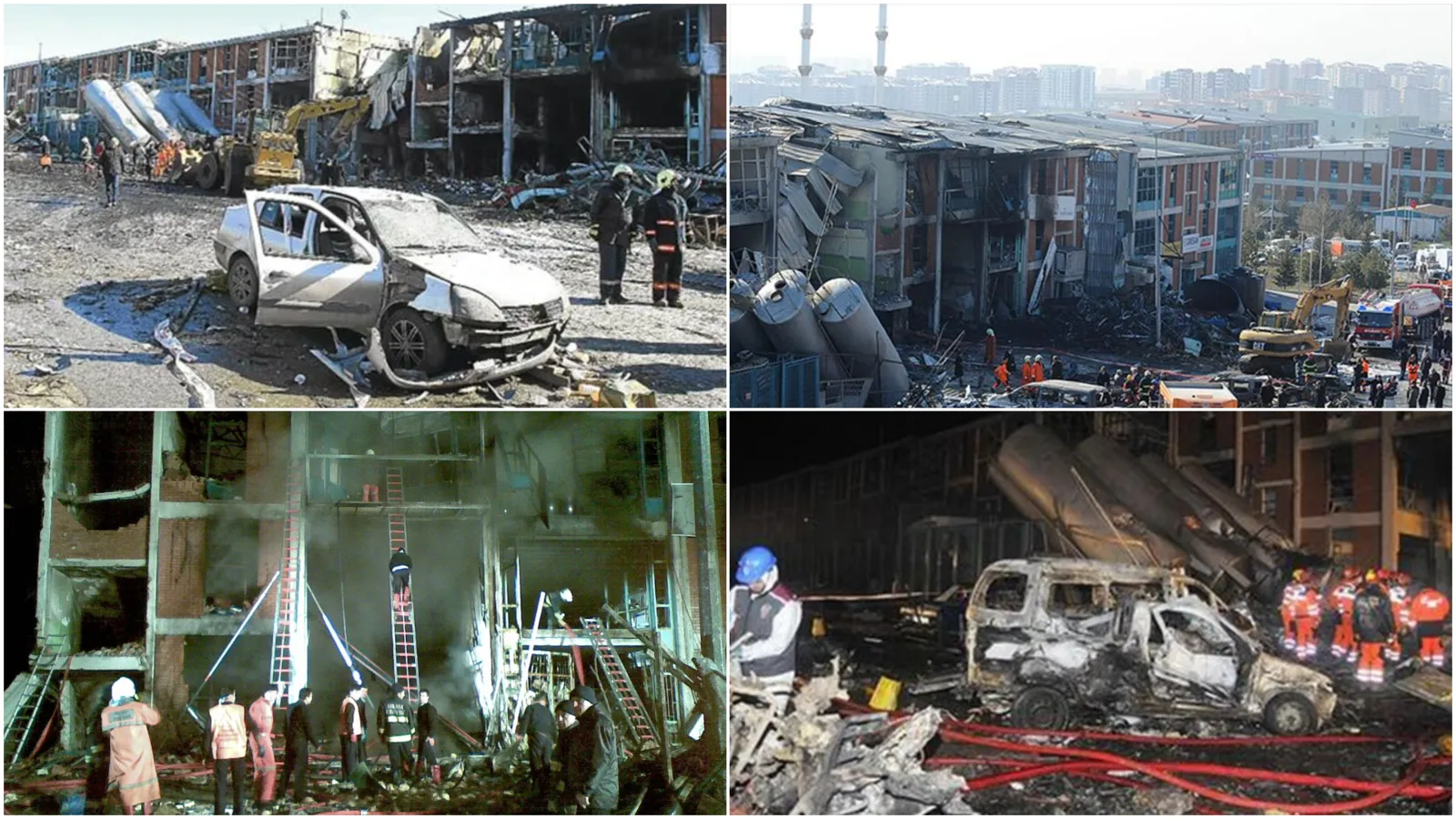
The case stems from a series of explosions and fires on February 3, 2011, in the Ostim Organized Industrial Zone and the İvedik Organized Industrial Zone — major manufacturing areas in Ankara — where blasts at industrial facilities, reportedly involving gas cylinders or other pressurized equipment, triggered fires and building collapses that killed 20 workers.
Expert reports and findings cited in earlier proceedings pointed to alleged shortcomings by several institutions.
The labor ministry was criticized for failing to carry out inspections between 2007 and 2011 and for not ensuring worker safety training or compliance with regulations governing hazardous work.
The industry ministry, as structured at the time, was cited for deficiencies in monitoring inspection and certification of pressurized industrial equipment.
Local authorities were also implicated. The Ankara Metropolitan Municipality was accused of failing to adequately supervise a company supplying oxygen cylinders linked to the blasts.
The Yenimahalle Municipality, a district municipality in Ankara, was cited for not enforcing closure orders against workplaces allegedly operating without proper permits.
The administrations of the Ostim and İvedik industrial zones, which manage the industrial parks and are responsible for coordinating infrastructure and safety oversight across workplaces, were also said to have failed to ensure compliance with safety standards.
The Birleşik Metal-İş metalworkers union said the ruling showed that workplace deaths are preventable and linked to negligence rather than unavoidable accidents.
“The protection of workers’ lives is not only the responsibility of employers but also a fundamental duty of the state,” the union said.
The Health and Safety Labour Watch Turkey (İSİG) documented 2,105 work-related deaths in 2025, the highest annual total in at least a decade, indicating that workplace safety in Turkey is worsening rather than improving.
Workplace accidents remain a chronic problem in Turkey, where lax enforcement of occupational health and safety standards continues to cost lives.
Turkey made progress in aligning its occupational health and safety legislation with European Union standards after it became an EU candidate country in 1999 and also ratified the relevant International Labour Organization conventions in 2005. However, implementation and enforcement of these standards have been far less effective. In recent years an influx of migrants and growing economic instability have further undermined workplace safety, as investments in safety measures declined and informal employment increased.
Turkey’s poor record on labor rights has also been highlighted internationally. A yearly report produced by the International Trade Union Confederation (ITUC) on labor rights revealed that Turkey is one of the 10 worst countries in the world for workers in industrial sectors. According to the Brussels-based ITUC, workers’ freedoms and rights have been further denied since police crackdowns on protests in Turkey in 2025, while strikes and attempts to unionize were prevented by the authorities.