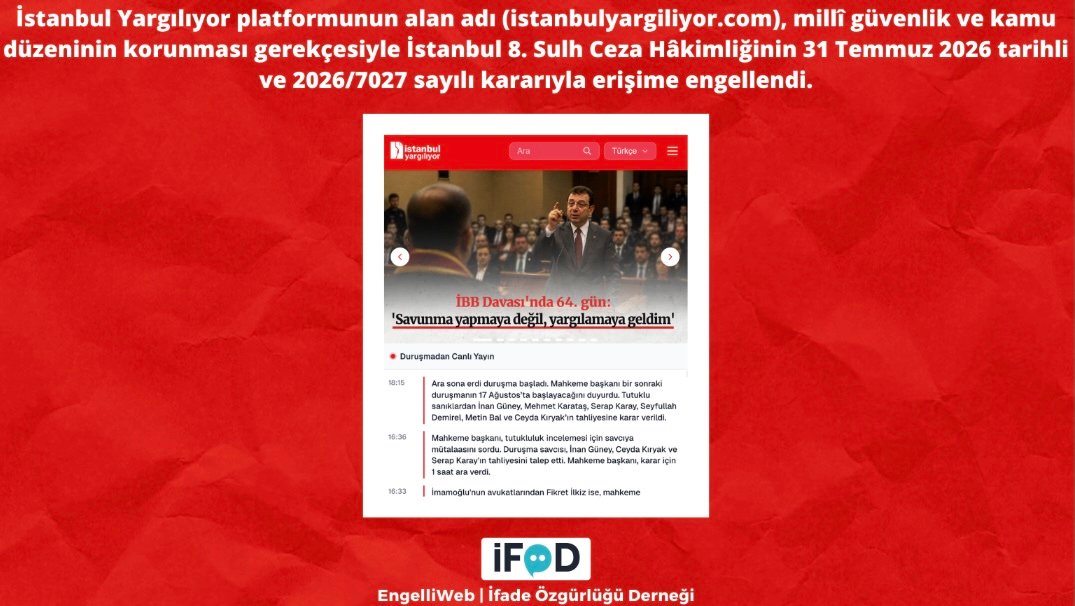
A Turkish court on Friday blocked access to a website reporting defense arguments and courtroom developments in the trial of jailed İstanbul Mayor Ekrem İmamoğlu, citing national security and public order concerns, the Freedom of Expression Association (İFÖD) reported.
The İstanbul 8th Criminal Magistrate of Peace blocked access to the “İstanbul Yargılıyor” (İstanbul Prosecutes) domain name. The platform publishes defendants’ testimony, defense submissions and updates from hearings in the İstanbul Metropolitan Municipality case.
İmamoğlu, widely seen as President Recep Tayyip Erdoğan’s strongest political rival, was arrested in March 2025 on corruption charges that critics say are politically motivated and intended to sideline him ahead of the 2028 presidential election.
He is standing trial with more than 400 defendants on charges including establishing a criminal organization, bribery, bid rigging, fraud and money laundering. İmamoğlu denies the charges.
The platform’s Instagram account had already been blocked by a court on April 10 and was subsequently withheld in Turkey by Instagram.
Authorities had also blocked the website and X account of “İstanbul İddianamesi” (İstanbul Indictment), another platform publishing documents concerning the prosecution. Its domain was blocked in November 2025 on the same national security and public order grounds, and X subsequently withheld its account in Turkey.
The investigations into the İstanbul Metropolitan Municipality are widely seen by critics as part of growing pressure on the main opposition Republican People’s Party (CHP).
Council of Europe Commissioner for Human Rights Michael O’Flaherty said in July that the proceedings raised “grave issues” concerning the right to a fair trial, including the equality of arms between the prosecution and defense.
International human rights groups have also criticized restrictions on access to the trial for lawyers, journalists and members of the public, saying they undermine the principle of open justice.
More broadly, rights advocates have raised concerns about Turkish courts’ frequent use of broadly worded national security and public order grounds to restrict news outlets, journalists and opposition figures, saying sweeping bans violate freedom of expression and the public’s right to access information.
Online censorship in the country has expanded sharply in recent years. According to İFÖD’s EngelliWeb, authorities blocked more than 232,000 websites and domain names in 2025, bringing the total number restricted since 2018 to more than 1.5 million.