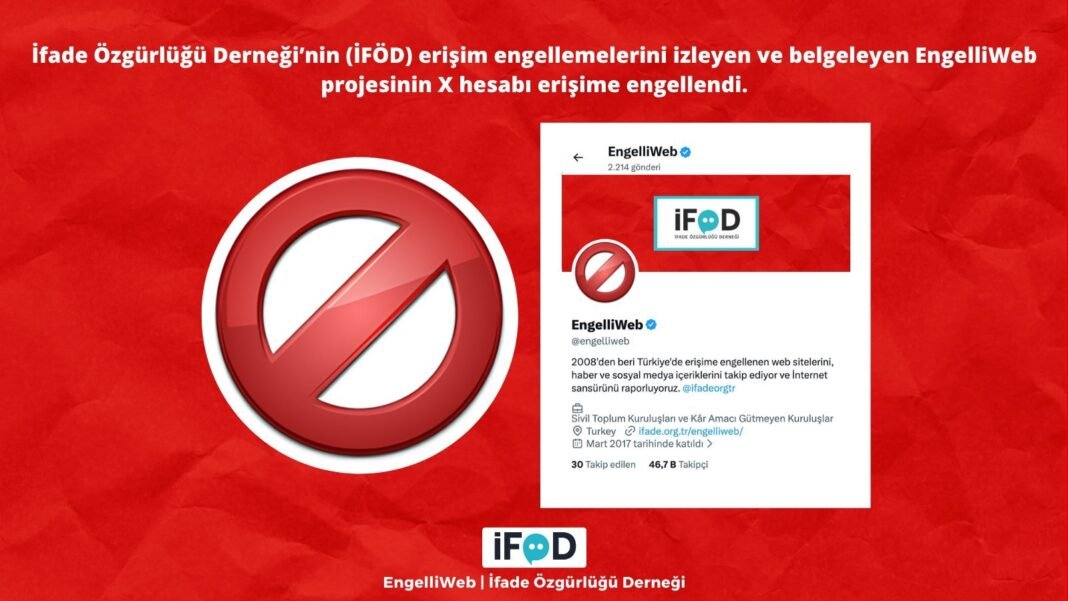
Turkish authorities have ordered access blocked to the X account of EngelliWeb, a project that tracks and documents online censorship in Turkey, as restrictions on journalists, rights groups, academics and financial commentators continue to expand.
The Freedom of Expression Association (İFÖD), which runs EngelliWeb, announced the decision Thursday.
The account had not yet been withheld from users in Turkey by X at the time of the announcement. İFÖD said the court that issued the order and its legal basis had not yet been disclosed.
The move means that an account devoted to documenting Turkey’s access-blocking decisions has itself become the target of one.
Founded in 2017, İFÖD works on freedom of expression and digital rights in Turkey. Its EngelliWeb project tracks court and administrative orders blocking websites, news reports, social media accounts and other online content, maintaining a public archive of internet censorship.
İFÖD says EngelliWeb helps fill a gap left by the lack of comprehensive official data and publishes annual reports on website blocks, content-removal orders and social media restrictions.
The decision against EngelliWeb comes a week after Turkey blocked the X account of İFÖD co-founder Yaman Akdeniz, one of the country’s best-known experts on internet law and digital rights.
Akdeniz’s account was blocked under Article 8/A of Turkey’s internet law on grounds of protecting national security and public order and was subsequently withheld by X in Turkey.
The latest decision also comes amid a sharp rise in account-level censorship in recent weeks.
On Monday Turkish authorities ordered access blocked to at least 150 X accounts, including those of BirGün reporters Meral Danyıldız and Sarya Toprak, ANKA news agency court reporter Esra Tokat, the Bizim TV news outlet and several lawyers.
EngelliWeb said many of the accounts had posted about Turkey’s recent investment fund crisis, the 2024 murder of 8-year-old Narin Güran, which drew nationwide attention and scrutiny of the investigation, or the Furkan movement, an Islamist religious group whose members have faced repeated police operations and prosecutions.
The fund crisis erupted in September after a number of investment funds were unable to meet redemption requests amid sharp declines in heavily concentrated stocks.
Turkey’s Capital Markets Board subsequently ordered the liquidation of 131 funds managed by seven firms, affecting 455,758 investors and assets valued at around $18 billion. Prosecutors have since opened market-manipulation investigations and detained dozens of suspects.
EngelliWeb said Wednesday that at least 147 additional X accounts belonging to people who had posted about the fund crisis had been blocked. The accounts had a combined following of about 2.65 million, with five exceeding 100,000 followers, 17 exceeding 50,000 and 36 exceeding 10,000.
Those targeted included economists, academics, financial analysts, traders, investors and lawyers.
Earlier restrictions had also targeted economists, academics and journalists discussing the crisis. Journalist Ali Tarakçı’s entire X account was blocked after he was jailed under Turkey’s controversial disinformation law over a post claiming that a senior minister was preparing to resign.
The restrictions initially intensified during a September crackdown on LGBTQ organizations and activists. Courts ordered social media accounts belonging to Amnesty International Turkey, the Media and Law Studies Association, journalists and rights groups blocked before the bans spread to a wider range of journalists, academics and financial commentators.
The censorship drive escalated further this week when an İstanbul court shut down the T24 independent news website and its social media accounts after prosecutors cited 118 items published over the previous year that they characterized as “LGBT propaganda.”
The order against T24 included an X account with about 1.9 million followers, a YouTube channel with some 268,000 subscribers and an Instagram account followed by approximately 238,000 people. The decision was issued as part of an investigation known as “My Family Is Safe” and cited Article 8/A of Turkey’s internet law.
İFÖD has repeatedly criticized the use of Article 8/A of Law No. 5651 to block entire social media accounts rather than individual posts, arguing that such measures remove large amounts of lawful content along with the material cited in court orders.
The blocking of EngelliWeb adds another layer to that pattern: The project that has spent years documenting Turkey’s expanding system of online censorship has now itself been targeted by an access ban.
The move comes against an already restrictive digital environment.
Freedom House rates Turkey’s internet as “Not Free,” with a score of 31 out of 100 in its 2025 Freedom on the Net report. Among the European countries assessed, Turkey had the lowest score, behind Serbia at 67 and Hungary at 69.
This article is republished from Turkish Minute.