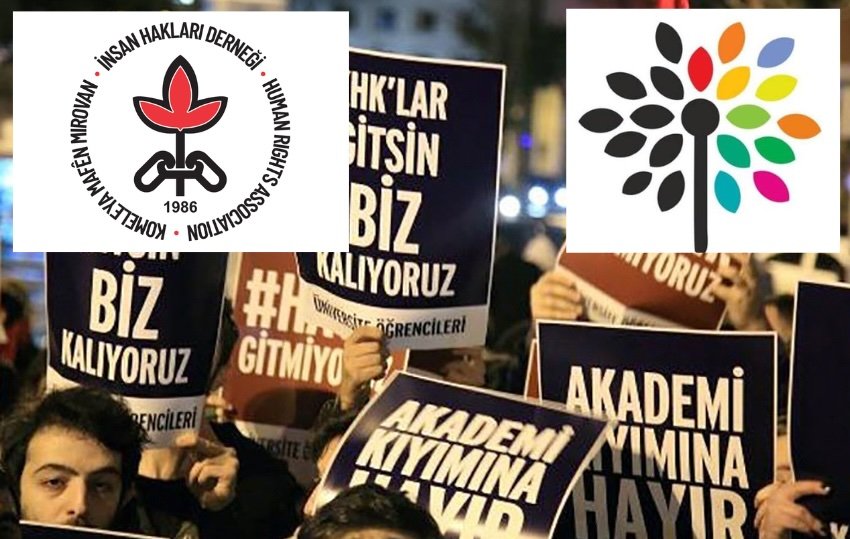
Human rights groups have called on Turkish authorities to remedy continuing rights violations caused by emergency decrees issued after a 2016 coup attempt, saying their consequences for dismissed public servants and their families persist a decade later.
The Human Rights Association (İHD) and the Union of Platforms for Those Dismissed with Emergency Decrees said in a joint statement on Saturday that dismissals under state-of-emergency decrees had deprived people of employment, social security and, in some cases, the ability to engage in their professions, while passport restrictions and stigmatization had prolonged the impact of the measures.
The groups said 162,000 people had been dismissed from public service and that investigations into more than 600,000 others were still ongoing. They said many of the dismissals were imposed through lists attached to emergency decrees without giving those affected an opportunity to defend themselves, in disregard of the presumption of innocence.
After the coup attempt of July 15, 2016, Turkey declared a state of emergency on July 21, and the first emergency decree containing lists of dismissed civil servants was published in the Official Gazette six days later. During the state of emergency, which was extended seven times before ending on July 19, 2018, the Turkish government issued 32 emergency decrees, 12 of which included mass dismissals from public service over alleged ties to terrorist organizations or groups deemed by the National Security Council (MGK) to be acting against national security. The campaign has primarily targeted people affiliated with the Gülen movement, but other government critics, including the Academics for Peace, a group of scholars dismissed for signing a peace petition critical of the government, have also faced similar pressure.
Turkish President Recep Tayyip Erdoğan has targeted the Gülen movement, a worldwide civic initiative inspired by the ideas of Muslim cleric Fethullah Gülen, who died in 2024, since corruption investigations in December 2013 implicated Erdoğan as well as some members of his family and inner circle. He dismissed the probes as a Gülenist conspiracy and designated the movement as a terrorist organization in May 2016, intensifying a sweeping crackdown after the coup attempt in July of the same year that he accused Gülen of orchestrating. The movement denies involvement in the coup attempt or any terrorist activity.
They said any solution should be based on the rule of law, the presumption of innocence, the right to a fair trial, individual responsibility, proportionality, human dignity and social peace, adding that judgments of the European Court of Human Rights (ECtHR) should be implemented without exception and without delay.
Referring to the ECtHR’s landmark judgements of Yüksel Yalçınkaya v. Türkiye and Yasak v. Türkiye, the groups said the court had found that the use of a digital messaging application, membership in a trade union or association and having an account at a bank could not, on their own, serve as grounds for conviction without an individualized assessment, concrete evidence and proof of criminal intent.
In 2023 the ECtHR ruled in Yüksel Yalçınkaya v. Türkiye that the convictions based on alleged Gülen-linked activities, such using ByLock, an encrypted messaging app, once widely available on Apple’s App Store and Google Play, that Turkish authorities claim was used as a secret communication tool for Gülen supporters, as well as depositing money in the now-closed Bank Asya and membership in a Gülen-linked labor union or association violated the rights to a fair trial, no punishment without law and freedom of association.
The statement said the consequences of the emergency decrees also conflicted with International Labour Organization (ILO) Convention No. 111 on discrimination in employment and occupation, one of the ILO’s fundamental conventions, which Turkey ratified in 1967.
The groups also pointed to draft legislation submitted as part of an ongoing peace process aimed at ending Turkey’s decades-long conflict with the outlawed Kurdistan Workers’ Party (PKK), saying it offered an important opportunity to address grievances stemming from the emergency decrees.
The groups called on the government, parliament, political parties and civil society organizations to pursue a comprehensive solution and monitor the implementation of ECtHR judgments.