
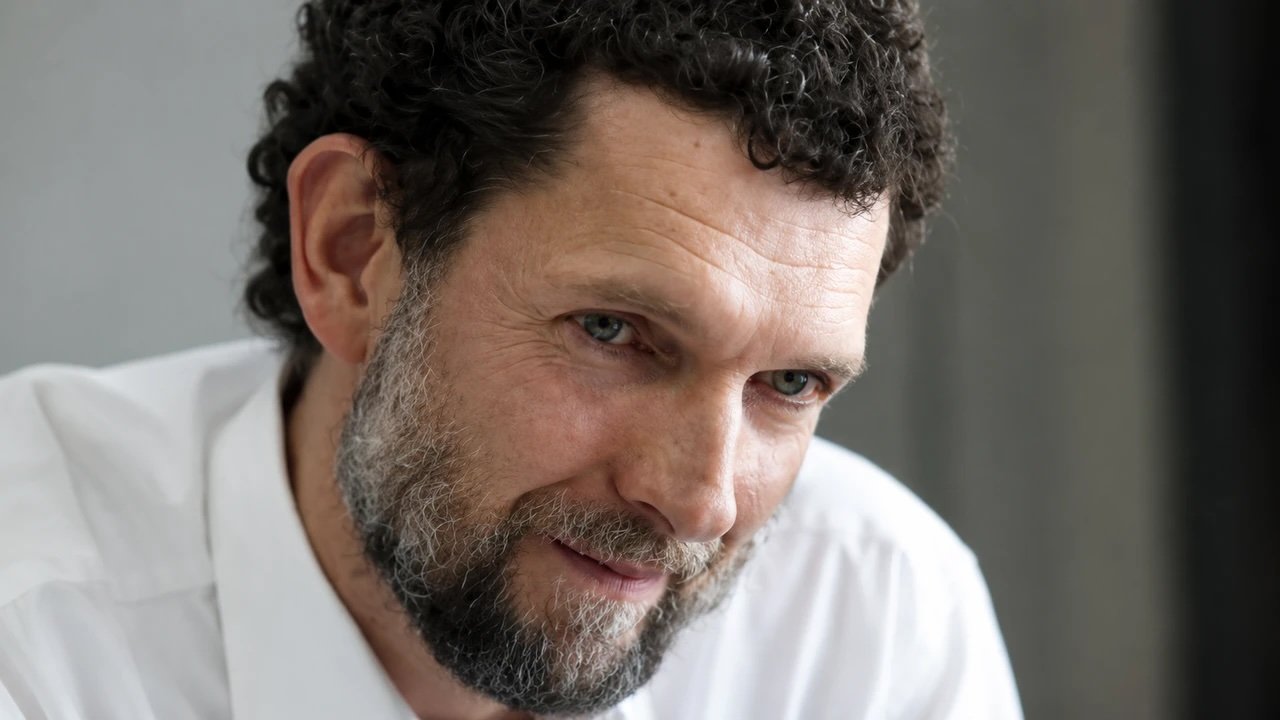
Jailed Turkish philanthropist Osman Kavala on Friday accused an İstanbul court of undermining the credibility of Turkey’s judiciary by refusing to reopen his case despite a binding European Court of Human Rights (ECtHR) judgment ordering his release.
In a written statement published Friday on a website dedicated to his case, Kavala criticized the İstanbul 13th High Criminal Court for rejecting his request for a retrial, arguing that the judges had missed an opportunity to end a serious human rights violation.
Kavala, who has been imprisoned since November 2017, referred to an August 25 ruling by the ECtHR that described the proceedings against him as a flagrant denial of justice.
He claimed that his imprisonment had continued despite the absence of evidence that he had committed a crime and accused the Turkish court of arbitrarily interpreting European human rights procedures and provisions of the country’s criminal procedure law to justify rejecting his request.
The court’s refusal to reopen the case, rather than ending what he described as a serious violation of his rights, “also damages the reputation of the judiciary,” Kavala said.
The statement came three days after the İstanbul court rejected his requests for release and a retrial, ordering him to continue serving an aggravated life sentence imposed over his alleged role in the 2013 anti-government Gezi Park protests.
Kavala, a businessman and civil society activist, was convicted in April 2022 of attempting to overthrow the government by financing and organizing the demonstrations, which began over plans to redevelop a park in central İstanbul and spread into nationwide protests against then-prime minister Recep Tayyip Erdoğan’s government.
He denies the charges and claims that his prosecution was politically motivated.
The ECtHR’s 17-judge Grand Chamber ruled on August 25 that Turkey must release Kavala and eliminate the consequences of his conviction, which it found should be regarded as null and void under European human rights law.
The court concluded that Kavala’s prosecution and imprisonment had been intended primarily to punish and silence him for his civil society activities and involvement in the Gezi protests.
It also found that Turkish courts had failed to establish a concrete connection between Kavala and acts of violence committed during the demonstrations.
Despite the ruling, the İstanbul court rejected his application on Tuesday, arguing that the ECtHR was not an appeals court above Turkey’s judiciary and that the assessment of evidence remained the responsibility of domestic courts.
The judges also cited the requirement to exhaust legal remedies in Turkey, noting that a separate application before the country’s Constitutional Court was still pending.
The European court had already addressed that argument in its August judgment, finding that Kavala could not reasonably be expected to wait for the Constitutional Court because lengthy delays and Turkey’s repeated failure to implement earlier rulings had undermined the effectiveness of that legal remedy in his case.
Kavala’s lawyers can challenge the rejection before another İstanbul court within two weeks of being formally notified of the decision.
The latest dispute is part of a yearslong confrontation between Turkey and European human rights institutions over Kavala’s imprisonment.
The ECtHR first ordered his release in December 2019, finding that his detention lacked reasonable grounds and had been used to silence him.
Turkey’s refusal to comply prompted the Council of Europe to launch infringement proceedings, a rarely used mechanism against member states. In July 2022 the Strasbourg court ruled that Ankara had failed to fulfill its obligation to implement the earlier judgment.
The Council of Europe’s Committee of Ministers, which oversees the implementation of ECtHR rulings, gave Turkey until October 14 to explain what steps it had taken or planned to take to secure Kavala’s release.
The committee has repeatedly emphasized that Turkey is legally obliged to comply with the court’s judgments and is expected to consider further action at its December meeting.
Kavala was acquitted in his first Gezi Park trial in February 2020 but was detained again before leaving prison. His acquittal was subsequently overturned, and his conviction following a retrial was upheld by Turkey’s Supreme Court of Appeals in September 2023.
Erdoğan and his government have repeatedly denied that Kavala’s imprisonment is politically motivated, insisting that Turkish courts operate independently.
This article is republished from Turkish Minute.