
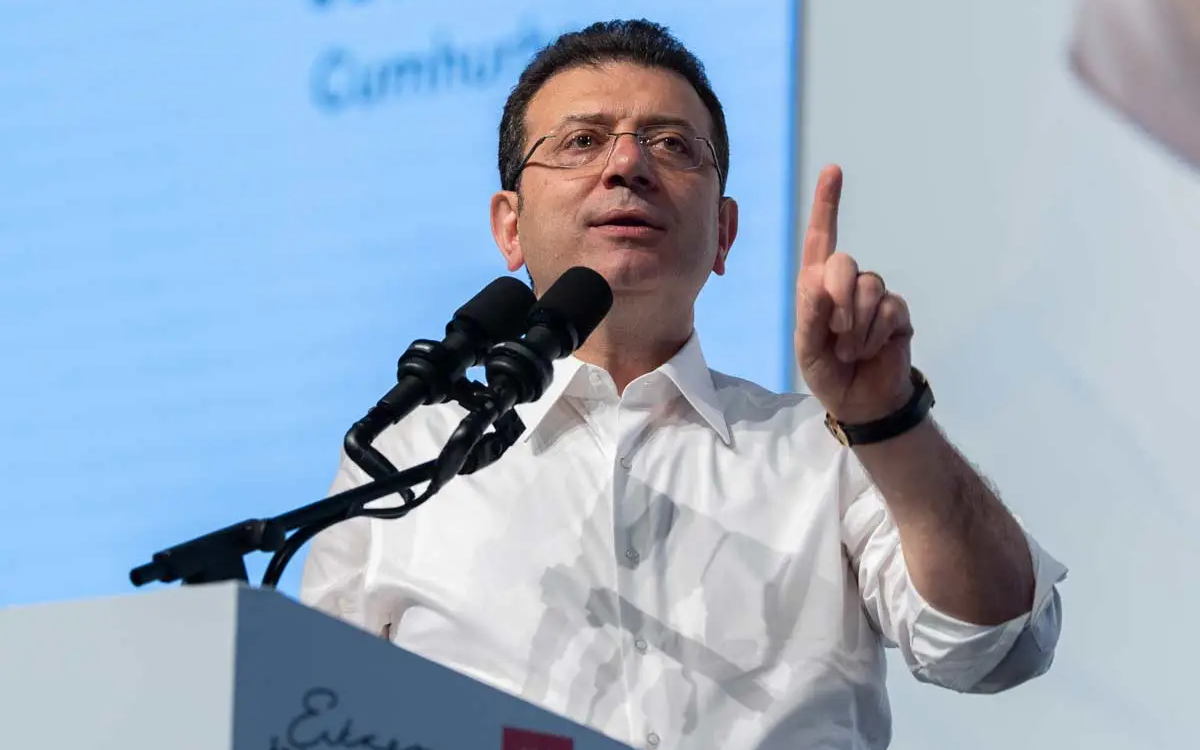
Three international rights and legal organizations have published a joint submission urging the European Court of Human Rights (ECtHR) to examine İstanbul Mayor Ekrem İmamoğlu’s detention in the context of what they describe as a pattern of politically motivated prosecutions in Turkey.
Human Rights Watch (HRW), the Turkey Litigation Support Project (TLSP) and the International Commission of Jurists (ICJ) published the submission on November 3. Dated September 14, it was filed with the court’s permission as a third-party intervention, allowing the organizations to provide legal analysis without becoming parties to the case.
The organizations had received permission from the president of the ECtHR’s Second Section on July 9 to intervene in İmamoğlu’s case.
İmamoğlu, widely seen as President Recep Tayyip Erdoğan’s strongest political rival, has been jailed since March 2025. He denies corruption charges and says the proceedings are intended to prevent him from challenging Erdoğan in a presidential election. The government denies political interference in the judiciary.
The organizations claim that using criminal proceedings to exclude opposition politicians from public life harms both the individuals targeted and voters’ ability to choose their representatives.
“Detaining political opponents and perceived dissenting voices to remove them from political life and to silence them has become a familiar playbook in Türkiye,” the TLSP’s Ayşe Bingöl Demir said in an accompanying statement.
Police detained İmamoğlu on March 19, 2025. A court jailed him pending trial on March 23, the same day the Republican People’s Party (CHP), then Turkey’s main opposition party, formally designated him as its presidential candidate. He was subsequently suspended from office.
His detention triggered Turkey’s largest anti-government protests in more than a decade.
His main corruption trial began in March. The case now involves 436 defendants, including 46 in pretrial detention after the court ordered seven releases in October. Prosecutors accuse İmamoğlu of leading a criminal organization and are seeking up to 2,430 years in prison on charges including bribery, bid-rigging and money laundering.
İmamoğlu applied to the Strasbourg court on November 10, 2025, arguing that his detention lacked sufficient evidence, had not been effectively reviewed by domestic courts and was intended to prevent him from competing in a presidential election.
The ECtHR notified the Turkish government of the application on March 23 and asked whether there was reasonable suspicion justifying his detention and whether it served an ulterior political purpose. Communication of the case does not establish that a rights violation occurred.
His complaints concern the right to liberty, the prohibition on restricting rights for ulterior purposes and the right to free elections. The intervention argues that the court should consider the Turkish presidency’s extensive powers when assessing how electoral protections apply to presidential candidates.
The organizations drew parallels with the imprisonment of former pro-Kurdish Peoples’ Democratic Party (HDP) leaders Selahattin Demirtaş and Figen Yüksekdağ and businessman and philanthropist Osman Kavala.
They cited eight judgments since 2019 involving HDP politicians and Kavala in which the ECtHR found violations of Article 18, which prohibits restrictions on rights for purposes other than those permitted by the European Convention on Human Rights.
The groups claimed that this record, along with weakened judicial independence and lower courts’ refusal to implement Constitutional Court rulings, should inform the examination of İmamoğlu’s detention.
The Council of Europe’s Committee of Ministers again called for Demirtaş and Yüksekdağ’s immediate release in September. In August the ECtHR’s Grand Chamber also ordered Kavala’s release, finding that his prosecution, detention and conviction predominantly served an ulterior political purpose.
The ECtHR has yet to rule on the merits of İmamoğlu’s application.
The concerns over judicial independence in Turkey are reflected in international assessments.
Turkey was ranked 117th among 143 countries in the World Justice Project’s 2026 Rule of Law Index, released in October, moving up one place while its overall score remained virtually unchanged.
This article is republished from Turkish Minute.