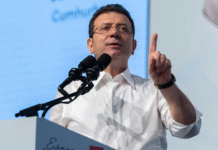

Former Kurdish opposition leader Selahattin Demirtaş marked 10 years in prison on Wednesday despite repeated European Court of Human Rights (ECtHR) rulings finding his detention unlawful and politically motivated and calling for his release, the Deutsche Welle (DW) news website reported.
Demirtaş, a former co-chair of the pro-Kurdish Peoples’ Democratic Party (HDP), has been imprisoned since November 4, 2016, and remains in custody pending an appeal against a 42-year prison sentence handed down in May 2024.
On the anniversary lawyers representing Demirtaş and 12 other imprisoned Kurdish politicians, together with 15 regional bar associations, submitted a new application to an Ankara appeals court seeking their release. The application cited binding ECtHR judgments and a September decision by the Council of Europe’s Committee of Ministers calling for the release of Demirtaş and former HDP co-chair Figen Yüksekdağ.
The latest application followed earlier requests for release that remained undecided as of October 5, according to an official submission by the Turkish government to the Council of Europe. The government confirmed that the case was before the 22nd Criminal Chamber of the Ankara Regional Court of Appeals and described Demirtaş and Yüksekdağ as being detained pending appeal.
In July 2025 the ECtHR found multiple violations of Demirtaş’s rights in connection with a detention warrant issued in September 2019, ruling that Turkish authorities had failed to establish reasonable suspicion of criminal wrongdoing or provide sufficient justification for his prolonged imprisonment.
The court also found a violation of Article 18 of the European Convention on Human Rights, concluding that the detention had pursued the improper political purpose of suppressing political pluralism and restricting democratic debate. The judgment became final on November 3, 2025, after the court rejected Turkey’s request to refer the case to its Grand Chamber.
The decision followed a December 2020 judgment by the court’s Grand Chamber, which found that Demirtaş’s earlier detention had violated his rights to liberty, freedom of expression and free elections. The court concluded that his imprisonment had sought to stifle political pluralism and limit democratic debate and ordered his immediate release.
The Council of Europe’s Committee of Ministers, which supervises the implementation of ECtHR judgments, renewed its demand in September for the immediate release of Demirtaş and Yüksekdağ, urging Turkish authorities to use all available legal means to comply with the rulings.
Under Article 46 of the European Convention on Human Rights, Turkey is legally obligated to implement final judgments of the ECtHR.
Demirtaş was initially jailed on November 4, 2016, during a crackdown on HDP lawmakers following the removal of parliamentary immunity for dozens of legislators. He was accused of membership in an armed terrorist organization and inciting criminal activity, allegations linked in part to his political speeches.
Although an Ankara court ordered his release in September 2019, he remained in prison under a separate conviction. Later that month he was put in pretrial detention again in connection with violent protests in October 2014 over an Islamic State assault on the predominantly Kurdish Syrian town of Kobani.
In May 2024 an Ankara court sentenced Demirtaş to 42 years in prison on multiple charges, including aiding efforts to undermine the unity and territorial integrity of the Turkish state and disseminating terrorist propaganda. The conviction has not been finalized because his appeal remains pending.
In its October submission to the Council of Europe, the Turkish government defended the proceedings, saying the trial court had examined allegations of fair-trial violations and concluded that Demirtaş’s rights had been respected.
Mahsuni Karaman, one of Demirtaş’s lawyers, told DW that implementing the European court’s judgments was a legal obligation that should not depend on the government’s ongoing peace process with Kurdish militants or the introduction of new legislation.
The Committee of Ministers has identified legislation adopted as part of a peace process with the outlawed Kurdistan Workers’ Party (PKK) as a possible means of securing Demirtaş’s release. However, its application depends on conditions relating to the group’s laying down of arms and whether Demirtaş would benefit from the law.
The committee is scheduled to review Turkey’s compliance with the judgments again in December.