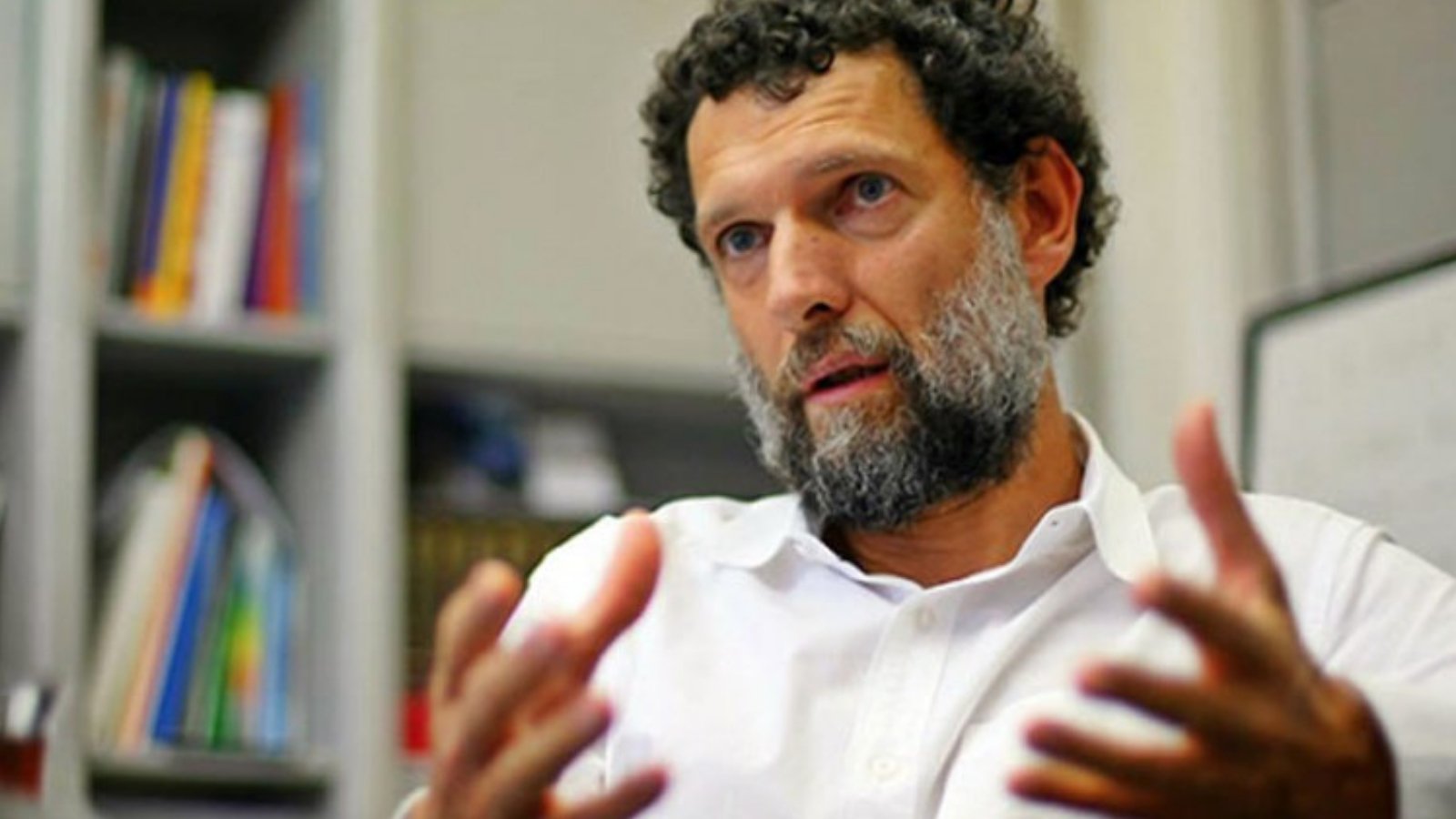
Turkish philanthropist and human rights defender Osman Kavala said his eight-year imprisonment on charges he calls fabricated serves as a deliberate warning to civil society that critical voices will no longer be tolerated, in written responses to questions published by T24 news website, Turkish Minute reported.
“I think my punishment is meant to send the message that civil society organizations no longer have the freedom they once had, that taking a critical stance creates danger,” Kavala, 68, wrote from his one-person cell at Marmara Prison on the outskirts of İstanbul.
Kavala was arrested in October 2017 at age 60 and has spent what he described as “almost all of the time I could have been actively engaged in civil society” in prison on charges stemming from the 2013 Gezi Park protests.
He is serving an aggravated life sentence for “attempting to overthrow the government” despite two European Court of Human Rights (ECtHR) rulings that found his detention violated his rights, ordering Turkey to release him immediately.
Kavala also said the government needed his imprisonment to make credible a conspiracy theory it adopted after a failed coup in July 2016, that the Gezi protests, which began as an environmental demonstration in İstanbul in 2013 and grew into nationwide anti-government protests, were actually a foreign-orchestrated plot to topple then-prime minister and current president Recep Tayyip Erdoğan.
“After the July 15 coup attempt, in an atmosphere of distrust, the narrative that the Gezi protests were a foreign-backed uprising was embraced and became the government’s official view, and public opinion was directed accordingly,” Kavala wrote. US billionaire George Soros, who funded civil society groups in Turkey through his Open Society Foundations, was designated the main foreign actor.
“To give credibility to the narrative that Gezi was planned and organized by Soros, there was a need to accuse and imprison me because of my relationship with the Open Society Foundation.”
Kavala said that once someone is imprisoned, “it becomes easier to spread the perception that they are guilty.” He added that the government’s extensive use of the foreign conspiracy narrative to discredit the opposition, particularly during the period when Turkey’s relationship with former US President Joe Biden’s administration was strained, meant that “accepting my innocence would mean changing this reality that has been constructed over eight years, with the active support of a section of the media. Taking that step is probably not very easy for them.”
The philanthropist, who founded cultural NGO Anadolu Kültür and worked for decades on projects promoting minority rights, arts and dialogue between Turkey’s diverse communities, said Turkish prosecutors and judges have abandoned the fundamental legal principle that people cannot be imprisoned without concrete evidence.
“Prosecutors bring grave accusations without concrete evidence, judges can issue conviction rulings without concrete evidence, on the grounds that their conscientious belief is in that direction, and they believe such behavior is legitimate,” he wrote. This reflects not just a refusal to recognize the authority of the Constitutional Court and the ECtHR, “but also a manifestation of the fact that the fundamental legal principle, that people’s freedom cannot be restricted without concrete evidence that they committed a crime according to law, has not been internalized.”
He pointed to the absurdity of a prosecutor accusing celebrity manager Ayşe Barım of “attempting to overthrow the government” and a court sentencing her to 12 years in prison, despite no evidence connecting her to any such attempt.
“This shows that this strange perception of reality is effective in the judiciary,” he said.
Europe’s top rights court to hear Kavala case on March 25
The ECtHR will hold a Grand Chamber hearing on Kavala’s case on March 25, examining Turkey’s continued detention of Kavala after the court’s 2019 ruling that ordered his immediate release. The hearing will focus on whether Turkey’s refusal to comply with that ruling and its subsequent sentencing of Kavala to life imprisonment in April 2022 constitute continued violations of his rights.
The 2019 ECtHR ruling found that Kavala’s detention was arbitrary and pursued “the ulterior purpose” of silencing him as a human rights defender. In July 2022 the ECtHR’s Grand Chamber issued a second landmark ruling finding that Turkey had failed to fulfill its legal obligation under the European Convention on Human Rights to comply with the 2019 judgment, only the second time in the court’s history that it has taken such action against a member state.
Kavala is a businessman and philanthropist who worked for decades funding civil society initiatives in Turkey. Through his Anadolu Kültür foundation, he supported projects promoting Kurdish-Turkish dialogue, the restoration of Armenian churches, environmental protection and arts programs. He was a board member of the Open Society Foundation’s Turkey office until it closed in 2018.
He was arrested in October 2017 on charges of financing and organizing the 2013 Gezi Park protests. Police crackdown on the protests left 11 dead and thousands injured.
Prosecutors later added espionage charges and expanded the case to include allegations related to the July 2016 coup attempt, a claim Kavala called “terrifying” because of how such accusations have historically been used against dissidents. He was acquitted of the Gezi charges in February 2020, only to be rearrested hours later. In April 2022 an İstanbul court sentenced him to aggravated life without parole for “attempting to overthrow the government.”
Seven other defendants in the Gezi case, including architect Mücella Yapıcı and filmmaker Çiğdem Mater, received 18-year sentences. All deny the charges. Turkey’s Supreme Court of Appeals upheld Kavala’s sentence in September 2023.
Before his arrest, Kavala maintained relationships with government ministries on cultural projects while also signing statements critical of government policies, including opposition to legal changes that would have allowed Turkey to support the US invasion of Iraq.
“In the period before, people active in civil society could cooperate with state institutions in the realization of their projects, while at the same time criticizing some of the government’s practices and participating in campaigns initiated to change them,” he wrote. “After the Gezi protests, with the impact of the July 15 coup attempt, a serious change occurred. The government began to see civil movements with critical messages as political opponents.”
Kavala’s case has become a flashpoint in Turkey’s relations with Europe and a symbol of the erosion of judicial independence under Erdoğan’s government. His continued imprisonment despite binding ECtHR rulings has prompted calls from European officials for his release and warnings that Turkey’s refusal to comply undermines the entire European human rights system.
He remains in Marmara Prison with other high-profile prisoners including jailed Istanbul Mayor Ekrem İmamoğlu.