Human Rights Watch (HRW) said on Wednesday that Turkey’s government consolidated its authoritarian trajectory in 2025 with an unprecedented campaign against the country’s main opposition Republican People’s Party (CHP), warning that the crackdown threatens political freedoms and the prospects for free and fair elections.
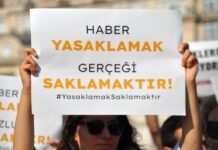
In its annual World Report 2026 Turkey chapter, the group said the government of President Recep Tayyip Erdoğan exercises control over domestic courts and persists in non-compliance with binding European Court of Human Rights (ECtHR) rulings, which it said leads to serious human rights violations. It said journalists, public figures and social media users frequently face prosecution and sometimes pretrial detention for criticism of the government and judiciary, including under terrorism and misinformation-related charges.
“The Erdoğan government has spent the past year attempting to remove political opponents and rivals and pursuing a barrage of lawsuits against the main opposition party,” Benjamin Ward, acting Europe and Central Asia director at HRW, said in commentary.
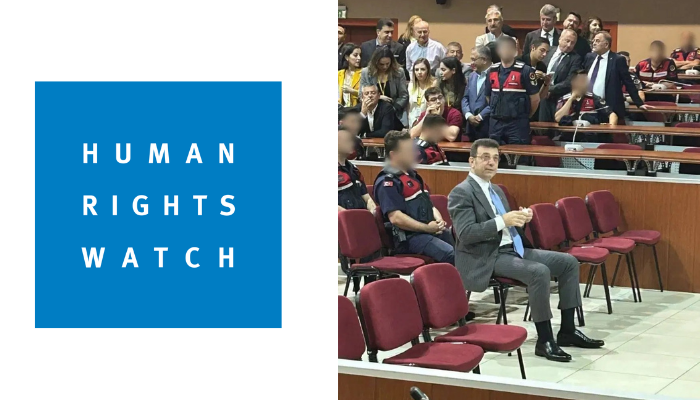
HRW pointed to the March 19 detention and later arrest of Istanbul Mayor Ekrem İmamoğlu, the strongest political rival of Erdoğan, as a turning point.
On the day of Imamoğlu’s arrest, Turkey’s internet authorities imposed a 42-hour bandwidth reduction that made social media platforms inaccessible and later blocked İmamoğlu’s account on X in Turkey.
Protest-related arrests also escalated after İmamoğlu’s detention, with hundreds of people, mostly students, detained for demonstrations. HRW said many faced charges such as attending unauthorized protests and failing to disperse.
The group said reports of ill-treatment in custody persisted, citing accounts from young people detained during mass demonstrations following İmamoğlu’s arrest. It said a culture of impunity remained widespread, with only rare cases of accountability.
The campaign against the CHP included efforts at removing party chair Özgür Özel and other leaders. HRW said the detention of opposition mayors and council members in Istanbul districts and other cities reinforced concerns that authorities were trying to sideline the country’s main political opposition.
The group said Turkey’s courts remained heavily influenced by the government and continued to ignore binding judgments from the ECtHR, a pattern it said contributed to serious rights violations.
According to the report the government maintained pressure on journalists and public figures through criminal investigations and detentions for criticism of officials and the judiciary. At the time of writing, 27 journalists and media workers were in pretrial detention or serving prison sentences.
Human Rights Watch highlighted the arrest of veteran journalist Fatih Altaylı, who broadcasts on YouTube, saying he received a prison sentence of four years and two months on what it called baseless charges of threatening Erdoğan. It also noted trials against executives of the Turkish Industry and Business Association (TÜSİAD) on charges including “publicly disseminating misinformation,” citing their public criticism of Turkey’s human rights record.
The report said Turkey’s broadcasting regulator, the Radio and Television Supreme Council (RTÜK), imposed arbitrary fines and disproportionate broadcast suspensions on opposition outlets and streaming platforms, limiting freedom of expression. It said public broadcaster the Turkish Radio and Television Corporation (TRT), the Anadolu Agency and most major private television stations were aligned with the government.
The group also said thousands of people remained caught up in terrorism investigations and trials linked to the faith-based Gülen movement.
President Recep Tayyip Erdoğan has been targeting followers of the Gülen movement, inspired by the late Muslim cleric Fethullah Gülen, since corruption investigations in December 2013 implicated him as well as some members of his family and inner circle.
Dismissing the investigations as a Gülenist coup and a conspiracy against his government, Erdoğan began to target the movement’s members. He designated the movement as a terrorist organization in May 2016 and intensified the crackdown on it following an abortive putsch in July of the same year that he accused Gülen of masterminding. The movement strongly denies involvement in the coup attempt or any terrorist activity.
HRW cited a July 2025 statement by the justice minister saying investigations of 58,000 people and the trials of 24,000 were continuing, while 11,640 people were in prison in pretrial detention or serving sentences in cases tied to the Gülen movement.
Lawyers faced heightened judicial harassment, particularly when representing clients in politically charged cases or speaking publicly about rights violations. HRW cited the removal of the Istanbul Bar Association’s board in a civil case brought by the Istanbul prosecutor after the association called for an investigation into the killing of two Kurdish journalists in a Turkish drone strike in Syria.
The report said criminal proceedings also continued against lawyers linked to İmamoğlu’s cases, stating that Mehmet Pehlivan, identified as İmamoğlu’s defense lawyer, had been held in pretrial detention since June and was indicted in November on charges including “membership of a criminal organization” in the main case against the mayor.
Human Rights Watch said Turkey continued to defy ECtHR rulings ordering the release of philanthropist Osman Kavala, who has been jailed since 2017. It said Kavala and other civil society figures, including Çiğdem Mater, Can Atalay, Mine Özerden and Tayfun Kahraman, remained behind bars after convictions concerning the 2013 Gezi Park protests that the group described as baseless.
The Gezi Park protests, which began over an urban development plan in central İstanbul in the summer of 2013 and spread to other cities in Turkey, posed a serious challenge to the rule of then-prime minister Erdoğan. They were violently suppressed by the government of Erdoğan, who later labelled the protests as a “coup attempt” against him.
Human Rights Watch cited the continued imprisonment of former Peoples’ Democratic Party (HDP) co-chairs Selahattin Demirtaş and Figen Yüksekdağ, who have been jailed since 2016 over “legitimate non-violent political activities and speeches.”
HRW also said Turkey’s refugee policy increasingly relied on unlawful deportation orders and coercive “voluntary return” procedures, despite protection claims. It cited cases involving Turkmenistan activists it said were labelled as threats to national security without concrete evidence and warned of the risk of deportation despite interim rulings from Turkey’s Constitutional Court.
On women’s and LGBT rights, the group said the government used its designation of 2025 as the “Year of the Family” to justify measures that undermined women’s rights and increased pressure on lesbian, gay, bisexual and transgender people. It pointed to a ministry directive instructing provincial offices to avoid using terms such as gender, sexual orientation and gender identity and said a leaked draft law raised concerns about potential new criminal penalties and restrictions on gender-affirming care.
Human Rights Watch said the authorities also used references to public morality to justify investigations of artists and censorship of online platforms. It cited the indictment of Manifest, an all-female music group, on charges including obscenity, and said Istanbul Pride was banned for an 11th consecutive year.
The report also cited economic conditions, noting an official annual inflation rate of 31 percent at the time of writing and warning that rising food and rent costs put pressure on low and middle-income households’ right to food and housing.