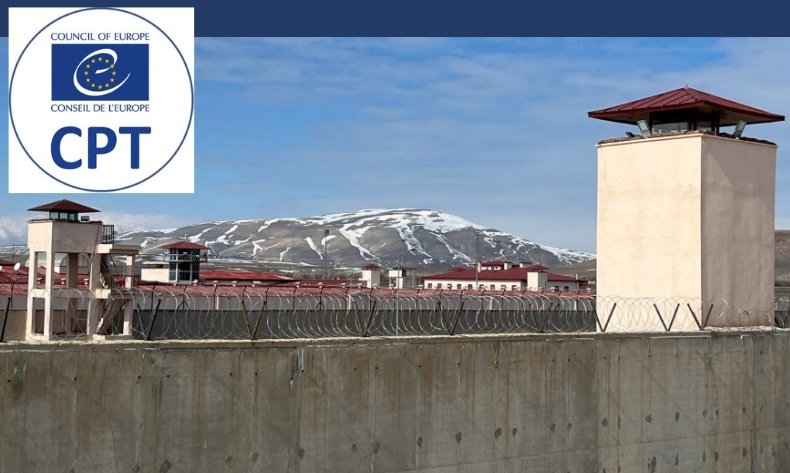
The Council of Europe’s anti-torture committee has documented allegations of beatings and electric shocks and raised concerns about prolonged solitary confinement and inadequate healthcare in Turkish detention facilities, according to two reports published Tuesday.
The European Committee for the Prevention of Torture and Inhuman or Degrading Treatment or Punishment (CPT) also raised concerns about the treatment of women, children and LGBTQ+ prisoners, inadequate safeguards against abuse in police custody and severe overcrowding in prisons, calling on Turkish authorities to address them.
The reports were based on CPT visits in January 2021 and February 2024 to 13 police and gendarmerie detention facilities and eight prisons in Ankara, Antalya, Diyarbakır, Iğdır, İstanbul, Kayseri and Van. Delegations interviewed hundreds of detainees, including people suspected of terrorism-related offenses, and examined conditions in high-security prisons and detention facilities holding women, children and LGBTQ+ prisoners.
The CPT said its delegations received credible allegations of prisoners being slapped, punched, kicked and beaten with truncheons by prison officers, including senior staff. Some prisoners also reported being beaten on the soles of their feet, a practice known as falaka. In one case CPT inspectors observed recent injuries consistent with the prisoner’s account.
According to the CPT some of the reported incidents occurred in areas not covered by security cameras. The CPT urged Turkish authorities to ensure that allegations of ill-treatment were effectively investigated and the use of force properly documented.
Women and children also reported physical ill-treatment. Female prisoners said officers pushed them, pulled them by their hair and slapped and kicked them, while boys in juvenile detention reported beatings following disciplinary incidents or acts of self-harm. The CPT also received credible accounts of senior prison officials personally participating in the physical and verbal abuse of detained girls.
The CPT also found that mothers and their children were held in unsuitable living conditions. It called for a dedicated mother-and-baby unit, adequate nutrition for pregnant women, breastfeeding mothers and children, and an end to solitary confinement as a disciplinary punishment for mothers accompanied by their children.
Detainees, including children, also reported being beaten or subjected to electric shocks from handheld devices while in police or gendarmerie custody, allegedly to extract information or confessions as punishment.
Some detainees said police delayed access to court-appointed lawyers so they could question them without legal representation. The CPT also found that medical examinations, a key safeguard against ill-treatment, were sometimes conducted within the earshot of police officers.
The CPT also raised serious concerns about prolonged solitary confinement, finding that many prisoners serving aggravated life sentences had been held in de facto solitary confinement for months or even years, spending at least 21 hours a day alone in their cells with little meaningful human contact.
The CPT also found that prisoners with mental health conditions were held in prolonged isolation.
Some prisoners who identified themselves as gay were also kept in de facto solitary confinement for months until they received certificates confirming their sexual orientation.
The committee warned that prolonged solitary confinement could seriously harm prisoners’ physical and mental health and, in certain circumstances, amount to inhuman or degrading treatment. It urged Turkish authorities to revise the detention regime for prisoners serving aggravated life sentences and reduce the isolation of gay and transgender prisoners.
The CPT identified shortages of doctors and qualified nurses, inadequate access to psychological and psychiatric care and shortcomings in medical examinations of newly admitted prisoners. The committee called for improvements in healthcare services, including proper documentation of injuries and protection of medical confidentiality.
Both reports also highlighted concerns about severe prison overcrowding. According to official figures cited by the CPT, Turkey’s prison population rose from approximately 192,000 in January 2021 to 338,000 by June 2024, equivalent to 395 prisoners per 100,000 inhabitants, the highest rate among Council of Europe member states.
The committee warned that building more prisons would not solve overcrowding and urged Turkish authorities to address its underlying causes by reducing the number of people sent to prison and length of time they spend incarcerated.
Turkey’s Human Rights Association (İHD) urged authorities on Thursday to act immediately on the CPT’s findings and recommendations and establish effective mechanisms to prevent rights violations in prisons and police custody.
Torture and ill-treatment in Turkish detention facilities have been a longstanding concern, particularly since a coup attempt in July 2016. Following a visit to Turkey later that year, the UN special rapporteur on torture reported that such abuses had been widespread in the immediate aftermath of the coup attempt, particularly during arrests and in police or gendarmerie custody.
The CPT’s report on its August–September 2016 visit to Turkish detention facilities remains unpublished because the Turkish government has not authorized its release, despite a 2019 call by the Parliamentary Assembly of the Council of Europe for its immediate publication. Reports from subsequent visits in 2017 and 2019 were published in 2020.
According to the İHD, at least 1,842 people were subjected to torture or ill-treatment in Turkey in 2025, including 185 prisoners. In a separate report, the association documented at least 26,632 rights violations in Turkish prisons in 2024.