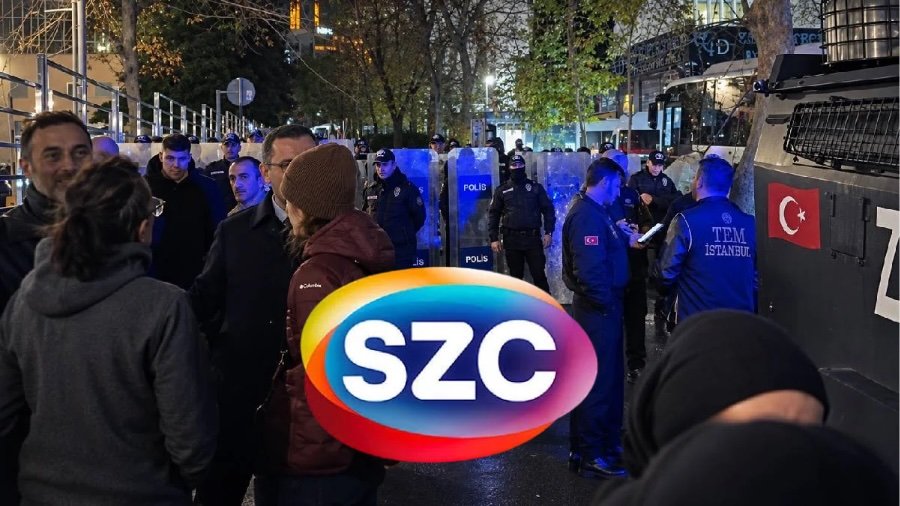
Politicians in Turkey and Europe, press groups and rights advocates have condemned Tuesday’s takeover of Sözcü TV, with critics accusing the government of using court-appointed management to silence the broadcaster’s coverage of an investment fund scandal involving figures linked to the ruling party.
Police raided the broadcaster’s İstanbul headquarters and detained four executives as a court appointed the Savings Deposit Insurance Fund (TMSF), a state body administering seized companies, to manage Mega Ajans, the company operating Sözcü TV and its news website.
Those detained were board chairwoman Funda Tuncer Sıdalı, former general manager Mustafa Asım Akgül, Yonca Yücekaleli, who has served as Sözcü’s finance director, and İsmail Öz, who previously had authority to sign documents for companies in the media group.
The trusteeship excludes the group’s Sözcü, Tavır and Korkusuz newspapers.
Burak Akbay, the media group’s owner, is being investigated for alleged Gülen movement membership and terrorism financing, the İstanbul Chief Public Prosecutor’s Office announced in a written statement.
Turkish President Recep Tayyip Erdoğan has targeted the faith-based Gülen movement, inspired by Muslim cleric Fethullah Gülen, who died in 2024, since corruption investigations in December 2013 implicated him as well as some members of his family and inner circle. He dismissed the probes as a Gülenist conspiracy and designated the movement as a terrorist organization in May 2016, intensifying a sweeping crackdown after a coup attempt in July of the same year that he accused Gülen of orchestrating. The movement denies involvement in the attempted coup or any terrorist activity.
Prosecutors accused Akbay of using overseas bank accounts to finance media companies they linked to the movement.
Seven Sözcü journalists and executives were convicted of aiding the Gülen movement in 2019, but those convictions were overturned by the Supreme Court of Appeals, and they were acquitted at a retrial in March 2025.
Akbay had also faced prosecution over alleged Gülen links, but his trial continued separately, so he was not covered by those acquittals.
The current financial investigation began after the court handling Akbay’s continuing case referred his financial dealings to prosecutors, the office’s statement said.
The group’s lawyer, Ersan Barkın, disputed the takeover’s legal basis in a live interview on KRT TV, arguing that it relied on the earlier Sözcü prosecution despite the acquittals.
The fund crisis erupted in September when investment funds could not meet withdrawals, prompting the liquidation of 131 funds affecting 455,758 investors and investigations into market manipulation.
The operation followed the October 14 takeover of Halk TV, another broadcaster critical of the government of President Erdoğan.
Main opposition New Party leader Özgür Özel accused Erdoğan’s government of tolerating neither criticism nor the disclosure of facts, declaring on X, “We will neither fall silent nor be afraid nor surrender.”
At a parliamentary news conference, his party’s deputy group leader, Ali Mahir Başarır, linked the takeover to fund scandal coverage and alleged that talk shows and guests were being barred despite broadcasts resuming.
In an X post, Ankara Mayor Mansur Yavaş questioned reliance on allegations concerning a period before Sözcü TV began broadcasting.
Tülay Hatimoğulları, co-chair of the pro-Kurdish Peoples’ Equality and Democracy Party (DEM Party), Turkey’s second-largest opposition party in parliament, in an X post demanded the executives’ release and reversal of the trusteeship, warning that the press was being forced to speak with one voice.
Republican People’s Party (CHP) spokesman Müslim Sarı argued on X that allegations against media owners could not justify punishing journalists and audiences because legal responsibility is individual.
Nationalist opposition İYİ (Good) Party leader Müsavat Dervişoğlu condemned the takeover on X as an attack on democracy, law and access to information, while party lawmaker Hakan Şeref Olgun in a social media post linked the intervention and unresolved fund scandal to the possibility of a snap election.
Speaking in parliament’s budget committee, New Way Party (Yeni Yol) parliamentary representative Sadullah Kısacık questioned why the government feared the remaining outlets giving space to opposition voices.
Workers’ Party of Turkey (TİP) leader Erkan Baş accused the government on X of “waging war” against the public’s right to learn the truth.
Felicity Party (SP) leader Mahmut Arıkan questioned on X why journalists exposing wrongdoing were targeted instead of those responsible for exploiting investors’ savings.
Orhan Erdem, a lawmaker from Erdoğan’s ruling Justice and Development Party (AKP), told parliament’s budget committee that the decision resulted from a legal process subject to judicial review.
Speaking to reporters after his party’s parliamentary group meeting, Erdoğan ally Devlet Bahçeli, leader of the Nationalist Movement Party (MHP), directed questions about the takeover to Sözcü executives and commentators he accused of speaking without watching their words.
European Parliament rapporteur on Turkey Nacho Sánchez Amor, writing on X, linked the takeover to the dangers of investigating the fund scandal, warning that independent, critical television journalism had almost disappeared after interventions at TELE1, Halk TV and Sözcü.
“Another step into darkness,” he wrote.
The European Democratic Party, an alliance of centrist parties, demanded a firm European Union response, declaring on X, “A regime that fears independent journalism fears its own people.”
In an X post Amnesty International’s Turkey office urged the government to ensure Sözcü could continue independent broadcasting and end attacks on press freedom and access to information.
The International Federation of Journalists (IFJ) in a post on X demanded reversal of the trusteeship and expressed solidarity with the Journalists Union of Turkey (TGS) and Sözcü employees.
Nine organizations demanded reversal of the decision and the protection of sources, editorial independence and jobs in a joint statement published on the TGS website.
The signatories were the Press Council, Progressive Journalists Association (ÇGD), Economic Reporters Association (EMD), Journalists Association (GCD), İzmir Journalists Association (İGC), Media, Communications and Postal Workers Union (Haber-Sen), Media and Law Studies Association (MLSA), Parliamentary Reporters Association (PMD) and TGS.
In separate X posts, TGS accused the government of obstructing access to news through successive trusteeships, while the ÇGD rejected state control over newsrooms.
The Press Workers Union (DİSK Basın-İş) warned about employees’ livelihoods on X, while the Turkish Journalists Association (TGC) warned in a written statement of a media system allowing only one voice.
The Confederation of Public Employees Trade Unions (KESK) condemned restrictions on differing views in a statement on X.
The Education and Science Workers Union (Eğitim-İş) demanded withdrawal of trustees and job protection in a statement on its website.
The Turkish Medical Association (TTB) defended professional autonomy and access to information in a social media post.
The İstanbul Bar Association condemned threats to press freedom and democracy in a public statement, while İzmir’s bar association posted a similar warning on its website.
Ankara Bar Association President Elçin Özge Şimşek Çağlayan warned in a social media post that editorial interference undermined scrutiny of those exercising power.
Morning news presenter İsmail Küçükkaya described being refused entry and told he had no broadcast, writing on X that he feared for his country.
Broadcasts resumed at noon under the new management.
This article is republished from Turkish Minute.