
“I did not wake up one morning and decide that I wanted to abandon my country, my university, my friends, and my family. I was forced into that decision by what happened to me,” said 24-year-old Meral.
On the 10th anniversary of a coup attempt in July 2016 that triggered a sweeping purge carried out by the Turkish government, the Stockholm Center for Freedom (SCF) is speaking with young people whose childhoods and adolescence were shaped by the crackdown, whether as children of imprisoned parents, refugees or exiles. Meral is one of those young people who were driven from their homeland and forced to rebuild a life in a country they knew nothing of before.
Meral was only 14 when her father, a religious studies teacher, was summarily fired from his job with a government decree.
Turkey’s Justice and Development Party (AKP) government declared a state of emergency (OHAL) following the abortive putsch on July 15, 2016, that remained in effect until July 19, 2018. During the state of emergency the AKP carried out a purge of state institutions under the pretext of an anti-coup fight by issuing a number of government decrees, known as KHKs, firing over 130,000 civil servants from their jobs due to their real or alleged connections to “terrorist organizations.”
Turkey’s former public servants were not only fired from their jobs; they were also prohibited from working again in the public sector and getting a passport. The government also made it difficult for them to work formally in the private sector. Notes were put on the social security database about dismissed public servants to deter potential employers.
As financial pressures mounted, Meral’s family of six—her parents, three siblings and herself — was forced to leave their home in the northern province of Ordu and move into her grandparents’ village house in Zonguldak, some 651 kilometers away.
But the house offered little comfort.
“I call it a house, but it barely was one,” Meral recalled. “The floors were still bare earth, and we had only the most basic necessities. My parents couldn’t afford to repair it, so we lived like that for a long time. We all slept on the floor in the same room because there was only one heater, and the other rooms were freezing.”
As the family struggled to adjust to their new living conditions, their financial situation grew increasingly precarious. Meral’s father remained under criminal investigation over alleged links to the Gülen movement, making it increasingly difficult for him to find employment and provide for his family.
Turkish President Recep Tayyip Erdoğan has targeted the Gülen movement, a worldwide civic initiative inspired by the ideas of Muslim cleric Fethullah Gülen, who died in 2024, since corruption investigations in December 2013 implicated him as well as some members of his family and inner circle. He dismissed the probes as a Gülenist conspiracy and designated the movement as a terrorist organization in May 2016, intensifying a sweeping crackdown after the coup attempt in July of the same year that he accused Gülen of orchestrating. The movement denies involvement in the attempted coup or any terrorist activity.
“Nobody would hire him,” Meral recalled. “But despite everything, both my parents remained incredibly resilient. It was harder for us as children because we still had to go to school and face people every day.”
During her first year of high school, Meral changed schools four times. Each move brought a new environment, but the same sense of isolation followed her.
“I became very withdrawn. I hardly made any friends because I didn’t want to explain what we were going through,” she said. “I felt tainted by the terrorism accusations against my father. I felt detached from everyone around me.”
School, which might have offered some sense of normality, instead became another source of anxiety. Meral recalled that her teachers did little to ease her fears. Once they learned about her father’s situation, some would bring up Gülenists and terrorism during class discussions, leaving her terrified that her family’s story would be exposed to her classmates.
“I was no longer simply the daughter of a teacher or a civil servant. I had become the daughter of a man accused of belonging to a terrorist organization.”
Despite the hardships, Meral recalled that her family remained close and loving. Yet each member was grappling with their own struggles, and over time the weight of their circumstances created an emotional distance between them. With so much energy devoted to getting through each day, there was little room to speak openly about their individual pain.
“I couldn’t come home and talk about what had happened at school because my parents were struggling just to put food on the table and keep a roof over our heads,” she explained. “I think both my parents were suffering psychologically, even if they didn’t always recognize or express it.”
For Meral, the uncertainty surrounding the family’s finances became a constant source of fear. She recalled spending nights crying alone in her room as a teenager, overwhelmed by worries about their situation that she felt unable to share with her parents.
Meral described those years as among the most difficult of her life, leaving a profound mark on her. But the ordeal was far from over.
In 2019 she moved to Istanbul to pursue a university degree, hoping to build a life of her own. She was living in shared student accommodation with several other young women, when on the morning of June 9, 2023, police arrived at their door.
It was around six in the morning. Three police officers presented Meral with an official document issued by the Istanbul Chief Public Prosecutor’s Office. It contained a list of individuals wanted for questioning over allegations of membership in a terrorist organization. Meral’s name was among them.
“I was completely shocked. I had no idea that I was being investigated. I didn’t even know what evidence they claimed to have against me,” she said.
The officers took her to the Istanbul police headquarters on Vatan Street, where, according to Meral, she was questioned without a lawyer present.
“The atmosphere was extremely strange. The room was full of cigarette smoke, almost like something from a police movie,” she said. “While I was sitting there, I could hear officers speaking to one another. They were still trying to locate other people. Apparently, I had been among the first people detained that morning.”
As she listened to the officers coordinating their search for other suspects, Meral began to grasp the scale of the operation. She later came to believe that police had tracked her whereabouts through her mobile phone signal and were using the same method to locate others.
“There was an extraordinary sense of pursuit. It was as though they were chasing dangerous criminals,” she said. “And sitting there, listening to all of this, I began to feel as though I really must be some kind of criminal. They were trying so hard to catch us. But I was only 20 years old.”
Meral was eventually allowed to contact her parents, who arranged for a lawyer to represent her.
During questioning, officers asked about her friendships, her living arrangements and whether any of her housemates had connections to the Gülen movement. They also scrutinized her phone records, pressing her to explain calls made to individuals they alleged were associated with the movement.
“The calls they were interrogating me about were to my father,” Meral explained. “So, they used my calls to him to accuse me of contacting people linked to the movement.”
Later that day she was released from police custody. But the relief was overshadowed by another unsettling possibility. According to Meral, her lawyer warned that the authorities might have released her deliberately, hoping to monitor her movements and see whether she would contact others named on the detention list.
Even after leaving the police station, Meral was left with the fear that she might still be under surveillance.
It was this lingering fear of being detained again that eventually pushed Meral to leave Turkey. But the decision was far from straightforward. After years of upheaval, she had finally begun to build a life of her own, one she was reluctant to abandon.
“After I was released, I did not immediately decide to leave Turkey. In fact, I desperately wanted to stay,” she recalled. “I was finally attending university. I had started working part-time and earning my own money. That had made an enormous difference as to how I saw my life.”
For Meral financial independence represented more than simply earning a living. It was a chance to reclaim some control over a life that had long been shaped by circumstances beyond her control.
“I was living in Istanbul and learning to stand on my own feet. I was just beginning to experience adulthood. I did not want to give that up,” she said.
She had always dreamed of travelling abroad, perhaps through an exchange program, further education or employment. But she had never imagined leaving her country under the shadow of terrorism allegations.
“I had never imagined leaving Turkey as someone accused of membership in a terrorist organization. That was what made the idea of departure so painful.”
In 2023, fearing further prosecution, Meral left Turkey and sought refuge in a country she knew little about. She declined to disclose her destination, concerned that revealing it could expose her identity and put her parents, who still live in Turkey, at further risk.
“I felt as though leaving would mean accepting the identity Turkish authorities had imposed on me,” she said. “But I could not keep living there, terrified that every knock on the door might be the police again.”
By then, Meral felt that her dreams had been taken from her one by one.
As a teenager she had hoped to become a surgeon, an ambition she said she was forced to abandon after her father’s dismissal plunged the family into financial hardship. She eventually pursued a different university degree, only for her education to be disrupted again by the investigation into her. Now, she was leaving behind not only her studies but also her friends, family and the independence she had only recently begun to enjoy.
Yet leaving Turkey did not bring the stability she had hoped for.
For the next three years Meral struggled to rebuild her life while living in refugee accommodations, navigating an unfamiliar asylum system and trying to learn a language she had never spoken before. Separated from her family and social circle, she watched important moments in the lives of those closest to her pass from afar.
“My sister got married, and I could not be there for her,” she said.
As the years passed without a resolution to her asylum case, Meral said her fear increasingly gave way to anger. She resented both the Turkish authorities, whom she held responsible for forcing her to flee, and the prolonged asylum process that had left her unable to establish a stable life in her new country.
Above all, she struggled with a profound sense of injustice.
“Whatever explanations governments or institutions may offer, the reality is that I am a young woman who has spent three years living in a refugee camp without being able to establish a normal life,” she said. “I was only 20 when this began. And I keep asking myself what I actually did. What was my crime? Sometimes the things treated as suspicious were so absurd that I could hardly believe them.”
What made her situation even more painful, Meral explained, was the feeling that even those closest to her could not fully comprehend what she had endured.
“My relatives tell me to come back, that it will be OK, and nothing will happen to me. Whenever I hear that, I want to scream,” she said.
“I did not want to leave. I did not choose this. I did not wake up one morning and decide that I wanted to abandon my country, my university, my friends and my family. I was forced into that decision by what happened to me.”
Their reassurances, however well-intentioned, left her feeling increasingly isolated.
“The people close to me in Turkey do not seem to understand the seriousness of the situation. So how is the asylum officer supposed to understand?”
Meral was just 14 when the coup attempt of July 2016 triggered a sweeping crackdown on people accused of links to the Gülen movement. At an age when she was only beginning to form her own views of the world, she found herself confronting the consequences of allegations directed at her father.
She maintained that neither she nor her father had been involved in terrorism. Yet, she said, the accusations against him had shaped much of her adolescence, affecting her education, her friendships and eventually her own standing in the eyes of the authorities.
Having witnessed from a young age how allegations of political or ideological affiliation could lead to criminal investigations, Meral said she continued to struggle to reconcile what had happened to her family with her understanding of justice.
The experience has also changed the way she thinks about her future.
“Everyone else is moving forward in life. They finished their studies, they began their professional lives. I had dreams, too. I wanted to study, travel, work and build a life,” she said.
“I had imagined going abroad through an exchange program, for further education or for employment. I had never imagined leaving Turkey as someone fleeing accusations of belonging to a terrorist organization. That is something I still cannot accept emotionally.”
After years of seeing her plans unravel, Meral said she had become reluctant to imagine what might come next.
“I don’t make long-term plans anymore. I feel that if I allow myself to dream too clearly, I will only be disappointed again.”
Her experiences have left her with a persistent sense of displacement. No longer able to feel secure in the country where she grew up yet unable to establish a settled life in the country where she sought protection, Meral described feeling as though she belonged fully to neither.
But amid the uncertainty and loss, she said her experiences had also changed the way she understood the suffering of others. Having been forced to leave behind everything familiar, she now felt a deeper connection to the millions of people around the world who had been displaced from their homes.
“Becoming a refugee has changed me,” she reflected. “It has made me more sensitive to the suffering of others, and it has taught me to look at the world differently.”
According to the latest figures from the justice ministry, more than 127,000 people have been convicted of alleged links to the movement since 2016, with 10,485 still in prison and legal proceedings ongoing against 83,404 individuals. In addition to the thousands who were jailed, scores of other Gülen movement followers fled Turkey to escape the government crackdown.
In the wake of the post-coup purge, thousands of children faced severe hardship, such as witnessing their parents’ arrest, being forced into hiding with their families, social exclusion, financial hardship and accompanying long-term psychological distress.
According to a documentary produced by the US-based human rights group Advocates of Silenced Turkey (AST), 86 children, including 21 infants, died during the crackdown, in some cases during attempts to flee Turkey with their parents or due to illness. It also notes that more than 3,000 have spent part of their childhood behind bars with their mothers, while thousands of others have fled the country with their families due to the crackdown.
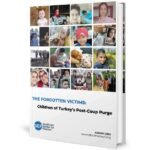
SCF previously documented these issues in its report, “The Forgotten Victims: Children of Turkey’s Post-Coup Purge,” which examines the persecution, social exclusion and psychological trauma endured by the children from families targeted in Turkey’s unprecedented post-coup purge.