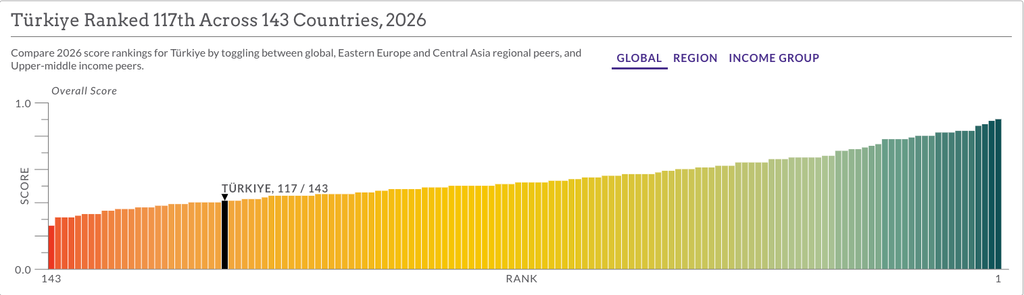
Turkey ranked 135th out of 143 countries for fundamental rights and 136th for constraints on government powers in the World Justice Project’s 2026 Rule of Law Index.
The index gave Turkey an overall score of 0.41 on a scale from zero to one, down about 0.4 percent from 2025, although its global ranking improved slightly from 118th to 117th.
The index measures performance in eight categories: constraints on government powers, absence of corruption, open government, fundamental rights, order and security, regulatory enforcement, civil justice and criminal justice. It assesses 44 subfactors, drawing on surveys of households, legal practitioners and experts.
Among 15 countries in Eastern Europe and Central Asia, Turkey was ranked last in both fundamental rights and civil justice. Its overall score was below the regional average of 0.50 and it ranked 14th overall in the region.
Turkey was ranked below countries including China (92nd), Belarus (104th) and El Salvador (114th) in the overall index, despite placing 117th itself. It also trailed Pakistan, Russia and Belarus in fundamental rights.
Turkey slipped one place, from 134th to 135th, in fundamental rights. The index also recorded declines in freedom of opinion and expression, civic participation and the judiciary’s ability to limit government power but showed no decline in freedom of assembly and association.
Turkey also fell from 110th to 116th in open government, from 106th to 110th in criminal justice and from 118th to 120th in regulatory enforcement. In order and security, however, its ranking improved from 79th to 67th.
Globally, rule-of-law scores declined in 62 percent of the 143 countries and jurisdictions covered by the 2026 index.
Turkey’s decline in the World Justice Project’s rule of law rankings began amid government interference in the judiciary following December 2013 corruption investigations implicating then-prime minister Recep Tayyip Erdoğan, members of his family and senior government officials. His government removed prosecutors and police officers involved in the probes and introduced changes to the judicial council in 2014 that increased executive influence over the judiciary. Turkey’s ranking fell sharply, from 59th out of 99 countries in 2014 to 80th out of 102 in 2015.
Turkey’s rule-of-law record deteriorated further after a coup attempt in July 2016, when Erdoğan’s government launched sweeping purges of the judiciary and other public institutions, dismissing more than 4,000 judges and prosecutors. Constitutional changes in 2017 further weakened checks on executive power and restructured the Council of Judges and Prosecutors (HSK), giving the president and parliament control over appointments to 11 of its 13 members, with the remaining two held by the justice minister and deputy justice minister.