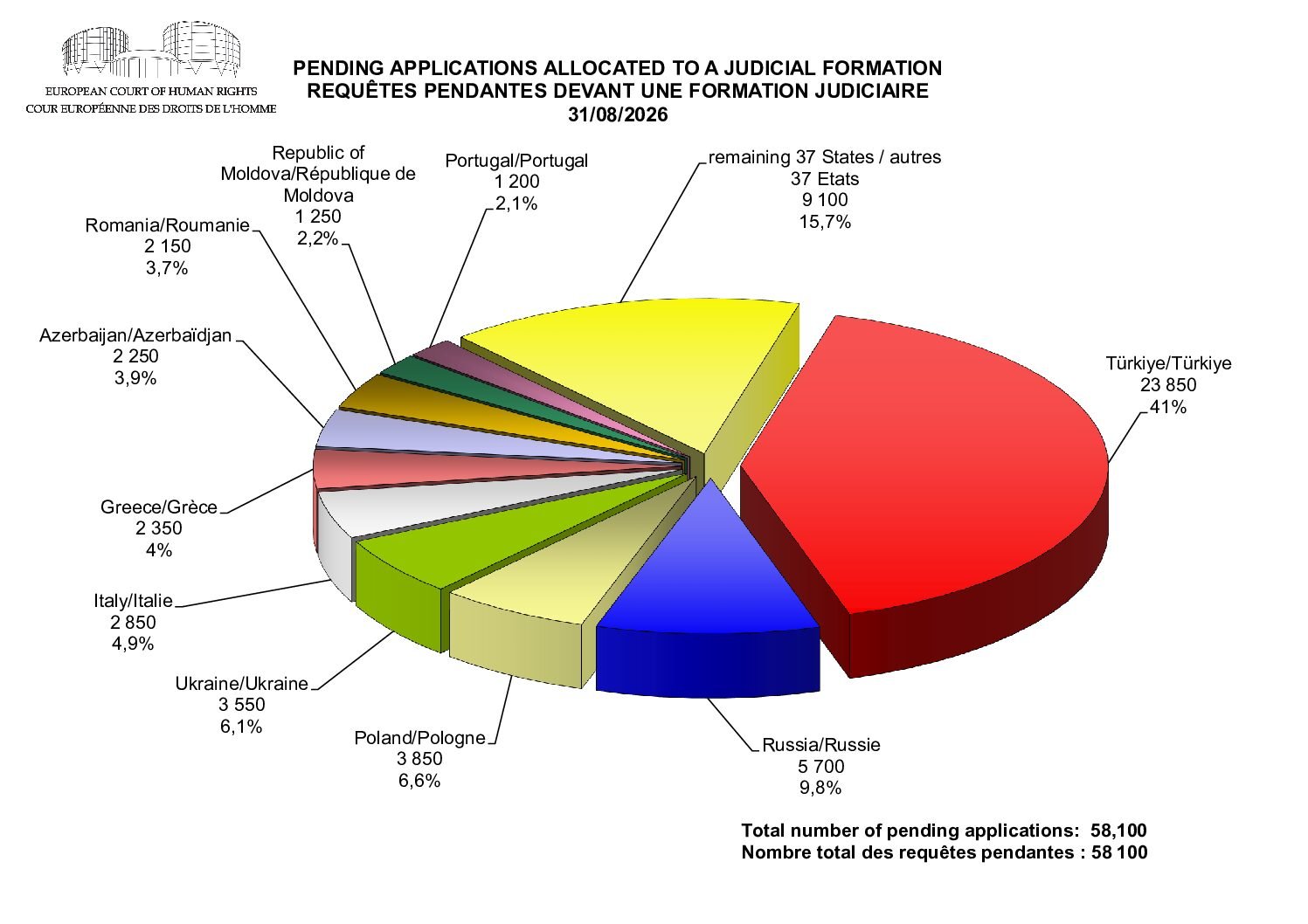
Applications involving Turkey accounted for 41 percent of all cases pending before the European Court of Human Rights (ECtHR) at the end of August, by far the largest share involving any country, according to the court’s latest statistics.
The Strasbourg-based court had 58,100 pending applications as of August 31, with 23,850 concerning Turkey. Russia was second with 5,700 applications, or 9.8 percent of the total, followed by Poland with 3,850, or 6.6 percent. Ukraine had 3,550 pending applications and Italy 2,850.
Turkey’s pending caseload has increased sharply this year. There were 18,464 applications involving the country pending at the end of 2025, meaning the number grew by 5,386, or about 29 percent, in the first eight months of 2026. Turkey accounted for about 34.5 percent of the court’s pending applications at the end of last year.
The court’s overall caseload increased by 4,650 applications over the same period, from 53,450 to 58,100. The increase in applications against Turkey was therefore greater than the net growth in the court’s entire backlog, with declines in cases involving some other countries offsetting part of the Turkish increase.
The Turkish caseload includes thousands of applications stemming from arrests, prosecutions and other measures taken after a failed coup on July 15, 2016, particularly cases involving people accused of links to the Gülen movement.
Turkish President Recep Tayyip Erdoğan has targeted the faith-based Gülen movement, inspired by Muslim cleric Fethullah Gülen, who died in 2024, since corruption investigations in December 2013 implicated him as well as some members of his family and inner circle. He dismissed the probes as a Gülenist conspiracy and designated the movement as a terrorist organization in May 2016, intensifying a sweeping crackdown after the coup attempt in July of the same year that he accused Gülen of orchestrating. The movement denies involvement in the coup attempt or any terrorist activity.
One large group of cases concerns convictions for membership in an armed terrorist organization based on the alleged use of ByLock, an encrypted messaging application that Turkish authorities said was used by members of the Gülen movement.
In its 2023 Grand Chamber judgment in Yüksel Yalçınkaya v. Türkiye, the ECtHR found violations of the right to a fair trial, the principle that there can be no punishment without law and freedom of association. The court described the problems identified in the case as systemic and said at the time that about 8,500 applications raising similar complaints were already pending.
The flow of similar cases continued. In July 2025 the court ruled on 239 applications involving convictions based on alleged ByLock use and said it had already notified the Turkish government of 5,000 similar applications, while thousands more were continuing to accumulate on its docket.
Another potential source of a large number of applications involves public employees dismissed after the coup attempt. In December 2025 the ECtHR said it had received a substantial number of applications since mid-October from dismissed civil servants, judges, military personnel and other public officials and anticipated a possible “massive” influx of cases raising similar issues.
The court introduced special administrative procedures from January 1, 2026, to process those applications. The dismissals concerned people accused of belonging to or having links with structures considered by Turkish authorities to pose a threat to national security, particularly the Gülen movement. The ECtHR said the recent influx followed the completion of proceedings in Turkish administrative courts and the Constitutional Court.
The court’s monthly statistics do not provide a breakdown of Turkey’s 23,850 pending applications by subject, making it impossible to determine from the figures how much of the current caseload is attributable to post-coup prosecutions or dismissals.
The ECtHR hears applications alleging violations of the European Convention on Human Rights by states subject to its jurisdiction. A pending application does not mean the court has found a rights violation. Applicants generally must exhaust available domestic legal remedies before bringing a case to Strasbourg.