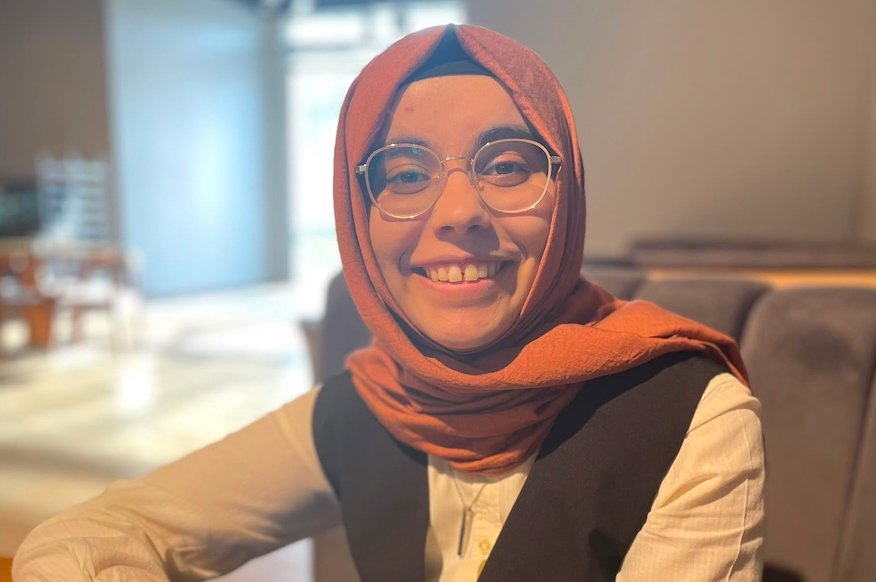
“My father’s unlawful arrest inflicted immeasurable pain on my family, but leaving Turkey also opened so many doors and opportunities. I am still grateful,” said 23-year-old Rana Özçelik.
On the 10th anniversary of a coup attempt in July 2016 that triggered a sweeping purge carried out by the Turkish government, the Stockholm Center for Freedom (SCF) is speaking with young people whose childhoods and adolescence were shaped by the crackdown, whether as children of imprisoned parents, refugees or exiles. Özçelik’s story is one of resilience, adaptation and rebuilding a life far from home.
Rana spent her adolescent years in the shadow of the Turkish government’s purge against anyone affiliated with the faith-based Gülen movement.
Turkish President Recep Tayyip Erdoğan has targeted the Gülen movement, a worldwide civic initiative inspired by the ideas of Muslim cleric Fethullah Gülen, who died in 2024, since corruption investigations in December 2013 implicated him as well as some members of his family and inner circle. He dismissed the probes as a Gülenist conspiracy and designated the movement as a terrorist organization in May 2016, intensifying a sweeping crackdown after the coup attempt in July of the same year that he accused Gülen of orchestrating. The movement denies involvement in the coup attempt or any terrorist activity.
According to the latest figures from the justice ministry, more than 127,000 people have been convicted of alleged links to the movement since 2016, with 10,485 still in prison and legal proceedings ongoing against 83,404 individuals.
In addition to the thousands who were jailed, scores of other Gülen movement followers fled Turkey to escape the government crackdown.
Rana’s father, İsmet Özçelik, was among the thousands arrested in Turkey after he was forcibly returned from Malaysia. Rana was only 13 years old when she and her mother were left confused, vulnerable and distraught in Malaysia.
İsmet Özçelik, a former teacher who worked at schools affiliated with the movement, was imprisoned for seven years. After his release in 2024, he reunited with his family in Sweden.
“I was in shock. I didn’t go to school for days, I refused to eat, and I actually fell into a state of depression. I was crying all the time,” she said. “But the experience also made me more resilient, and I learned to adapt.”
For years Rana campaigned on social media to bring her father’s case into the public spotlight. Her X account became dedicated to telling his story, which also attracted significant hostility from Erdoğan supporters.
“At one point my inbox was overflowing with insults and threats,” she said. “But I never really cared. I didn’t let it define me. My priority was getting my dad out of prison.”
Her online advocacy also connected her with people who supported her family and sympathized with their situation, many of whom had also been affected by the purge. She remains in contact with Turkish political dissidents living in exile.
Rana and her mother arrived in Sweden on June 7, 2017. After what happened to her father, they no longer felt safe in Malaysia and sought refuge in the Nordic country. However, starting over came with its own challenges, most notably learning a new language and adapting to a different education system.
Having only recently mastered English in Malaysia, Rana had to begin learning Swedish from scratch. She attended a small village school, repeated the eighth grade and credits her teachers with helping her integrate into Swedish society.
She also began working while attending school to support her family. She worked not only to cover her own expenses but also to help pay legal costs during her father’s imprisonment and later to support her mother. Looking back, she says that had she kept all the money she earned for herself, she could already have bought a house.
Despite balancing school and multiple jobs, Rana found time for hobbies, particularly long-distance cycling, which became one of her ways of coping with difficult circumstances.
Although life in a new country can sometimes feel lonely, Rana says she has built a close-knit circle of friends, while her parents have also established their own social network through language courses and community activities.
“I now feel at home in Sweden,” she said. “Despite all the challenges that come with being a refugee, I encountered only kindness and goodness in this country. I found freedom, opportunity and belonging.”
After everything her family endured in Turkey, Rana says she has no desire to return, even if the political situation were to improve.
“Even at my young age, I built a life here. I enrolled in a high-achieving secondary school and began working in elderly care while studying nursing, which has been immensely beneficial for my personal development. I have so many plans for the future. I want to finish my nursing degree and continue my education with another university program. If I have the opportunity, I’d like to do humanitarian work abroad and use my skills to help others.”
Rather than seeing herself as a victim, Rana believes exile forced her to become independent at an early age. She says she learned to support herself, manage her finances and take responsibility for her future much sooner than she would have had she remained in Turkey.
Acceptance has become one of Rana’s defining coping strategies. Rather than dwelling on misfortune, she says she tries to accept reality quickly and focus on what comes next.
“Whenever something happened, I would tell myself, ‘It happened. Now let’s move forward.’”
She believes that mindset enabled her to endure even the most difficult moments and ultimately rebuild her life.
In the wake of the post-coup purge, thousands of children faced severe hardship, such as witnessing their parents’ arrest, being forced into hiding with their families, social exclusion, financial hardship and accompanying long-term psychological distress.
According to a documentary produced by the US-based human rights group Advocates of Silenced Turkey (AST), 86 children, including 21 infants, died during the crackdown, in some cases during attempts to flee Turkey with their parents or due to illness. It also notes that more than 3,000 have spent part of their childhood behind bars with their mothers, while thousands of others have fled the country with their families due to the crackdown.
SCF previously documented these issues in its report, “The Forgotten Victims: Children of Turkey’s Post-Coup Purge,” which examines the persecution, social exclusion and psychological trauma endured by the children from families targeted in Turkey’s unprecedented post-coup purge.