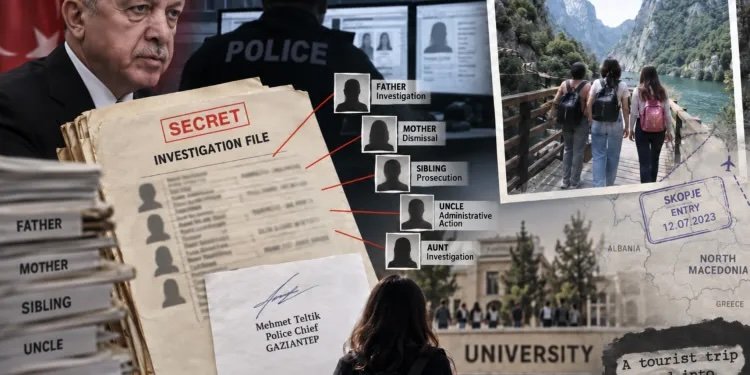
Confidential police records obtained by Nordic Monitor reveal that Turkish authorities profiled 207 university students using information about investigations, prosecutions and other measures involving their relatives over alleged links to the faith-based Gülen movement.
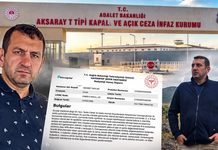
The records were part of a 262-page investigation file compiled by police in the southeastern province of Gaziantep and sent to a prosecutor’s office with a cover letter signed by Police Chief Mehmet Teltik on May 23, 2025.
The cover letter attached to the police investigation file bears the signature of Gaziantep Police Chief Mehmet Teltik:
According to Nordic Monitor, the profiles extended beyond parents and siblings to include uncles, aunts and other relatives, with some entries citing measures previously taken against more distant relatives over alleged Gülen links.
Turkish President Recep Tayyip Erdoğan has targeted the faith-based Gülen movement, inspired by Muslim cleric Fethullah Gülen, who died in 2024, since corruption investigations in December 2013 implicated Erdoğan as well as some members of his family and inner circle. He dismissed the probes as a Gülenist conspiracy and designated the movement as a terrorist organization in May 2016, intensifying a sweeping crackdown after a coup attempt in July of the same year that he accused Gülen of orchestrating. The movement denies involvement in the coup attempt or any terrorist activity.

The records include a 21-year-old computer engineering student whose profile cited police or judicial action involving his brother, and a 20-year-old law student whose father, a police officer, had been dismissed from public service. A 22-year-old gastronomy student’s profile included action taken against his father, while that of a 24-year-old industrial design engineering student referred to the dismissal of his late father. In another case the profile of a 25-year-old civil engineering student included information about an official measure taken against her aunt.
Police records on university students include information about investigations, prosecutions and other measures involving their parents, siblings, uncles and aunts. Identifying information was redacted by Nordic Monitor due to privacy and security concerns:
The investigation also examined trips made by some of the students to Balkan countries including North Macedonia, Bosnia and Herzegovina and Albania, which Turkish citizens can visit without obtaining a visa in advance.
According to Nordic Monitor, police and prosecutors treated some of the trips as possible evidence of organized activity linked to the Gülen movement. The investigation file also included photographs of students visiting Matka Canyon, a tourist destination near Skopje in North Macedonia.
Three female students are seen sightseeing at Matka Canyon in North Macedonia in photo Turkish police included in a criminal investigation file as purported evidence against them:
Nordic Monitor said the file contained no evidence that the trips had been organized by the Gülen movement or involved meetings on its behalf. Some students with no adverse information recorded about themselves or their relatives were nevertheless included in the investigation after traveling to the same or similar destinations at around the same time as students already under police scrutiny.
The records therefore show that the investigation extended beyond students whose own profiles or family connections contained information considered relevant by the authorities to include others based on their travel patterns and associations with students already under scrutiny.
The use of family and social ties in investigations over alleged links to the Gülen movement has previously drawn criticism from the United Nations human rights experts.
In a March 2018 report on Turkey, the Office of the UN High Commissioner for Human Rights said it had documented measures affecting not only people directly targeted by the authorities but also their family members, including children, siblings and parents. The UN office said the practice raised concerns about “guilt by association or collective guilt” and the principle of individual legal responsibility.
In an October 8, 2025, communication to the Turkish government, UN special rapporteurs and other mandate holders raised concerns about counterterrorism operations in May 2024 and May 2025 that resulted in the arrest of 55 and 208 people, respectively, many of them students, women and young people. The experts said the operations appeared to reflect a broader pattern in which otherwise lawful activities and alleged family or social ties to the Gülen movement were treated as evidence of criminal activity.
Following a coup attempt on July 15, 2016, the Turkish government declared a state of emergency that remained in effect until July 19, 2018. During this period, the government carried out a purge of state institutions under the pretext of an anti-coup fight by issuing a number of government decrees.
A total of 113,290 people were dismissed from public service under emergency decrees. More than 4,000 judges and prosecutors were separately removed by the Supreme Board of Judges and Prosecutors (HSYK), later renamed the Council of Judges and Prosecutors (HSK), while the Turkish Armed Forces expelled 26,206 members, including 150 of the Turkish Armed Forces’ 326 generals and admirals, through emergency decrees and administrative decisions for alleged membership in or relationships with “terrorist organizations” by emergency decree-laws subject to neither judicial nor parliamentary scrutiny.
According to figures announced by Justice Minister Akın Gürlek, authorities have initiated legal proceedings against 720,338 people over alleged Gülen links since 2016 and secured the conviction of 127,102. Investigations or trials involving another 83,404 people are ongoing, while 10,485 people accused or convicted of involvement in the coup attempt or membership in the movement are still in prison.
The practice resembles Sippenhaft, or family punishment, a concept associated with Nazi Germany under which relatives were held accountable for the actions or offenses of a family member.
The Stockholm Center for Freedom (SCF) examined the practice in a 2024 report on family punishment in Turkey, saying it extends punitive measures beyond the individual considered responsible to relatives, including parents, siblings and children and conflicts with the principles of individual responsibility and the presumption of innocence.
Many of the university students identified in the records were children or teenagers when the government launched its crackdown in 2016. The records show that measures taken against their parents or other relatives during that period were later included in police files concerning the students themselves.