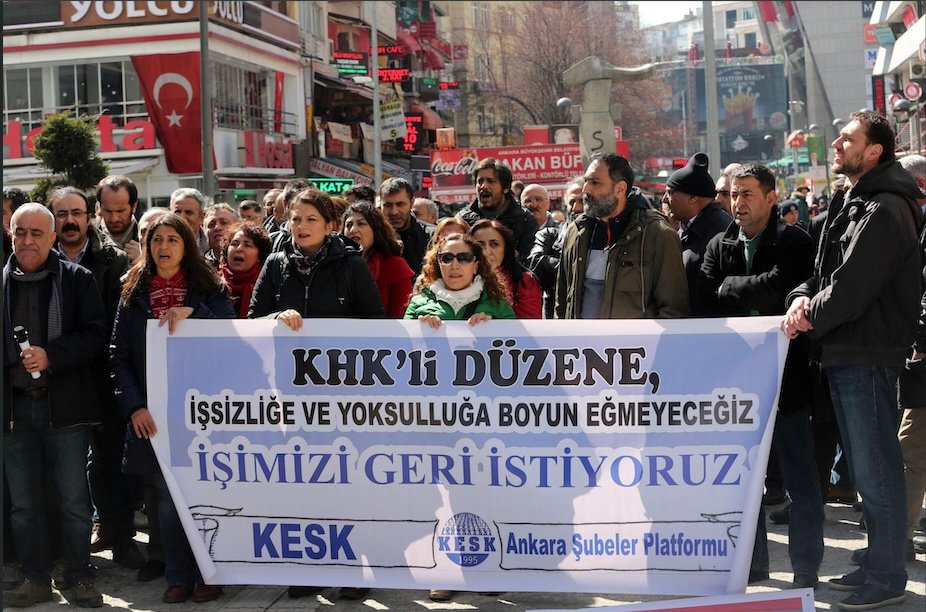
Ten years after the coup attempt of July 15, 2016, the Turkish government’s mass dismissal of public servants remains one of the defining aspects of its post-coup crackdown, destroying the lives of at least 134,000 dismissed people and their families while reshaping key state institutions and public life more broadly.
The dismissals were carried out mainly through emergency decrees issued during a two-year state of emergency, administrative decisions by public institutions and, after the state of emergency ended, temporary legal provisions allowing the process to continue.
Turkish authorities began mass dismissals immediately after the coup attempt, before criminal investigations into alleged links to the faith-based Gülen movement had been completed or even launched. The process bypassed the individualized review that allegations of membership in a terrorist organization would normally require and instead relied on broad and often vague criteria.
The campaign has primarily targeted people affiliated with the Gülen movement, but other government critics, including the Academics for Peace, a group of scholars dismissed for signing a peace petition critical of the government, have also faced similar pressure.
Turkish President Recep Tayyip Erdoğan has targeted the Gülen movement, a worldwide civic initiative inspired by the ideas of Muslim cleric Fethullah Gülen, who died in 2024, since corruption investigations in December 2013 implicated Erdoğan as well as some members of his family and inner circle. He dismissed the probes as a Gülenist conspiracy and designated the movement as a terrorist organization in May 2016, intensifying a sweeping crackdown after the coup attempt in July of the same year that he accused Gülen of orchestrating. The movement denies involvement in the coup attempt or any terrorist activity.
Turkey declared a state of emergency on July 21, 2016, and the first emergency decree containing dismissed lists was published in the Official Gazette a mere six days later. During the state of emergency, which was extended seven times before ending on July 19, 2018, the Turkish government issued 32 emergency decrees, 12 of which included mass dismissals from public service.
A total of 113,290 people were dismissed from public service under emergency decrees. 4,006 judges and prosecutors were separately removed by the Supreme Board of Judges and Prosecutors (HSYK), later renamed the Council of Judges and Prosecutors (HSK) under the 2017 constitutional amendments, while the Turkish Armed Forces expelled 26,206 members, including 150 of the Turkish Armed Forces’ 326 generals and admirals, through emergency decrees and administrative decisions.
The largest purges took place in the Turkish National Police, where 34,636 employees were dismissed, and the Ministry of Education, which removed 34,393.
Rights groups say the actual number may have been considerably higher. The officially documented total does not include an unknown number of public employees dismissed through separate administrative decisions, including removals carried out after the state of emergency under temporary powers granted to ministers by Decree No. 667. The government has never disclosed a consolidated figure for these dismissals.
Critics say the purge also enabled the government to reshape key state institutions by removing experienced personnel deemed politically unreliable and replacing them with officials seen as loyal to the ruling party, further weakening the independence and professionalism of the civil service.
During the state of emergency many dismissals were carried out through lists published in the Official Gazette without prior individual hearings, and those affected often learned of their removal only after seeing their names on the lists. Dismissals made later through administrative decisions were not published in the same way.
The criteria used by authorities to establish alleged links to the Gülen movement became one of the most controversial aspects of the purge. Many of the same indicators were also used in criminal investigations and prosecutions for alleged membership in a terrorist organization. International human rights organizations and Council of Europe bodies criticized the government’s reliance on vague indicators and lawful activities rather than individualized evidence of criminal conduct.
These included financial ties, such as having an account at Bank Asya, a bank seized by the government shortly before the coup attempt; educational and social links, including children attending Gülen-affiliated schools or individuals staying in movement-linked student houses and dormitories; and civic activities such as donating to or volunteering for organizations later accused of ties to the movement.
Authorities also relied on alleged use of ByLock, an encrypted messaging app once widely available on Apple’s App Store and Google Play that Turkish authorities claim was used as a secret communication tool for Gülen supporters.
In 2023 the European Court of Human Rights (ECtHR) ruled in a landmark case that convictions based on ByLock use and other alleged Gülen-linked activities, including having an account at Bank Asya, violated the rights to a fair trial, freedom from punishment without law and freedom of association.
Immediately after the state of emergency ended, Law No. 7145, which took effect in July 2018, added a provisional article to a decree law, providing that dismissals could continue for four years. Dismissals continued under this provision as well.
The Turkish government established the State of Emergency Procedures Review Commission (OHAL Commission) on January 23, 2017, as an appeals body under pressure from the Council of Europe in order to prevent tens of thousands of applications from reaching the ECtHR.
The commission consisted of seven members, including three appointed by the president, one by the justice minister, one by the interior minister and two by the HSK. Critics questioned the body’s independence, noting that most members were appointed directly by political authorities.
The commission began reviewing applications on December 22, 2017. A total of 127,292 applications were submitted. By the time its mandate ended on January 22, 2023, the commission had approved 17,960 applications, or 14.1 percent, while rejecting 109,332.
The commission was widely criticized by international bodies for failing to provide an effective remedy against the dismissals. The Venice Commission, the Council of Europe’s advisory body on constitutional law, raised concerns about the commission’s independence, procedural safeguards and the scope of its review, while the European Commission, in its 2020 Turkey Report, expressed serious concerns about its ability to provide an effective remedy against dismissals.
Dismissed public servants faced consequences beyond the loss of employment. They were permanently banned from working in public service. Many had their passports, and in some cases those of family members, cancelled. Some were forced to leave public housing within 15 days, while the publication of their names in the Official Gazette exposed them to severe social stigma and difficulties finding employment.
The government also made it difficult for them to work formally in the private sector. Confidential codes were put on the database of Turkey’s Social Security Institution and Turkish Employment Agency about dismissed civil servants to deter potential employers. As a result, many purge victims have had to work in uninsured jobs with very little workplace safety. There have also been several cases where former public servants have died due to occupational accidents in physically demanding jobs.
Many applicants whose appeals were rejected had never faced criminal investigations, had received decisions of non-prosecution from prosecutors or had been acquitted in criminal cases. Despite this, their dismissals remained in place.
Thousands of dismissed public servants later turned to administrative courts, Turkey’s Constitutional Court and the ECtHR.
A key test case in this regard is Mehmet Candar and Others v. Türkiye, which the ECtHR communicated to the Turkish government in June 2026. The court requested observations on whether the post-coup dismissals were compatible with the European Convention on Human Rights, raising questions about the legality, foreseeability and proportionality of the measures.
In December 2025 the ECtHR announced that it had received a “substantial number” of applications from civil servants, judges, military personnel and other public officials dismissed after the 2016 coup attempt. The court said it would apply special administrative measures to process the new group of cases, reflecting the continued flow of post-coup dismissal complaints nearly a decade after the purge began.
The court’s scrutiny of the dismissals follows the reasoning set out in its earlier judgments in Yalçınkaya v. Türkiye and Yasak v. Türkiye, in which it criticized the use of vague concepts and insufficiently individualized evidence in terrorism-related proceedings.
Ten years after the coup attempt, the mass dismissal of civil servants remains one of the defining elements of Turkey’s post-coup crackdown. While the government continues to defend the measures as necessary for national security, critics and international rights bodies have continued to raise concerns over due process, proportionality and the long-term impact of a purge that reshaped the lives of hundreds of thousands of people and their families.