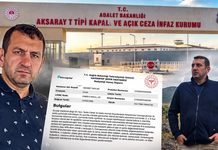
A social media campaign has called for the release of Abdullah Tırpan, a 74-year-old critically ill inmate imprisoned over alleged links to the faith-based Gülen movement, amid warnings from relatives and rights advocates that his deteriorating condition poses an imminent risk to his life.
The hashtag “#AbdullahTırpan AcilTahliye” (Emergency Release for Abdullah Tırpan) began trending on social media on Tuesday, with users urging authorities to free Tırpan before his condition worsens further.
Tırpan suffers from multiple chronic and acute conditions, including diabetes, hypertension, neuropathy and vision problems. Despite his health problems, a request for the suspension of his sentence was rejected after Turkey’s Council of Forensic Medicine (ATK) ruled on December 17, 2025, that he was fit to remain in prison.
The ATK frequently comes under criticism over its questionable reports that find ailing inmates fit to remain in prison. Rights advocates slam the agency over its lack of independence from political influence and its role in compounding the persecution of political prisoners.
Tırpan was first detained on August 16, 2016, during a crackdown that followed a coup attempt a month earlier and spent some 19 months in pretrial detention. He was later sentenced to more than seven years in prison by the Tekirdağ 3rd High Criminal Court. After Turkey’s Supreme Court of Appeals upheld the sentence, he was re-arrested on February 25, 2025.
Turkish President Recep Tayyip Erdoğan has targeted followers of the Gülen movement, inspired by the US-based cleric Fethullah Gülen, who died in 2024, since corruption investigations in December 2013 implicated him as well as some members of his family and inner circle. He dismissed the probes as a Gülenist conspiracy and later designated the movement as a terrorist organization in May 2016, intensifying a sweeping crackdown after a coup attempt in July of the same year that he accused Gülen of orchestrating. The movement denies involvement in the coup attempt or any terrorist activity.
Human rights defender and Peoples’ Equality and Democracy Party (DEM Party) lawmaker Ömer Faruk Gergerlioğlu said in a video shared on X that 70 percent of Tırpan’s brain vessels were blocked, warning that he could be require intensive care at any moment and might not survive. Gergerlioğlu said relatives who recently visited Tırpan described his condition as critical and said they feared he was approaching death.
Responding to Gergerlioğlu’s post, journalist Nihal Bengisu Karaca said sick and elderly prisoners should not be left to die in prison. She said acts cited in Tırpan’s conviction, including having an account at Bank Asya, attending religious gatherings and making donations, had been deemed lawful activities by Turkey’s Constitutional Court and the European Court of Human Rights in similar cases.
His daughter, Esra Tırpan Yakut, appealed directly to the head of the Council of Forensic Medicine in a social media post, saying her father faced the risk of paralysis and urging authorities to reconsider his case.
Another social media user recalled that Tırpan had reportedly waited 112 days for an MRI last year despite his serious illnesses and called for his immediate release.
“What is being demanded for Abdullah Tırpan is not a privilege,” one social media user wrote. “It is humane treatment. It is the right to medical care. It is the right to life.”
Other users echoed calls from family members for Tırpan’s release before it was too late.
Turkish authorities have frequently been criticized for their systematic disregard of the health problems of prisoners.
Under Turkey’s Law on the Execution of Sentences and Security Measures, courts may suspend the sentence of a prisoner who, due to a serious illness or disability, cannot sustain life in prison conditions and who is not considered a serious or concrete danger to society. Rights groups say the provision is very rarely applied in practice.
Turkey’s Human Rights Association (İHD) says more than 1,400 sick prisoners are currently held in Turkey, including hundreds in critical condition. The group has repeatedly reported delays in trips to the hospital, inadequate treatment in prison infirmaries and forensic assessments that allow seriously ill detainees to remain incarcerated.