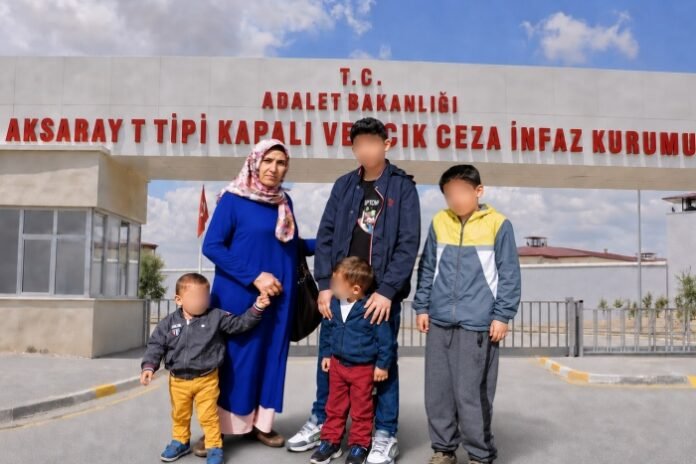
A Turkish opposition lawmaker has raised concerns about a former teacher and mother of four imprisoned on terrorism charges over alleged links to the faith-based Gülen movement, drawing attention to her separation from her children and poor prison conditions, the TR724 news website reported.
Hacer Kılıç is being held in Aksaray Prison, where her family says inmates face poor living conditions, including water cuts lasting up to 18 hours a day, overcrowding and inadequate sanitation. Her children, aged 17, 15, 6 and 4, are being cared for by relatives, with the two youngest staying with their grandmother, who is in poor health.
Kılıç’s situation was brought to public attention by pro-Kurdish Peoples’ Equality and Democracy Party (DEM Party) lawmaker and human rights advocate Ömer Faruk Gergerlioğlu at a press conference in parliament.
Kılıç, a former primary school teacher, was dismissed from her job by an emergency decree following a coup attempt in July 2016. She was sentenced to more than six years in prison for membership in a terrorist organization by the Ankara 13th High Criminal Court in 2021. She was imprisoned on April 27, after the Supreme Court of Appeals upheld her conviction.
Turkish President Recep Tayyip Erdoğan has targeted the Gülen movement, a worldwide civic initiative inspired by the ideas of Muslim cleric Fethullah Gülen, who died in 2024, since corruption investigations in December 2013 implicated him as well as some members of his family and inner circle. He dismissed the probes as a Gülenist conspiracy and designated the movement as a terrorist organization in May 2016, intensifying a sweeping crackdown after the coup attempt in July of the same year that he accused Gülen of orchestrating. The movement denies involvement in the coup attempt or any terrorist activity.
Her conviction was based on her involvement in religious gatherings, communal meals, trips and camps as well as her alleged use of ByLock, an encrypted messaging app, once widely available on Apple’s App Store and Google Play, that Turkish authorities claim was used as a secret communication tool for Gülen supporters. Kılıç denied using ByLock during her trial.
In 2023 the European Court of Human Rights ruled in a landmark case that convictions based on ByLock use and other alleged Gülen-linked activities, such as having an account at a movement-affiliated bank, violated the rights to a fair trial, no punishment without law and freedom of association.
Two other women with young children are also being held in the same prison, according to TR724, one with a 6-week-old baby and the other with a 2-year-old toddler. The women were detained in a nationwide operation targeting alleged Gülen movement members on July 13. The operation, announced by Justice Minister Akın Gürlek and Interior Minister Mustafa Çiftçi, resulted in the detention of some 700 people, including teachers, doctors, academics, police officers and prison guards as well as elderly, sick and disabled people.
Following the coup attempt of July 15, 2016, the Turkish government declared a state of emergency that remained in effect until July 19, 2018. During this period, the government carried out a purge of state institutions under the pretext of an anti-coup fight by issuing a number of government decrees. More than 113,000 civil servants and 4,362 judges and prosecutors were dismissed over alleged links to terrorist organizations, while more than 26,000 members of the armed forces were expelled from the military for alleged membership in or relationships with “terrorist organizations” by emergency decree-laws subject to neither judicial nor parliamentary scrutiny.
According to the latest figures from the justice ministry, more than 127,000 people have been convicted of alleged links to the movement since 2016, with 10,485 still in prison and legal proceedings ongoing against 83,404 individuals.