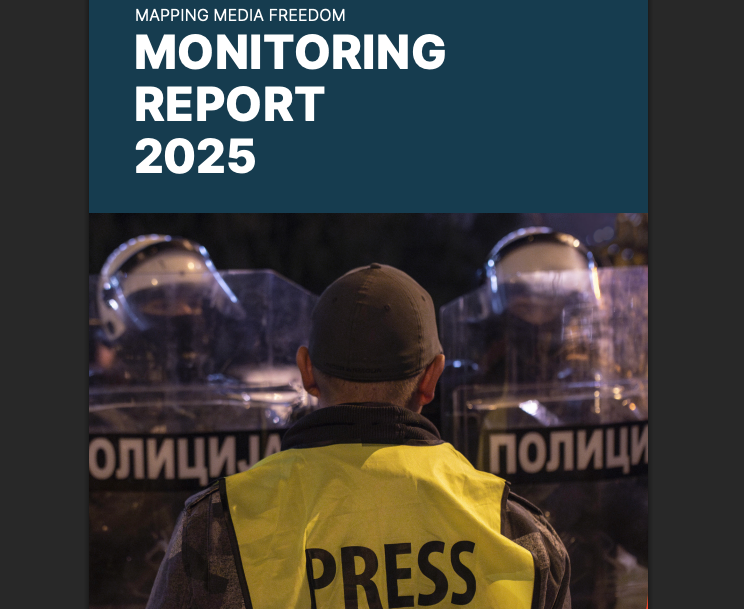
Media Freedom Rapid Response (MFRR) documented 137 press freedom violations in Turkey in 2025, the third highest among EU member states and candidate countries, in its new report published on Wednesday.
The violations affected 259 journalists and media outlets and reflected what the report described as a systematic pattern of repression that intensified following the March arrest of İstanbul Mayor Ekrem İmamoğlu, widely seen as President Recep Tayyip Erdoğan’s strongest political rival, on corruption charges. Measures used in this repression included legal action, physical violence, regulatory restrictions and digital controls.
Legal measures accounted for 70.8 percent of all recorded violations, making them the most frequently used tool used against journalists, while regulatory pressure rose to 10.2 percent, a sharp increase from 2.2 percent in 2024.
Nearly half of the cases, 49.6 percent, involved the arrest, detention or imprisonment of journalists on charges related to disinformation, terrorism, insult or national security.
At least 22 journalists were convicted over their reporting during the year, while high-profile journalists such as Fatih Altaylı, İsmail Saymaz, Nevşin Mengü, Barış Pehlivan, Timur Soykan and Enver Aysever were detained, arrested or prosecuted for commentary or political analysis.
The report also documented 16 incidents of physical assault and 20 cases of verbal attack, including death threats, as well as 17 attacks on property, including an armed assault on a local bureau of the Evrensel daily. It warned that the failure to effectively investigate such incidents has reinforced a perception of impunity.
Describing critical journalism as increasingly treated as “a criminal and security concern,” the report cited the killing of environmental journalist Hakan Tosun and an attack on journalist Mehmet Nafiz Koca as among the most serious incidents recorded during the year.
House arrests and judicial supervision measures, including international travel bans and requirements to regularly report to police stations, continued to restrict journalists’ professional activities throughout the year.
Pressure also expanded to what the report described as the “institutional viability” of opposition media outlets. It cited the arrest of Merdan Yanardağ, editor-in-chief of TELE1, and the appointment of a trustee to the TV station as examples.
The country’s broadcasting regulator, the Radio and Television Supreme Council (RTÜK), primarily targeted opposition media outlets in 2025 through broadcasting bans and fines, warning that repeated violations could lead to license revocations, including over coverage of protests following İmamoğlu’s arrest.
Turkish authorities also increasingly blocked access to news websites and social media accounts and also throttled internet bandwidth during protests, further restricting the public’s access to information.
MFRR, established in 2020 and co-funded by the European Commission, is a Europe-wide mechanism that tracks, monitors and responds to violations of press and media freedom in EU member states and candidate countries.