A US congressional human rights panel on Tuesday criticized Turkey’s record in Cyprus and at home, warning that Ankara’s policies under President Recep Tayyip Erdoğan reflect a broader pattern of rights violations, democratic backsliding and disregard for international law.
Speakers at the hearing linked Turkey’s policies in Cyprus to Erdoğan’s broader rights record, saying Ankara’s treatment of the divided island reflected the same disregard for democratic norms, civil liberties and international law seen in its domestic crackdown. They also warned against allowing him to use the NATO summit in Ankara on July 7-8 to deflect scrutiny of Turkey’s human rights record and regional policies.
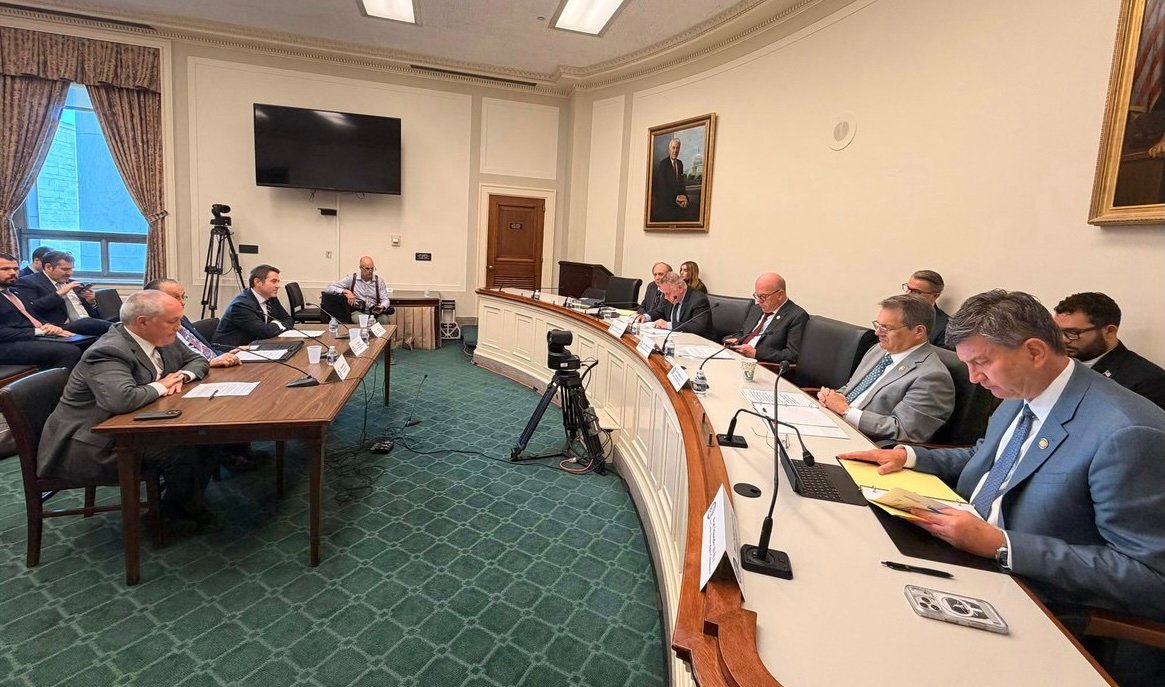
The hearing was held by the Tom Lantos Human Rights Commission, a bipartisan body in the US House of Representatives, and co-chaired by Representatives Christopher Smith, a Republican representing New Jersey, and James McGovern, a Democrat from Massachusetts. The commission heard testimony from Evangelos Sava, the Republic of Cyprus’s ambassador to the United States; Michael Rubin, a senior fellow at the American Enterprise Institute; Savas Tsivicos, alternate president of the International Coordinating Committee Justice for Cyprus; and Sinan Ciddi, director of the Turkey Program at the Foundation for Defense of Democracies.
Congressman Dina Titus, a Democrat from Nevada and a member of the commission, said the rights violations cited in Cyprus reflected similar patterns inside Turkey, where Erdoğan’s government had accelerated what she described as a systematic assault on democratic institutions, civil society and fundamental freedoms after a failed coup in 2016.
Turkey launched a sweeping crackdown after the coup attempt on July 15, 2016, declaring a state of emergency and dismissing more than 130,000 civil servants by emergency decree-laws, including judges, prosecutors, police officers and teachers as well as more than 24,000 military officers. Authorities also shut down media outlets, schools and civil society organizations without judicial process. According to rights groups, the measures went far beyond the alleged coup plotters and were used to purge state institutions, silence critics and criminalize dissent.
Titus said millions of people had been investigated under broadly defined terrorism laws, while journalists, academics, opposition politicians and ordinary citizens had faced prosecution or imprisonment for peacefully expressing dissent. She also cited the dismissal of more than 100,000 civil servants and the arrest of opposition figures, including İstanbul Mayor Ekrem İmamoğlu, in prosecutions viewed by critics as politically motivated.
İmamoğlu, widely seen as President Erdoğan’s strongest political rival, was arrested in March 2025 on corruption charges that critics say are politically motivated and intended to sideline him ahead of the 2028 general election.
Titus also cited reports documenting transnational repression targeting Turkish dissidents, journalists, educators and activists in dozens of countries, including alleged cases of harassment in the US.
Representative Smith compared Erdoğan’s treatment of İmamoğlu to tactics used by authoritarian leaders such as Nicaragua’s President Daniel Ortega, saying such leaders “arrest or kill their opposition for the presidency.”
Smith said Turkey had transformed Cyprus from a territorial dispute into a platform for projecting military power across the eastern Mediterranean while ignoring repeated international calls for a settlement. He also accused Erdoğan of attempting to reshape the identity of Turkish Cypriots, who embrace a secular and pluralistic political culture, through policies promoting what he described as “Ankara’s narrow nationalism.”
Cyprus has been divided since a Turkish military intervention in 1974 following a coup backed by Greece. The northern third of the island has since been administered by a Turkish Cypriot authority, which declared itself the “Turkish Republic of Northern Cyprus” in 1983 and is recognized only by Turkey. The European Union and the international community regard the Republic of Cyprus as the island’s sole legitimate government.
Ambassador Sava alleged continuing human rights violations in the island’s north, citing the displacement of nearly one-third of Cyprus’s population, denial of displaced persons’ property rights, harassment of the remaining Greek Cypriot population, the unresolved fate of 746 missing persons and the destruction of religious and cultural heritage sites. He also accused Turkey of sending settlers to northern Cyprus to alter the island’s demographic and cultural character and of withholding access to potential mass gravesites in military zones.
Rubin said northern Cyprus had become a hub for money laundering and terrorist financing and described Turkey’s settlement policy as a form of “cultural genocide,” saying demographic change had been used to prevent meaningful negotiations on the island’s future while undermining the identity of Turkish Cypriots themselves.
Ciddi said Erdoğan’s military buildup in northern Cyprus formed part of a broader revisionist agenda extending across the eastern Mediterranean and the Middle East, adding that a government that suppresses the rights of its own citizens could not be expected to respect the sovereignty or democratic norms of neighboring countries.
Witnesses also said providing Turkey with advanced military capabilities, including readmission to the F-35 fighter jet program or support for its indigenous KAAN fighter aircraft project, would be counterproductive unless Ankara demonstrated meaningful changes in its human rights record and regional policies. They called on the United States and its allies to increase pressure on Turkey to end its occupation of northern Cyprus and comply with international law.