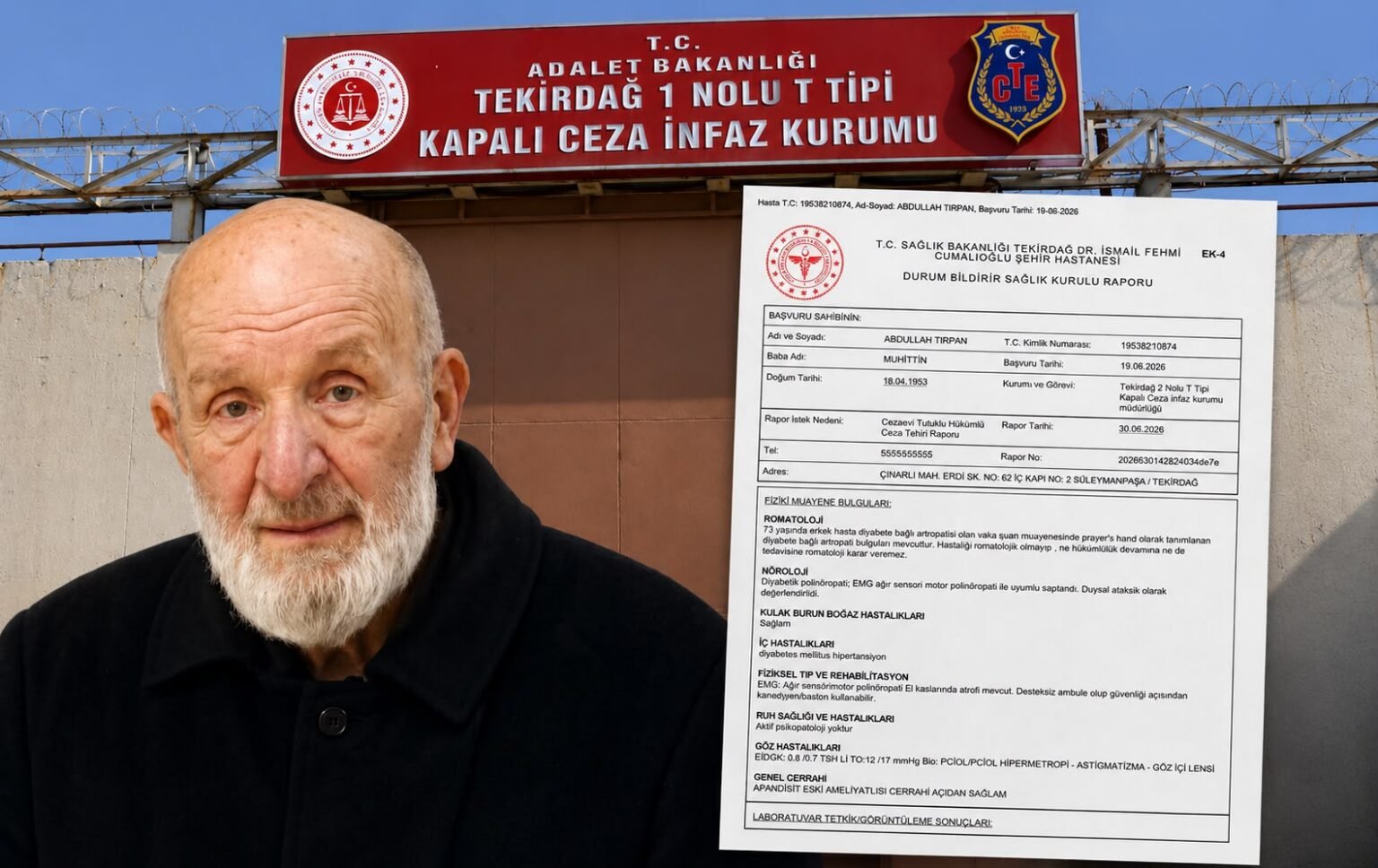
An independent Turkish lawmaker has warned that a 73-year-old man imprisoned over alleged ties to the Gülen movement could die in custody after finding him unable to stand and suffering from advanced gangrene despite repeated medical assessments declaring him fit to remain in prison, the TR724 news website reported Friday.
Mustafa Yeneroğlu, an independent member of parliament representing İstanbul, called for the immediate hospitalization of Abdullah Tırpan and the suspension of his prison sentence after visiting him at Metris Prison in İstanbul,
Yeneroğlu said Tırpan was brought into the visiting room in a wheelchair, unable to stand or lift his leg. His left leg had advanced gangrene, severe discoloration and open wounds.
Tırpan, who has diabetes, thrombosis, venous insufficiency, hypertension and severe circulatory problems, could face the amputation of his foot if his condition worsens, according to Yeneroğlu.
Despite his deteriorating health, Turkey’s Council of Forensic Medicine (ATK) concluded in December 2025 that Tırpan could remain in prison. Medical boards at Tekirdağ City Hospital reached the same conclusion in May and June 2026, and another examination on October 6 reportedly produced a similar assessment.
One medical report stated that Tırpan could meet his daily needs without assistance, a finding Yeneroğlu challenged after witnessing his physical condition.
The lawmaker said Tırpan could not perform basic tasks independently and questioned how medical authorities could continue to approve his imprisonment.
Yeneroğlu acknowledged that prison personnel were assisting Tırpan within their means but said his condition required inpatient hospital treatment rather than continued detention.
Tırpan, a father of five who worked as a butcher for 55 years in the northwestern province of Tekirdağ, has spent more than three years behind bars, including an earlier period of pretrial detention.
He was sentenced to seven-and-a-half years in prison by the Tekirdağ 3rd High Criminal Court on August 8, 2019, for membership in an armed terrorist organization over his alleged involvement in the Gülen movement. Turkey’s Supreme Court of Appeals upheld the conviction on March 7, 2022.
Turkish President Recep Tayyip Erdoğan has targeted the faith-based Gülen movement, inspired by Muslim cleric Fethullah Gülen, who died in 2024, since corruption investigations in December 2013 implicated him as well as some members of his family and inner circle. He dismissed the probes as a Gülenist conspiracy and designated the movement as a terrorist organization in May 2016, intensifying a sweeping crackdown after a coup attempt in July of the same year that he accused Gülen of orchestrating. The movement denies involvement in the coup attempt or any terrorist activity.
The evidence supporting Tırpan’s conviction included his shares in a company operating a government-licensed private school, participation in religious discussion meetings, charitable donations and a subscription to the now-closed Zaman newspaper.
The court also cited his decision to send his children and grandchildren to private schools associated with the movement, his possession of certain publications and his account at Bank Asya, a now-closed-down bank affiliated with the movement.
Since the coup attempt in 2016, the Turkish government has accepted such activities as having an account at the now-shuttered Bank Asya, one of Turkey’s largest commercial banks at the time; using the ByLock messaging application, an encrypted messaging app that was available on Apple’s App Store and Google Play; and subscribing to the now-shut-down Zaman daily or other publications affiliated with members of the movement as benchmarks for identifying and arresting alleged followers of the Gülen movement on charges of membership in a terrorist organization.
The lawmaker challenged what he described as inconsistencies in the court’s judgment, including its reliance on Tırpan’s Bank Asya account despite acknowledging that investigators had found no suspicious transactions following an alleged instruction to deposit money at the bank.
He questioned the use of testimony from a confidential witness who was not heard at trial and said the court had relied on another witness’s initial police statement despite the witness later correcting it in court.
Yeneroğlu argued that the activities used as evidence against Tırpan, including having accounts at a state-regulated bank, participating in legally operating educational institutions and subscribing to newspapers, were lawful when they occurred.
He said Tırpan did not deny his past association with the Gülen movement but maintained that prosecutors had failed to establish specific criminal acts committed knowingly in furtherance of the organization’s alleged objectives.
Yeneroğlu also cited a May 2026 judgment by the European Court of Human Rights (ECtHR), which found a violation of the prohibition against punishment without law in a separate Gülen-related case, Yasak v. Turkey. The court ruled that Turkish courts had failed to conduct an individualized assessment of the defendant’s criminal intent before convicting him of membership in an armed terrorist organization.
The lawmaker called for legislative changes allowing people convicted on similar grounds to seek retrials without first obtaining individual judgments from the European court.
He also urged authorities to suspend Tırpan’s sentence under Article 16 of Turkey’s Law on the Execution of Sentences, which permits the postponement of imprisonment in certain cases of serious illness.
Yeneroğlu said Tırpan had previously spent years outside prison while his conviction was pending without posing a demonstrated threat to public safety.
Warning that further delays could cost Tırpan his life, Yeneroğlu questioned who would bear responsibility if the prisoner died before receiving appropriate medical care.