
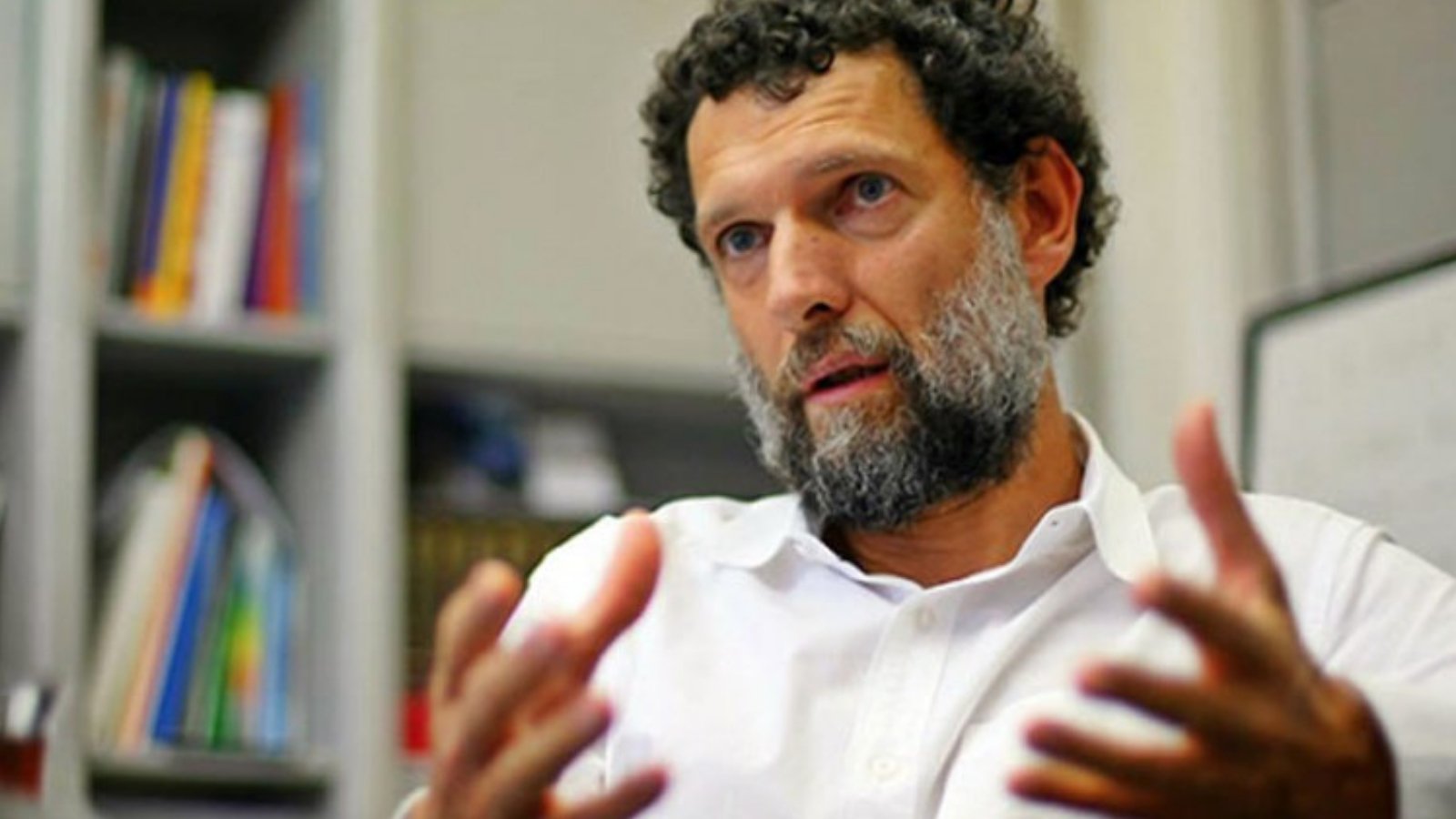
A Turkish court has rejected jailed philanthropist and businessman Osman Kavala’s requests for release and retrial despite a binding European Court of Human Rights (ECtHR) judgment ordering Turkey to free him and eliminate the consequences of his conviction, the ANKA news agency reported.
The İstanbul 13th High Criminal Court unanimously rejected the application on Tuesday and ordered Kavala to continue serving his aggravated life sentence. His lawyers had sought to suspend the sentence, secure his release and reopen his trial following the ECtHR Grand Chamber’s August 25 judgment.
Kavala, 68, has been imprisoned since October 2017 and is serving an aggravated life sentence for allegedly attempting to overthrow the government by financing and organizing the anti-government Gezi Park protests in 2013.
The demonstrations began over plans to redevelop a park in central İstanbul and spread into nationwide protests against then-prime minister Recep Tayyip Erdoğan’s government.
He denies the charge and says his prosecution was politically motivated.
In rejecting the application, the İstanbul court claimed that the ECtHR was not an appeals court above Turkey’s judiciary and that evaluating evidence remained the responsibility of domestic courts.
It also cited the requirement to exhaust domestic legal remedies.
The İstanbul Chief Public Prosecutor’s Office had urged the court to reject the request, saying Kavala’s individual application to Turkey’s Constitutional Court was still pending and domestic remedies had therefore not been exhausted.
However, the ECtHR had already examined that issue in its August judgment. It found that Kavala could not be expected to await the Constitutional Court’s decision because excessive delays and the repeated failure to implement earlier judgments had seriously undermined the effectiveness of that remedy in his case.
The Grand Chamber ruled that Turkey must secure Kavala’s release at the earliest possible date and eliminate the consequences of his conviction, which it said should be regarded as null and void under the European Convention on Human Rights. The judgment is final.
The European court found that Kavala’s prosecution and imprisonment were intended to punish and silence him for his civil society work and involvement in the Gezi protests. It described his conviction as a “flagrant denial of justice.”
Kavala’s lawyer, Ahmet Köksal Bayraktar, filed the retrial application under Article 311 of Turkey’s Code of Criminal Procedure, which provides for reopening proceedings when a final ECtHR judgment finds that a conviction violated the convention.
His lawyers can challenge Tuesday’s rejection before the İstanbul 14th High Criminal Court within two weeks of being formally notified of the decision.
The rejection came a day before a deadline set by the Council of Europe’s Committee of Ministers for Turkey to explain what concrete steps it had taken or planned to secure Kavala’s release.
In a September decision, the committee, which supervises compliance with ECtHR judgments, urged Turkey to provide that information by October 14. It reiterated that member states have an unconditional obligation to comply with the court’s judgments and said it would consider further action by its December meeting.
The ECtHR first ordered Kavala’s release in December 2019. Turkey’s refusal to comply prompted the Council of Europe to launch infringement proceedings and the court ruled in July 2022 that Ankara had failed to fulfill its obligation to implement the earlier judgment.
Kavala was acquitted in the first Gezi trial in February 2020 but was detained again before he could leave prison. The acquittal was subsequently overturned and his conviction in the retrial was upheld by the Supreme Court of Appeals in September 2023.
Erdoğan and his government have denied that Kavala’s imprisonment is politically motivated, insisting that Turkish courts operate independently.
This article is republished from Turkish Minute.