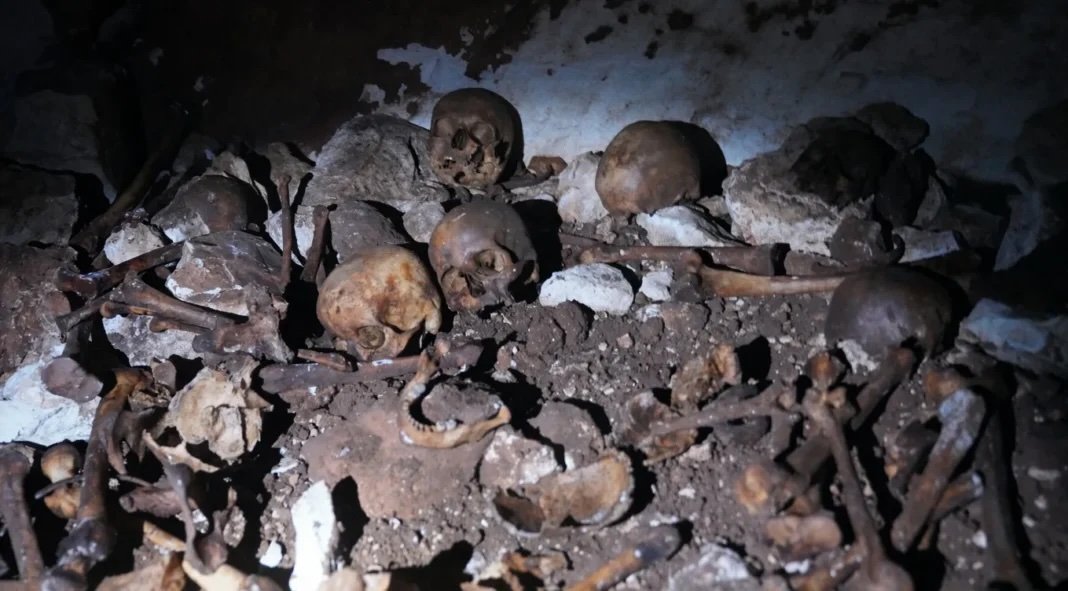
Skulls and hundreds of bones found in a cave in Turkey’s predominantly Kurdish southeast have prompted rights groups to ask prosecutors on Monday to investigate possible links to the disappearances and killings of Kurds in the 1990s.
The Human Rights Association (İHD), the Diyarbakır Bar Association and the Association of Lawyers for Freedom (ÖHD) submitted the request to prosecutors in Silvan, a district of the Kurdish-majority province of Diyarbakır.
A delegation from the organizations inspected the cave on November 19 after receiving a tip, accompanied by a journalist who filmed the remains, the Mezopotamya news agency reported.
Between 15 and 20 skulls and hundreds of bones were visible in the cave’s second chamber, with more remains in two other chambers, the delegation found.
Some skulls appeared small enough to belong to children, while others had holes resembling bullet damage, and some bones bore what appeared to be burn marks.
“We could not determine the exact number,” Fırat Akdeniz, a member of the İHD’s commission on missing persons in Diyarbakır who entered the cave, told Mezopotamya.
The organizations asked prosecutors to secure the site, arrange for the remains to be collected and send them to the Council of Forensic Medicine (ATK), Turkey’s state forensic agency, for identification and age assessments, the Bianet news website reported.
They also requested DNA samples from relatives of people who disappeared in the region, a review of past detention records and interviews with witnesses to identify anyone responsible, including public officials.
“An investigation is needed to determine whether the skeletons belong to that period,” Ercan Yılmaz, the İHD’s Diyarbakır branch chairman, said outside the courthouse after the filing.
The request concerns a period when Turkish security forces were fighting the Kurdistan Workers’ Party (PKK), a Kurdish armed group, and the southeast experienced village evacuations, killings and disappearances.
Many families reported that their relatives vanished after being taken into custody by security forces, with some bodies later recovered from wells, graves and other sites.
Rights groups have linked such cases to Gendarmerie Intelligence and Counterterrorism (JİTEM), a clandestine structure associated with the gendarmerie, the security force that polices rural areas.
Officials denied its existence for years, although parliamentary investigations, witness accounts and court files documented its activities and alleged role in killings.
Witness intimidation, failures to investigate commanders and time limits on prosecutions have obstructed accountability for crimes from that period, Human Rights Watch has documented.
The Supreme Court of Appeals dismissed the Dargeçit disappearance case this year after ruling that a 30-year statute of limitations had expired.
That case concerned disappearances in neighboring Mardin province in 1995 and 1996, with some victims’ remains recovered years later, and ended without convictions.
Relatives of the disappeared, organized as the Saturday Mothers, have campaigned since 1995 for answers about their loved ones’ fate and the prosecution of those responsible.
This article is republished from Turkish Minute.