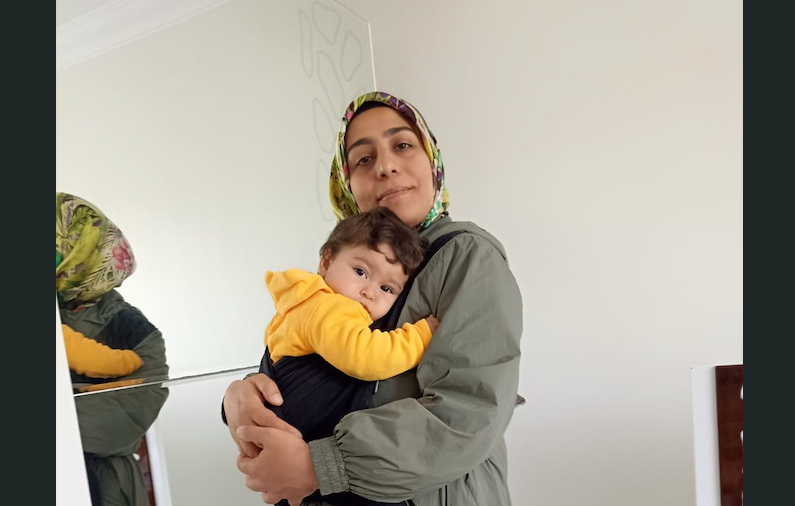
A Turkish court has not issued a release order for a former teacher with advanced cancer, convicted of alleged links to the faith-based Gülen movement, despite a forensic report recommending postponing her prison sentence on medical grounds, the TR724 news website reported.
Ferah Oktan, 37, was diagnosed with breast cancer in September while incarcerated. and is now suffering from stage-four cancer. She is undergoing chemotherapy and requires surgery. A recent report issued by the Council of Forensic Medicine (ATK) concluded that she cannot remain in prison, recommending that the execution of her sentence be postponed for six months.
Despite the ATK report, the İstanbul 23rd High Criminal Court did not order Oktan’s release. Instead, the court forwarded the report to the Supreme Court of Appeals, where her case file is currently under review.
Oktan, a mother of two, has been imprisoned since August 10, 2024, and is serving a sentence of more than seven years on conviction of “membership in a terrorist organization.” The charge is based on allegations including her employment at a private school affiliated with the movement, depositing money in the now-shuttered Bank Asya and membership in a teachers’ union.
President Recep Tayyip Erdoğan has been targeting followers of the Gülen movement, inspired by the late Muslim cleric Fethullah Gülen, since corruption investigations in December 2013 implicated him as well as some members of his family and inner circle.
Dismissing the investigations as a Gülenist coup and a conspiracy against his government, Erdoğan began to target the movement’s members. He designated the movement as a terrorist organization in May 2016 and intensified the crackdown on it following an abortive putsch in July of the same year that he accused Gülen of masterminding. The movement strongly denies involvement in the coup attempt or any terrorist activity.
Human rights defender and Peoples’ Equality and Democracy Party (DEM Party) lawmaker Ömer Faruk Gergerlioğlu criticized the court on X for prolonging the process by sending the report to Supreme Court of Appeals.
“A sick person’s life is at stake. End this injustice,” Gergerlioğlu said.
Oktan’s cancer reportedly metastasized due to delays in her access to proper medical treatment. Previous motions seeking her release were rejected by both the İstanbul 23rd and 24th high criminal courts.
Under Turkey’s Law on the Execution of Sentences and Security Measures, courts may suspend the sentence of a prisoner who, due to a serious illness or disability, cannot sustain life in prison conditions and who is not considered a serious or concrete danger to society. Rights groups say the provision is very rarely applied in practice.
Turkey’s Human Rights Association (İHD) says more than 1,400 sick prisoners are currently held in Turkey, including hundreds in critical condition. The group has repeatedly reported delays in trips to the hospital, inadequate treatment in prison infirmaries and forensic assessments that allow seriously ill detainees to remain incarcerated.