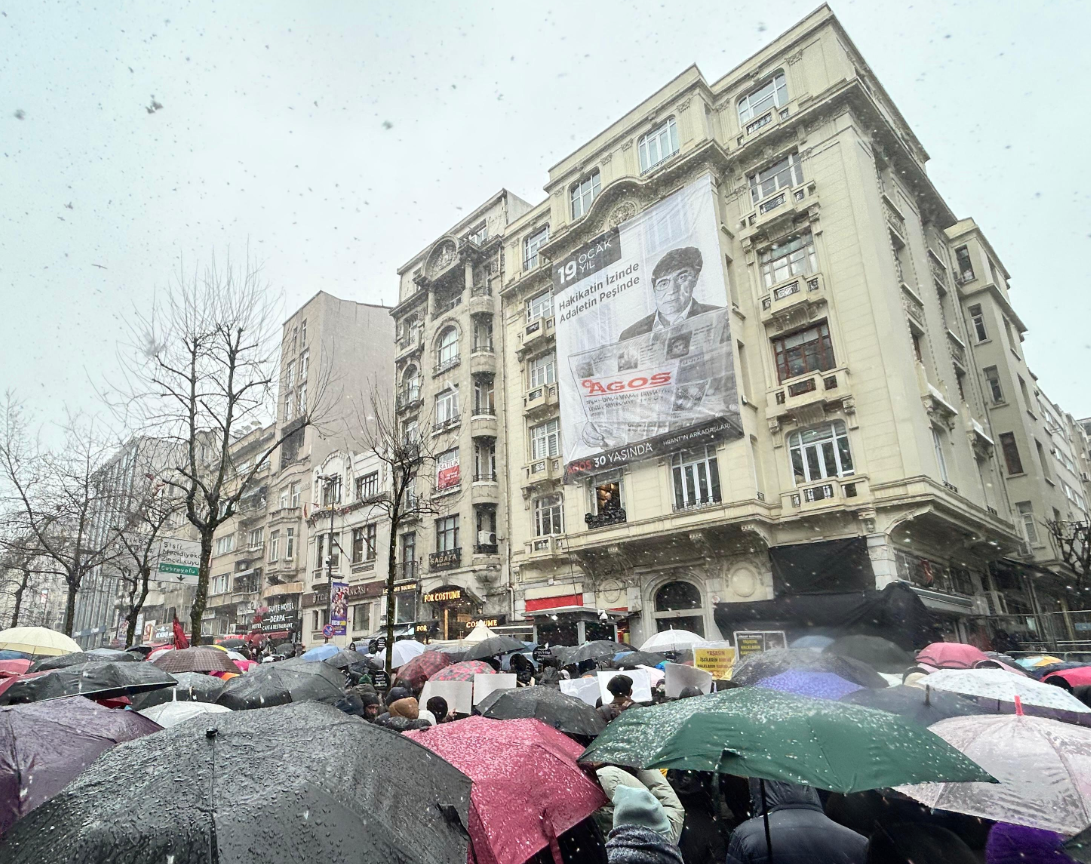
Hundreds of people gathered in İstanbul on Monday to commemorate the 19th anniversary of the killing of Hrant Dink, the Armenian-Turkish journalist who was shot dead outside the offices of the Agos newspaper in 2007, Turkish Minute reported.
Dink, the editor-in-chief of the Turkish-Armenian bilingual newspaper Agos, was murdered outside his office in central İstanbul on January 19, 2007, by Ogün Samast, then a 17-year-old jobless high school dropout.
The murder sparked national and international outrage, with critics accusing Turkish authorities of failing to prevent the killing despite clear threats against Dink from ultranationalist circles.
The annual vigil was held outside the Sebat Apartment building in the Şişli district, where Agos once operated and which now houses a site dedicated to the memory of Dink. A banner bearing Dink’s photograph and the words “Memory, truth, life, longing” was hung on the facade.
Dink’s family, friends and colleagues from Agos attended along with journalists, rights advocates and representatives of political parties and civil society groups. Participants chanted slogans calling for justice and opposing impunity in the case, which has long been cited by critics as an example of unresolved political violence and failures of accountability in Turkey.
Bülent Aydın, speaking on behalf of the “Friends of Hrant” group, said Dink’s words had endured and expanded over the years, pointing to a younger generation present at the commemoration.
Letters sent from prison by prominent figures were also read out at the event, including messages from Şişli Mayor Resul Emrah Sahan, Şişli Deputy Mayor Ebru Özdemir and civil society figures Osman Kavala and Çiğdem Mater, both imprisoned in connection with the 2013 Gezi Park anti-government protests. All of them are behind bars on what many call politically motivated charges.
Calls for justice
Opposition figures and political parties renewed calls for justice, saying full accountability has yet to be established in the murder of Dink.
Opposition lawmaker Sezgin Tanrikulu said in a post on X that the killing of Dink was not an isolated act but a “planned and organized political assassination,” arguing that warnings and threats against Dink were known to state institutions but not effectively addressed. He said years of fragmented trials had failed to expose those ultimately responsible, leaving impunity as a defining feature of the case.
The Workers’ Party of Turkey said Dink was killed for advocating peaceful coexistence and vowed to confront what it described as a system that freed perpetrators while failing to prosecute those who ordered the crime.
Dink, a prominent advocate for reconciliation between Turks and Armenians, had long faced threats due to his work challenging Turkey’s official stance on the 1915 mass killings of Armenians. His murder remains a symbol of the country’s struggle with press freedom and minority rights.
Independent lawmaker Mustafa Yeneroğlu said Dink’s killing remained an open wound, lamenting that justice had not been fully served despite the conviction of the gunman.
Samast was arrested the day after the murder and sentenced to nearly 17 years in prison. He was released in November 2023, prompting widespread condemnation from opposition politicians, journalists and human rights activists.
Following his release, a new indictment against Samast was merged with an ongoing trial involving 11 other suspects accused of complicity in Dink’s murder. However, a court in İstanbul dropped the charges against Samast in January 2025, citing the statute of limitations, in alignment with the prosecutor’s recommendation.
Yeneroğlu said the structures that enabled the crime had never been fully uncovered, calling the case a lasting stain on Turkey’s record on freedom of expression and democracy.